Louisiana redistricting: State House passes GOP gerrymander, scrapping majority-Black district
 Prefer us on Google
to see more of our voting rights news coverage when you search.
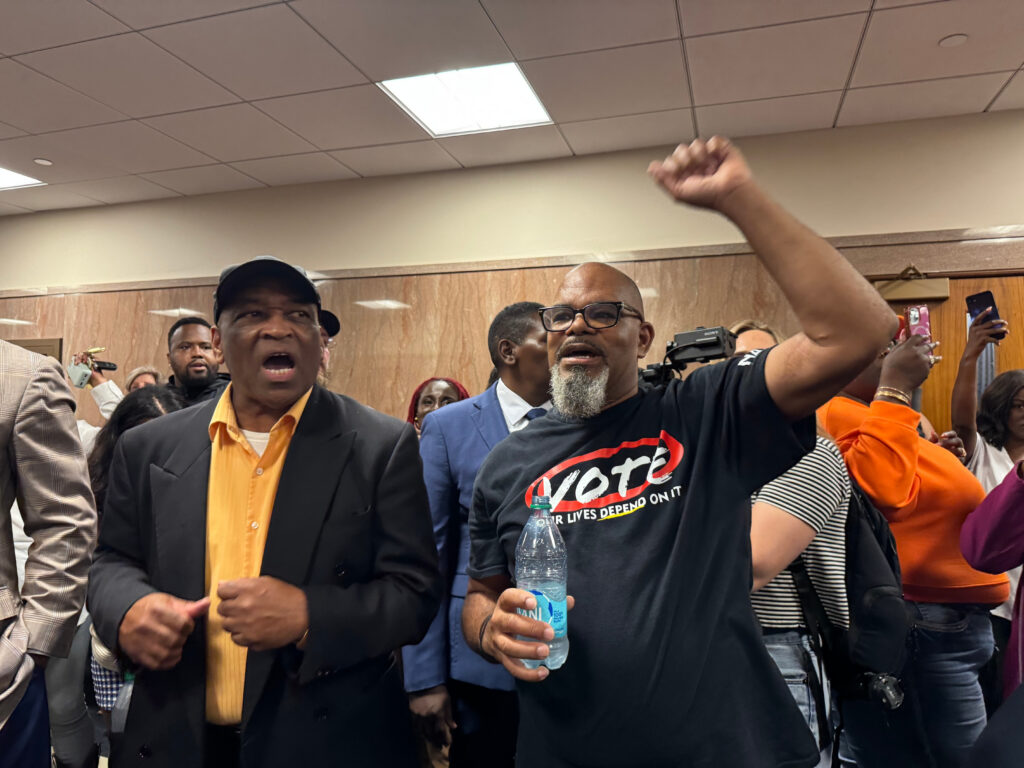
The Republican gerrymandering campaign across the South marched forward Thursday, as the Louisiana House voted to eliminate one of the state’s two majority-Black congressional seats.
The House voted 66-35 to replace the House district currently represented by Rep. Cleo Fields (D) with one far more likely to vote for a Republican. The new map would pack Black Louisianans into one district snaking in and around New Orleans held by Rep. Troy Carter (D).
The bill will now return to the Senate for a final vote. The Senate voted for an earlier version of the legislation earlier this month, but the House amended it in committee and again on the floor. The Senate is expected to pass the amended bill quickly. After that, it’ll head to Gov. Jeff Landry (R) to be signed into law.
The current U.S. House map was created ahead of the 2024 elections after a district court held that the prior map violated the Voting Rights Act (VRA) and directed the creation of a second majority-Black district, to better align with Louisiana’s racial demographics. The new map would essentially restore that struck-down map, with a few marginal tweaks.
Get updates straight to your inbox — for free
Join 350,000 readers who rely on our daily and weekly newsletters for the latest in voting, elections and democracy.
The U.S. Supreme Court reversed that decision in April with Louisiana v. Callais. The decision took a wrecking ball to the VRA, one of the last legal levees holding back gerrymanders. Until the Court effectively nullified it, the VRA stopped states from passing voting laws and electoral maps that were racially discriminatory, even if that discrimination wasn’t intentional.
After Callais, the GOP’s redistricting deluge spilled out across the South. In Louisiana, Gov. Landry suspended the ongoing primary elections for the U.S. House so the legislature could redraw maps ahead of November’s midterm elections.
During Thursday’s debate, Democrats pleaded with their Republican colleagues to put fealty to democratic ideals over loyalty to party.
“This chamber has a choice. We can draw a map that reflects the full diversity and dignity of Louisiana, or we can draw one that narrows political opportunity for hundreds of thousands of citizens,” said Rep. Dustin Miller (D). “Long after this vote is over, people will remember whether we stood for inclusion or exclusion, fairness or dilution, representation or silence.”
The measure was amended on the floor to make a few small shifts to congressional district lines. The amendment’s sponsor, Rep. Gerald “Beau” Beaullieu IV (R) defended the new map, repeatedly saying he used party affiliation, not race, to draw it.
“We didn’t look at race when we did it,” Beaullieu said Thursday. “We focused on the Democrat numbers, not the racial numbers when drawing this in this district.”
Beaullieu also noted that his amendment was made in coordination with the bill’s original sponsor, Sen. Jay Morris (R), making its prompt passage in that chamber more likely.
But the amended map caught some conservative criticism. As Beaullieu defended it on the floor, U.S. Rep. Clay Higgins (R-La.) took to X to lambast the proposal, saying it was “the worst I’ve seen yet, and I’ve seen many.”
“This Frankenstein looking thing was NO DOUBT drawn up by a very small handful of guys in a secret room,” he added. “NOBODY should support this insanely bad map.”
Rep. Mandie Landry (D) noted that the law firm that helped draw the new map, Holtzman Vogel, also wrote Gov. Landry’s amicus brief in Callais. “It seems that our Republican government is using our tax money to hire a Republican-backed law firm to pass Republican-controlled maps,” she said.
The Supreme Court’s decision in Callais remanded the case back down to the district court. In a court filing there Tuesday, the plaintiffs complained that Louisiana was moving too slowly to pass and implement the new map, signalling their intention to challenge it for purposefully using race to draw lines.
“As sponsor Senator Morris has testified, [the redistricting bill map] is meant to emulate the 2022 map and the 2011 map, which was pre-cleared by the DOJ and intentionally created a majority-Black district,” they wrote. “None of the minor modifications to SB121 have removed these racial markers.”
In response, the district court ordered the secretary of state to provide the “operational deadline” to implement a new map for the 2026 midterms by June 1.
Rep. Denise Marcelle (D) highlighted the irony of Louisiana facing more redistricting litigation even as it rushed to redraw their maps, noting how Republicans justified the move as a way to finally end an incessant stream of legal challenges. “The state got what it got, because here comes the lawsuits, the injunctions, the appeals, the emergency hearings, the special sessions, the federal court orders, and all of it’s paid for by the citizens that we represent,” Marcelle said.
Democrats also offered amendments to the legislation that would have kept their party ahead in two of Louisiana’s six congressional seats. They were all rejected in party-line votes.
Republicans’ gerrymandering efforts elsewhere in the South have stumbled. After considerable debate, lawmakers in South Carolina decided against trying to eliminate the state’s only majority-Black district before this year’s midterms. And earlier this week, a federal court blocked Alabama’s attempt to use a map in November that would erase its only majority-Black district.
In that case, which is being appealed to the Supreme Court, the judges ruled that Alabama’s proposed map was identical to the one the court had blocked as an intentional racial gerrymander in 2024.
During his remarks, Miller alluded to the Palmetto State. “Just because you can reduce the representation today, it doesn’t mean we should,” he said. “South Carolina didn’t do it. Why does Louisiana have to do it?”