Louisiana redistricting: State House panel advances GOP gerrymandering, erasing majority-Black district
 Prefer us on Google
to see more of our voting rights news coverage when you search.
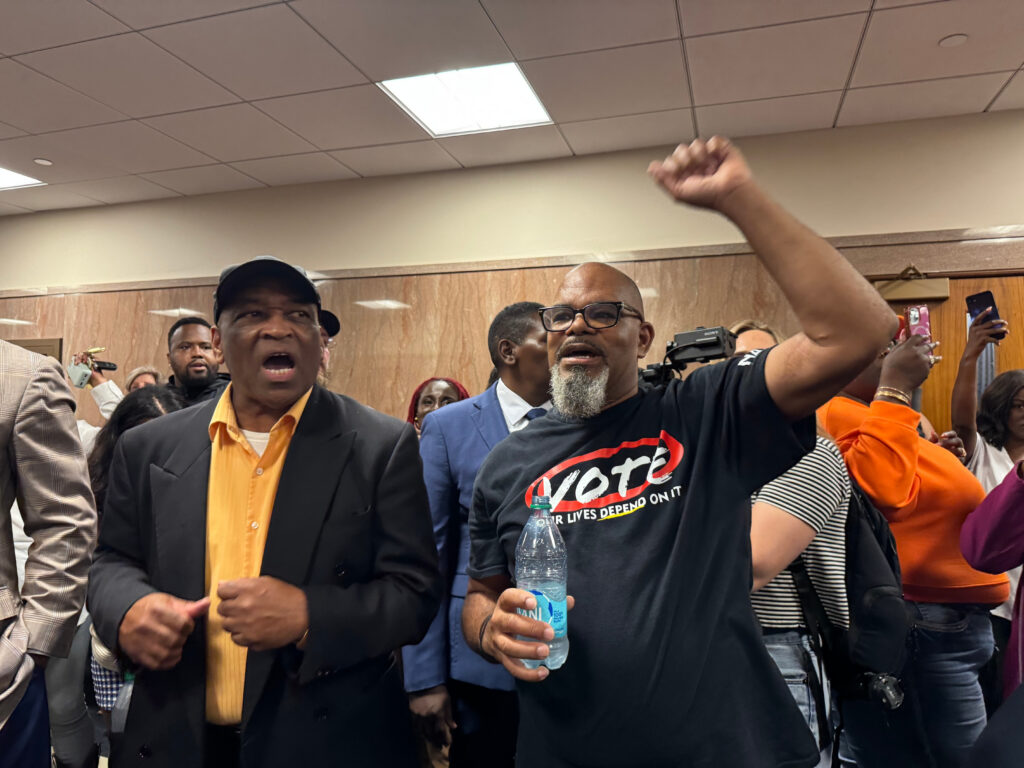
Louisiana lawmakers took another step toward erasing one of the state’s majority-Black congressional districts Thursday after listening to hours of public testimony begging them not to.
The Louisiana House and Governmental Affairs Committee advanced the remapping bill to the floor by a 10-7 party-line vote. The Louisiana Senate passed the legislation, sponsored by Sen. Jay Morris (R), last week, which would essentially restore a map that federal courts held violated the Voting Rights Act (VRA) in 2022.
If the chamber passes it, the new map would eliminate one of Louisiana’s two majority-Black congressional districts now held by Democrats and all but ensure that Republicans win five of the state’s six U.S. House seats. The GOP controls a supermajority in the Louisiana House.
Get updates straight to your inbox — for free
Join 350,000 readers who rely on our daily and weekly newsletters for the latest in voting, elections and democracy.
The U.S. Supreme Court reversed that decision last month in Callais v. Louisiana. Since then, Republicans have rushed to redraw maps across the South ahead of November’s midterm elections. In Louisiana, Gov. Jeff Landry (R) suspended an ongoing congressional primary election to give the legislature time to remap. While there are multiple lawsuits challenging that decision, it’s unclear whether any might succeed or be able to prevent the new map from being used.
Early in the all-day debate, Louisiana House Speaker Pro Tempore Mike Johnson (R) noted that attempting to draw an all-GOP map would jeopardize the seats held by U.S. House Speaker Mike Johnson (R-La.) and House Majority Leader Steve Scalise (R-La.), describing the proposal in purely partisan terms.
As Democrats on the panel decried the naked power grab as anti-democratic and inequitable, Johnson, who is not related to the Speaker of the U.S. House, waved off those criticisms.
“There’s nothing in a constitutional ruling that says that fairness as to political parties is required,” said Johnson.
Democrats on the panel interrogated Morris for hours, probing the motivations behind the new map. Rep. Denise Marcelle (D) noted that Callais did not require Louisiana to redraw a new map that benefited Republicans — it merely forbade using race as a motivating factor in drawing maps.
The new map will make it more likely that Republicans retain control of the U.S. House, Morris said, and thus more likely “to advance Republican ideals in Congress, which I think is important.”
“You may not agree with those ideals, but I do,” he added.
“You don’t believe that people who don’t think like you should have a voice, is what you’re saying,” Marcelle said. “You should silence the rest of Louisiana, because everybody does not feel the same way that you feel.”
Writing for the majority in Callais, Justice Samuel Alito held that Louisiana’s current map — drawn after a court ordered the creation of a second majority-Black district to align with the racial demographics of a state where a third of the population is Black — was an unconstitutional racial gerrymander. The lower court erred in ordering the remedial map, he contended.
“Much of the cited evidence—such as the low number of black Louisianans who have been elected to Congress in recent decades— failed to disentangle race from politics,” Alito wrote. “Indeed, the court observed that black voters have been aligned with the Democratic party for decades and that issues discussed by that party appealed to black voters. Those observations should have undercut, not strengthened, any showing of intentional racial discrimination because race and politics are so intertwined.”
Rep. Wilford Carter (D) attacked that premise, echoing other critics who’ve noted that Callais turns the 15th Amendment on its head.
“Race is party in Louisiana. Ninety-some percent of the Republicans are white, and ninety-some percent of Democrats are black,” said Carter. “So, race is party in Louisiana. You cannot discuss a map in Louisiana based on party and have it not be on race.”
The committee also heard testimony from members of the public, who were uniformly opposed to the new map, including former New Orleans Mayor Marc Morial.
“’Im not going to sit here and allow my intelligence and integrity to be insulted because someone can sit here and say, ‘I never consider race,’” Morial said. “You can say it 1001 times, this is a Jack O’Lantern player with a big Jack O’ Lantern mask on top of intentional racial discrimination.”
Ahead of the vote to advance the bill, the committee adopted an amendment from Rep. Dixon Wallace McMakin (R) that tweaks the map without significantly changing its partisan breakdown. McMakin swore he did not look at race in making his map, which he offered to reduce the number of parishes split between two congressional districts.
Another amendment, from Rep. Rodney Lyons (D) that would have allowed Democrats to remain competitive in two congressional districts but with no majority-Black districts, was rejected.
Last week, the legislature passed a bill that rescheduled the congressional primaries. After voting last year to replace Louisiana’s jungle primaries, which puts candidates of all parties on the same ballot, the legislature reinstated them for this year. Now, multiple candidates from the same political party can appear on the November ballot and if no candidate wins a majority of the votes, then there will be a runoff in December between the top two vote getters.
The rescheduling bill also voided ballots already cast in the primary.
Brentin Mock contributed to this report.