Georgia Republicans backtracked on gerrymandering because they feared a showdown over Black voting rights
 Prefer us on Google
to see more of our voting rights news coverage when you search.
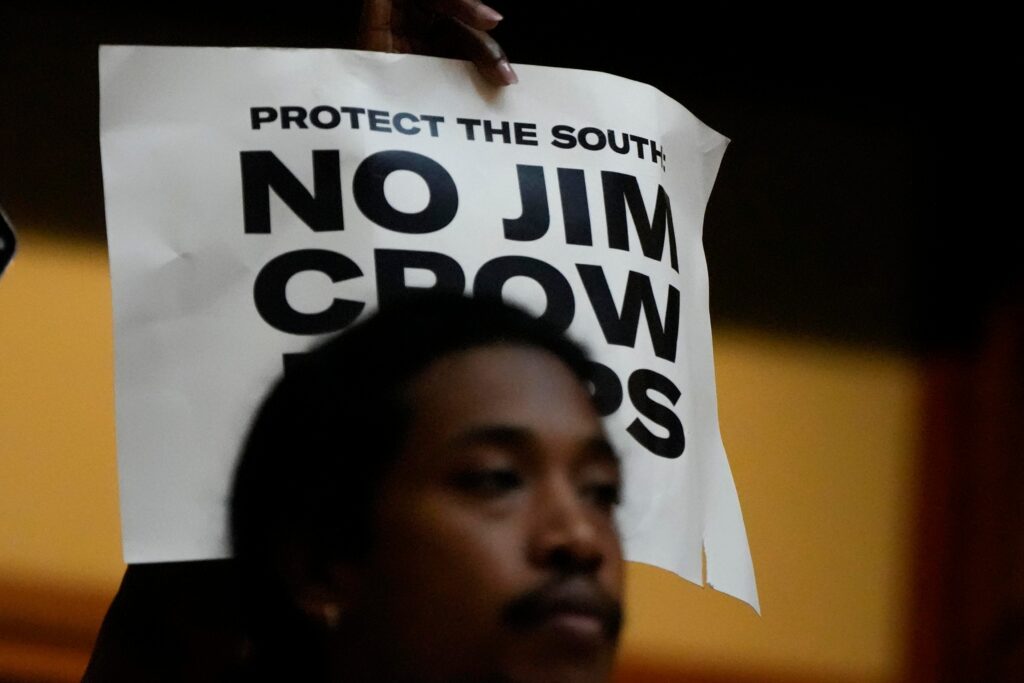
Georgia Republicans’ rushed attempt to redraw the state’s political maps collapsed Wednesday before lawmakers could even begin, handing voting rights advocates an important win and exposing the political risk of the GOP’s post-Callais push to dilute Black voting power.
It happened after Democrats and civil rights advocates turned the planned special session into a public showdown over minority voting rights — Sen. Raphael Warnock (D-Ga.) called the plan “a betrayal of the highest in the American ideals” — drawing attention to how Georgia Republicans were looking to weaken Black political representation.
Just hours before the Georgia legislature was set to convene for a special session called by Gov. Brian Kemp (R), state House Republican leaders told Kemp they would not take up congressional or legislative redistricting for the 2028 election.
The move abruptly derailed Kemp’s plan to use a recent U.S. Supreme Court ruling that gutted the Voting Rights Act to revisit Georgia’s maps, which voting rights advocates warned could be used to further weaken the political power of Black voters.
It was not a change of heart.
Republican leaders did not reject mid-cycle redistricting because they suddenly opposed gerrymandering or because they embraced fair maps.
Instead, they backed away after Democrats, civil rights groups and pro-voting advocates mobilized against the plan — and after some Republicans reportedly worried that a racially charged redistricting fight could energize Democratic voters, fracture their own caucus and create more political problems than it was worth.
The result is a revealing setback for a GOP strategy that has accelerated since the Supreme Court’s decision in Louisiana v. Callais, which opened the door for Republican-led states to attack districts that protect Black political representation.
Georgia Republicans may have shelved their scheme to gerrymander for now. But the failed push shows why they tried, why they blinked and why voting rights advocates are not treating the retreat as the end of the threat.
Get updates straight to your inbox — for free
Join 350,000 readers who rely on our daily and weekly newsletters for the latest in voting, elections and democracy.
Republicans say they needed more time
Publicly, Republican leaders framed the collapse as a process decision.
Georgia House Speaker Jon Burns (R) told Kemp in a letter that House Republicans would not move forward with redistricting because lawmakers and the public needed more time to evaluate the issue after the Callais ruling.
“There are a number of cases pending where judges are currently analyzing the impact of the decision in Callais on redistricting. Several of those cases involve Georgia’s prior and current maps,” Burns wrote. “Changes to Georgia’s maps should take place only when members of the General Assembly and citizens have been given ample opportunity to gather the facts, provide input and engage in meaningful discussion.”
The letter pointed to pending litigation over Georgia’s existing maps, allowing Republicans to argue that redistricting should not be rushed while courts are still weighing related legal questions.
But that explanation only went so far.
Republicans were not rejecting the premise of redrawing maps in response to Callais. They were rejecting this version of the fight, at this moment, under these political conditions.
Burns’ letter did not promise to leave Georgia’s maps alone through 2028. It simply said House Republicans would not take up congressional or legislative redistricting during this special session.
That distinction matters because it leaves the door open for Republicans to revive the scheme later, after the political backlash fades or after party leaders believe they have a clearer path to cementing new gerrymandered maps.
Legal uncertainty was far from the whole story
The timing of the retreat suggests Republican leaders were reacting to more than just legal uncertainty.
Demonstrators filled the Capitol chanting “Black voters matter!” while civil rights leaders, Democratic lawmakers and pro-voting groups warned that a rushed redistricting process would let Republicans dilute Black voting power.
Black voters are about 33% of all eligible voters in Georgia — one of the highest rates of any state.
“Hundreds of Georgians came to the Capitol today to oppose Republicans’ special session to rig our state’s voting maps, and now Republican House and Senate leaders are suddenly afraid that a fight over racist voting maps just before the election could create major backlash with Georgians that could break their majority in November,” Lauren Groh-Wargo, CEO of the pro-voting group Fair Fight Action, said. “Gov. Kemp and others want to proceed with rigging the maps to try and silence Black and Brown Georgians. They’re united by one thing: holding on to their own power and silencing ‘we the people’ – the disagreement is one of strategy, not of substance.”
Warnock framed the push in the language of Georgia’s civil rights history, calling the special session “a dark day in Georgia history” and comparing the effort to historical attempts to dress up voter suppression as partisan policy.
“It is a betrayal of the highest in the American ideals,” Warnock said. “And the same politicians who will be lining up, some of them wanting to come to my church in January and sing praises to Martin Luther King Jr. and remember him, are dismembering his legacy in real time.”
That pressure created significant political risk for Republicans.
Some Republicans privately expressed worries that a rushed redistricting plan that diminished Black and other minority voters’ political power could spark backlash and trigger greater Democratic turnout. They also worried that redrawn districts could backfire logistically, especially around metro Atlanta, by creating more competitive seats Democrats could win.
That same fear likely led South Carolina Republicans to drop their gerrymander bid last month, despite pressure from President Donald Trump.
“Republicans are abandoning their plans to further gerrymander Georgia’s congressional map after Democrats across the state fought back,” the Democrats posted on social media.
In other words, Republicans did not simply slow down because the process was complicated. They slowed down because the backlash was already working.