Louisiana halts an active election to get rid of Black-majority districts, as Democrats fight back
 Prefer us on Google
to see more of our voting rights news coverage when you search.
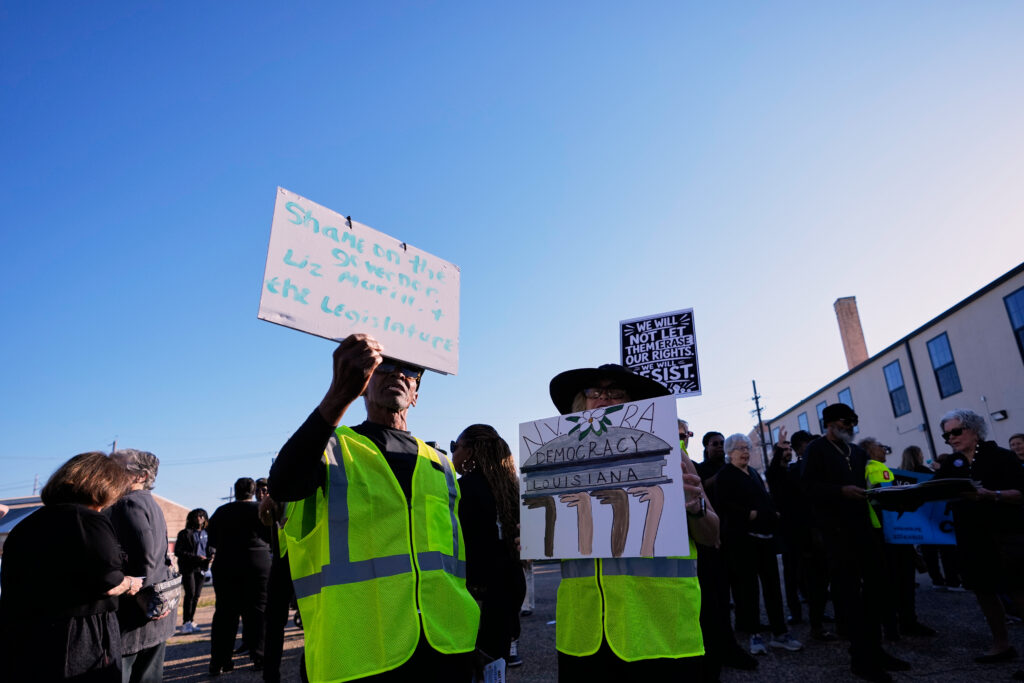
Louisiana Gov. Jeff Landry’s (R) suspension of active elections after the Supreme Court deemed the state’s congressional map unconstitutional has ignited confusion and a flurry of lawsuits across the Bayou State.
If allowed to stand, the governor’s emergency declaration could disenfranchise hundreds of voters who have already cast their ballots in the state’s primary elections, while also removing candidates from the upcoming midterms.
It will also allow the GOP to draw a new map to eliminate one or both of the state’s two Democratic-held majority-minority districts, which were created to comply with the requirement in the Voting Rights Act (VRA). Republicans currently hold four out of the state’s six congressional seats.
Get updates straight to your inbox — for free
Join 350,000 readers who rely on our daily and weekly newsletters for the latest in voting, elections and democracy.
And it also could set a dangerous precedent as fears grow about potential Trump administration efforts to intervene in the coming midterms, with the GOP expected to suffer heavy losses.
Louisiana Democrats have condemned the order.
“The Supreme Court ruled that that map that you created, that this legislature created and this governor signed, was illegal,” said Rep. Cleo Fields (D-La.), whose Baton Rouge congressional district was at the heart of the Supreme Court’s decision, at a Monday press conference.
“But the Supreme Court did not say, ‘Throw away those ballots.’ And that’s my fight today. Because we shouldn’t throw any ballots out,” Fields added.
Here’s where things currently stand
In an executive order last week, Landry declared a state of emergency to postpone the state’s active congressional primary races, claiming that the court’s 6-3 decision in Louisiana v. Callais constituted an “election emergency.”
The Supreme Court determined that Louisiana’s current congressional maps amounted to an unconstitutional gerrymander based on the race of voters because it included a second majority-Black district in the state.
By doing so, the court’s conservative-appointed majority largely gutted Section 2 of the VRA, which barred racial discrimination in voting and redistricting.
Landry claimed that, after the court’s decision, the Louisiana legislature now needed to redraw the state’s electoral maps for the upcoming midterm elections. He postponed primaries until either July 15 or “such time as determined by the Legislature.”
However, the governor issued the order, and the secretary of state certified it, just days before early voting was set to begin in Louisiana’s May 16 primary elections. Mail ballots had already been sent out to voters.
Landry’s suspension has unleashed confusion among both voters and political candidates themselves. Since his order only applied to congressional elections in the state, other races are ongoing.
Several U.S. House candidates in recent days have urged voters to continue voting in primary elections, even though those votes may ultimately be nullified by Landry’s order, according to the Louisiana Illuminator.
At polling places across the state, voters were met with bulletins announcing the cancellation of the House primaries, according to the New York Times.
Pro-voting lawsuits
In response to Landry’s emergency declaration, pro-voting groups filed four separate lawsuits: two in state court and two in federal court. The four lawsuits all seek court orders halting the governor’s declaration, though they make separate constitutional arguments against it.
In the lawsuits in state courts, judges denied requests from voting groups for temporary restraining orders to block Landry’s order suspending the elections.
However, in one of the state-based cases, which was brought by the National Council of Jewish Women and Louisiana voters*, a state judge ordered Louisiana to explain in writing why a preliminary injunction blocking Landry’s order should not be issued. The judge also scheduled a hearing in the case for May 6.
In one of the federal lawsuits, a three-judge panel made up of two Trump appointees and an Obama appointee ordered Louisiana to formally oppose plaintiffs’ request to block Landry’s executive order by tomorrow.
On Monday, 11 Democratic congressional candidates in the state asked the panel to allow them to join the federal suit.
The candidates argued they should be allowed to join the federal suit against Landry’s order because they “have a direct, personal, and concrete stake in the outcome of this litigation.”
“The Executive Order has caused, is causing, and will continue to cause each of these candidate-Plaintiffs concrete, particularized, and ongoing harm to their candidacies, campaign organizations, and ballot access,” their request read.
Democrats vow to fight
Speaking at a Baton Rouge Press Club event Monday, Fields slammed Landry’s order as an attempt to disenfranchise voters and remove qualified candidates from the ballot in November.
“This election had already started. People who wanted to be elected had already qualified. Some were unopposed. I was unopposed in my primary, so in a real sense, I’m already the nominee for the Democratic Party,” Fields said.
Fields added that he was embarking on a trip across the state to push back against Landry’s order.
“I’m telling the people who are voting to vote. And vote the full ballot,” he said. “Don’t listen to the secretary of state or the governor, for that matter. Because this issue is not resolved yet.”
Opposition to Landry’s order hasn’t been limited to Democrats in the state. Sen. Bill Cassidy, who faces a competitive Republican primary from a Trump-backed opponent, came out against it last week.
“The governor’s decision to move ahead with the Senate race during a confusing time is disappointing,” Cassidy wrote in a social media post. “Now, it’s up to all of us to help people understand what’s happening and make sure voters know how to cast their votes over the next two weeks.”
Supreme state of confusion
Adding to the confusion, Landry issued the order even though the Supreme Court’s Callais ruling has not yet been formally certified, meaning Louisiana’s current congressional map technically remains in place.
However, the “non-African American” plaintiffs who challenged the state’s congressional map asked the Supreme Court to expedite the release of the certified judgment to allow the court’s “updated” standard to be applied to the state’s congressional map.
On the other hand, Black voters who intervened in the case asked the court to halt its ruling until after this term’s 2026 midterms.
A decision from the court on whether to expedite certification and remand the case back to the district court could come at any moment.
Beyond Louisiana, Callais has triggered an onrush of Republican redistricting efforts in Alabama, South Carolina and Tennessee — all of which are aimed at wiping out Black political power. Like Landry’s order, those redistricting efforts are likely to be legally challenged.
Trump weighs in
Over the weekend, President Donald Trump backed suspending active elections to rig maps in the GOP’s favor, writing in a social media post that if voters “have to vote twice, so be it.”
Trump’s post, which wasn’t just limited to Louisiana, said the court’s Callais ruling required states to redistrict ahead of the midterms.
The president claimed that Republicans could gain “more than 20 House Seats” through the effort, though he did not specify that those seats would only be gained through the elimination of majority-minority districts across Southern states, which would dramatically diminish minority representation in Congress.
The Department of Justice’s Civil Rights Division has also made it clear that it will challenge the legality of all Black and Latino-majority voting districts across the country.
*Plaintiffs in this case are represented by the Elias Law Group (ELG). ELG Chair Marc Elias is the founder of Democracy Docket.