‘Like a bomb threat’: Election chiefs decry SAVE America Act, Trump’s attacks on voting
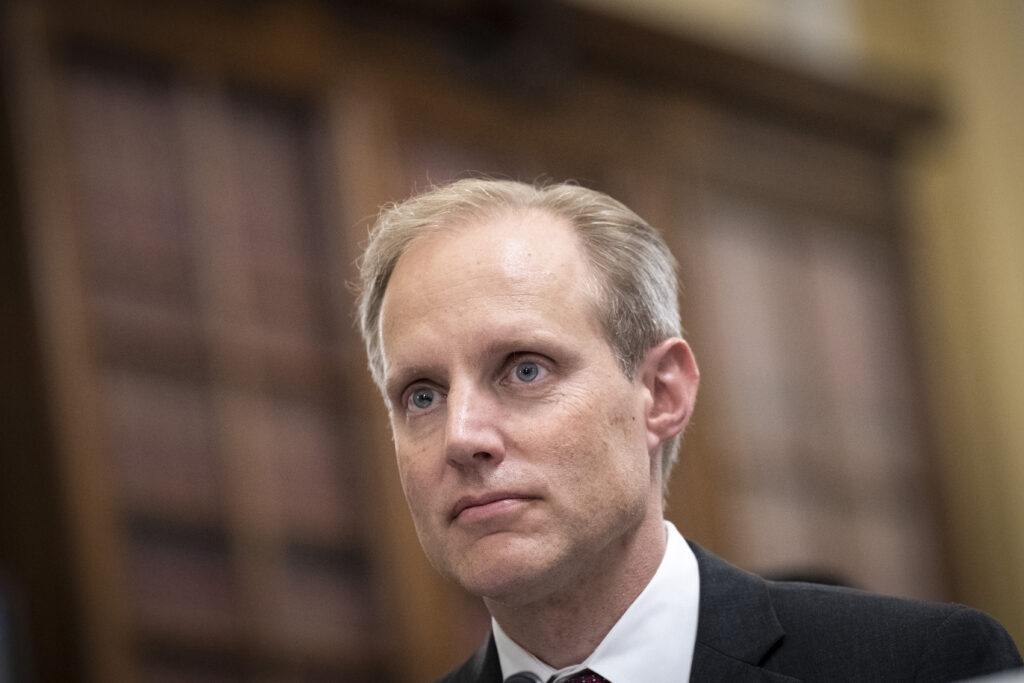
Secretaries of state slammed President Donald Trump and Republicans’ sweeping anti-voting bill, the SAVE America Act, warning Thursday that it would set off chaos if it became law before the upcoming 2026 midterms.
Though the legislation will likely die in the Senate, Republicans’ pursuit of the bill at Trump’s behest represents a major assault on Americans’ right to vote and states’ constitutional authority over elections.
Among its requirements, the bill would force prospective voters to show documentary proof of citizenship to register, impose strict photo identification requirements for casting a vote and require states to share voter data with the executive branch, which constitutionally has no authority over elections.
“The SAVE [America] Act would create chaos in the administration of elections,” Minnesota Secretary of State Steve Simon said during a briefing with reporters Thursday. “All of us know this.”
Get updates straight to your inbox — for free
Join 350,000 readers who rely on our daily and weekly newsletters for the latest in voting, elections and democracy.
Simon noted that unlike all other modern election laws passed by Congress, the SAVE America Act would take effect instantly, meaning states would have to rush to be in compliance before primary elections, which are ongoing in some states and right around the corner in others. The bill establishes criminal penalties for officials who fail to comply or even make a simple mistake.
“It is unheard of for something this sweeping in scope to take effect immediately,” he said.
The bill’s restrictions on the right to vote also aren’t hypothetical: Similar laws passed by states in the past led to widespread disenfranchisement, Simon said. He highlighted Kansas’ Secure and Fair Elections (SAFE) Act in 2011.
Though noncitizen registration in the state was statistically nonexistent, Kansas adopted SAFE and mandated that prospective voters show documentary proof of citizenship to register. That requirement, which has since been blocked by federal courts, prevented over 31,000 eligible citizens from registering to vote.
“This isn’t some theoretical or imagined circumstance,” Simon said.
“This bill assumes that every voter can navigate these requirements and navigate them quickly, and that is just not reality,” Connecticut Secretary of State Stephanie Thomas (D) said before raising specific examples of people who could be affected by the bill’s proof of citizenship requirements.
“Imagine a woman, divorced, she’s moved, changed her name and needs to update her voter registration,” Thomas said. “Under this bill, that is no longer a simple matter. It means tracking down multiple documents.”
“Or imagine an 82-year-old man, he just moved into assisted living. He’s voted his entire life. He’s never had a passport. No one knows where his birth certificate is at this point, and he doesn’t have a family member to help him use a computer,” she added. “That lifelong voter could be blocked, not because he’s ineligible, but because he can’t produce the right document at the right time.”
Washington Secretary of State Steve Hobbs (D) criticized Republicans for pursuing the SAVE America Act without also considering increased election funding for the states to make drastic technological and administrative changes to meet the bill’s extreme requirements,
That’s never happened before, Hobbs said, noting that when Congress passed its last major election administration laws, the Help Americans Vote Act, it also allocated around $3 billion to help states to meet its requirements.
Hobbs said the SAVE America Act would increase Washington’s costs for the upcoming 2026 midterms by $35 to $40 million and its 39 counties would face millions of dollars in new costs each year dealing with its unprecedented paperwork requirements.
“Updates to the state voter database and registration systems to comply with that would cost 20 million and would take months to develop,” Hobbs said. “And that’s just my state.”
Hobbs said that if the SAVE America Act became law, his office would immediately challenge it.
“We would have to,” he said. “We’d have no choice.”
On Trump’s threats to take control of elections, Simon said his office is preparing for that possibility as if it were an emergency event, like a severe weather event or a power outage.
“I regret to say, and it’s very sad to say, that in the year 2026, I have to add to that bucket the possibility that our own federal government will do something that will either directly or even indirectly interfere with the freedom to vote,” he said. “That’s never happened before.”
“We have to treat this like a bomb threat,” Simon added.
As part of Trump’s effort to take control of elections, the Department of Justice has sued Simon, Hobbs, Thomas and dozens of other secretaries to access states’ unredacted voter registration records, which contain private personal data on millions and millions of voters.