Even election officials who like voter ID have issues with the SAVE America Act
 Prefer us on Google
to see more of our voting rights news coverage when you search.
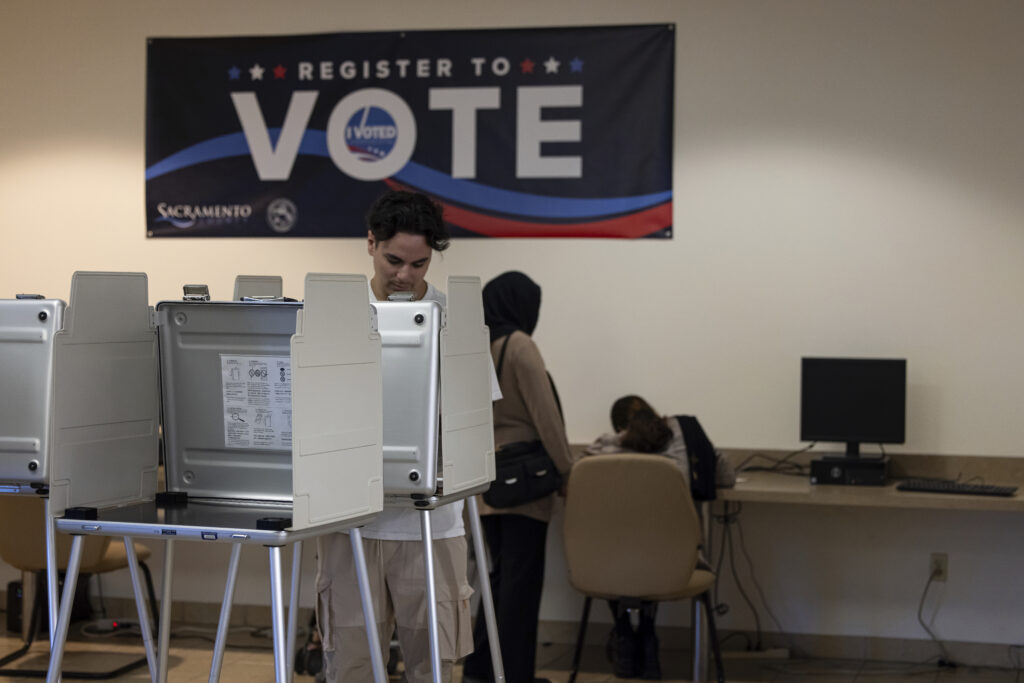
Deidre Holden believes voters should prove their citizenship and show identification before they can cast a ballot.
“Do I think there needs to be mechanisms in place to make sure that noncitizens are not voting? Absolutely,” said Holden, the director of elections in Paulding County, Georgia. “Do I think you need to have a photo ID? Absolutely.”
But Holden, a nonpartisan appointee who is currently busy overseeing the special election to replace former Rep. Marjorie Taylor Greene in Georgia’s ruby red 14th congressional district, does not support the Safeguard American Voter Eligibility, or SAVE America Act. At least, she says, not without pushing the law’s immediately-upon-enactment effective date back far enough to give election administrators like her time to implement the new policies without accidentally disenfranchising someone.
“With election law, you need to give the states time to put those laws into place, train the people on them, get the voters educated on it,” she said. “You don’t need to rush into something like this.”
Holden isn’t the only election official worried about the SAVE America Act, which would require voters provide documentary proof of citizenship (DPOC) — like a U.S. passport or birth certificate — when they register to vote, show photo identification when they cast a ballot, force states to provide the attorney general access to their voter registration rolls and mandate monthly purges of those rolls. The bill narrowly passed the House earlier this month and now has 50 Republican cosponsors in the Senate, where it still faces long odds of overcoming a filibuster despite an all-out pressure campaign on Senate Majority Leader John Thune (R-S.D.) to scrap the filibuster in order to enact it.
Get updates straight to your inbox — for free
Join 350,000 readers who rely on our daily and weekly newsletters for the latest in voting, elections and democracy.
President Donald Trump has been one of the proposal’s loudest boosters. Speaking at a political rally in Georgia’s 14th district Thursday, Trump said that if Republicans pass the bill, then “We’ll never lose a race. For 50 years, we won’t lose a race.”
Opponents say DPOC and voter ID rules are unnecessary burdens on voters aimed at preventing noncitizen voting, even though that is already illegal and exceedingly rare.
“It is claiming to solve a problem that is, frankly, imaginary,” said Amanda Gonzalez (D), the election clerk for Jefferson County, Colorado. “And what’s going to happen is we are unjustifiably going to make voting harder for millions of eligible voters across the country.”
“It’s a classic ‘show your papers’ law designed to make it harder for US citizens to vote at a time when the current US president is extremely unpopular,” said Michigan Secretary of State Jocelyn Benson (D).
“It’s almost like pushing voter registration back 50 years,” said Brook Schreiner, the nonpartisan director of elections for Chatham County, Georgia. “By putting more on getting people to register to vote, it’s basically suppressing it.”
Benson, Gonzalez, and Shreiner all echoed Holden’s concerns about SAVE America Act’s instantaneous implementation deadline.
“The bottom line is — in the worst case scenario — if this legislation were to pass later this year, it simply would not be possible for any state to implement it and its changes in time for the midterm elections,” said Benson.
“We would see a dramatic surge in in person traffic, which we are not currently staffed or funded for. We would likely need new systems, new training for employees, new legal guidance and an entirely new voter education campaign,” said Gonzalez, noting her county is home to 430,000 active registered voters. “Without significant federal funding, which it seems like we would be unlikely to see, the cost would fall directly on local taxpayers.”
“Elections officials like myself, we are used to doing things in well researched and methodical ways. If we are going to change a policy or procedure, it is usually done at least over the course of months, if not years, so that we are ensuring that the process works, that it’s fair, that it’s transparent, that it’s that we’ve done the appropriate communications,” Gonzalez added. “The right to vote is sacred. This is the way that people are able to have their voices heard in their communities. And we can’t just be changing how we run or implement elections at the drop of a hat. It just is going to have potentially devastating effects on voters.”
Holden, who’s worked in local elections for 21 years, worries it’s already too late in the election cycle to implement new laws without causing chaos.
“We’re already almost into March, and you’re trying to get this implemented by the November election,” she said. “That’s a lot to do, so I don’t think things need to be rushed into when it comes to elections.”
Beyond the timing concerns, election administrators worried about the SAVE America Act’s ambiguities and how it might upend existing procedures.
Schreiner and Gonzalez wondered what would happen to their states’ online portals for renewing registrations, assuming they would become obsolete if the SAVE America Act were enacted, forcing every voter looking to renew their registration or update it after a move to show up in person.
Shreiner also worried the legislation would require individuals who already provided proof of citizenship to the Georgia Department of Driver Services when obtaining their license and registering to vote to present those same documents again at her office.
Local officials aren’t the only people confused by the proposal. Even some of the SAVE America Act’s cosponsors are misguided about the bill’s identification requirements for registration, mistakenly believing a state driver’s license compliant with the 2005 REAL ID Act would be sufficient.
But as currently written, the measure requires a REAL ID “that indicates the applicant is a citizen of the United States.” Only five states currently offer these “enhanced” drivers licenses and identification cards, which can be used in lieu of a passport when re-entering the U.S. from Canada, Mexico or some of the Caribbean: Michigan, Minnesota, New York, Vermont, Washington.
The standard-issue REAL IDs don’t indicate citizenship (including drivers licenses in states that have enhanced IDs). In fact, many legal noncitizen residents can and do get REAL ID-compliant driver licenses.
So a REAL ID, alone, wouldn’t work under the SAVE America Act. Instead, registrants — even in a place like Georgia, with its strict voter ID laws — would need to also provide their birth certificate or naturalization papers. Alternatively, registrants could prove their citizenship with a valid U.S. passport, a military ID (with service records indicating place of birth), or a tribal ID that shows birth place.
Compared to the SAVE America Act, Georgia’s voter ID law is downright permissive, allowing voters to show a Georgia driver’s license — even if it’s expired — a student ID from a state college, or an employee I.D. from any federal or Georgia government entity (including localities).
Holden recalled the headaches she went through when Georgia implemented REAL ID, gathering all the necessary paperwork — even though she had those documents on hand, which is something not everyone can say. Any voter ID law would need to accommodate them, she said.
“We have so many people that have moved here from other countries, from other states, and they may not have access to that,” Holden said. “They just need time to be able to get the documentation together for this to be a smooth process.”
The Brennan Center for Justice estimates that 21 million Americans lack easy access to their birth certificates, marriage licenses or naturalization papers. And according to the Center of America Progress, 146 million Americans don’t have a passport.
“I’m one of those people,” said Shreiner. ‘I don’t have a passport yet.”
Getting a U.S. passport or a copy of your birth certificate can take time, and certainly isn’t free. A passport will set you back $165 and take 4-6 weeks, unless you expedite it for another $60 — then you get it in just two weeks. Costs and processing times for birth certificates vary. Massachusetts, for example, takes 7-10 business days and $54 to order online or over the phone.
In addition to the Georgia special election, early voting for the 2026 primaries has already begun in Texas, North Carolina, and Arkansas.
“If you are poor and you don’t have the funds to get a replacement birth certificate, and because you’ve lost it, or your house was on fire or some hardship, how are you supposed to register to vote?” Shreiner said.
It’s “effectively creating a poll tax on people,” said Gonzalez. “At the very best, that’s an inconvenience for some voters, but for others, it’s a huge barrier, depending on where you live, if you have access to a car, what your working hours are, if you have a disability, if you have kids.”
And doing all that to stop a figmentary problem comes at a real cost, Gonzalez added.
“When election staff are being pulled away from the important work of serving the public to serve the delusion of a small group of individuals, that’s government waste, that’s inefficiency,” she said.