It’s on: Senate kicks off marathon debate over SAVE America Act, Trump’s extreme voter suppression bill
 Prefer us on Google
to see more of our voting rights news coverage when you search.
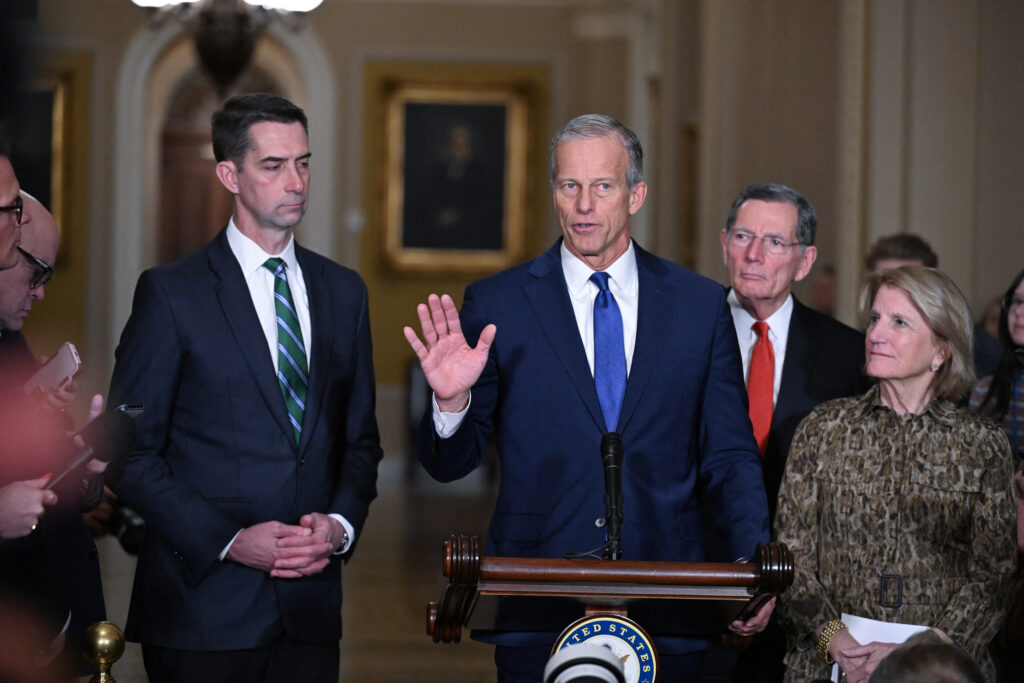
Debate on the most restrictive voting bill ever considered by Congress began Tuesday afternoon with a procedural inquiry, not a bang, as Senate Majority Leader John Thune asked the chair to “lay before the Senate the House message to accompany S. 1383,” the SAVE America Act.
In a week’s time, or maybe more, the debate will probably end with a similar bureaucratic whimper when supporters of the bill finally face the fact they lack the votes to enact it and move to table the debate.
But until then, the debate promises to offer a priceless window into the extreme anti-voting mindset of the modern GOP, as well giving Democrats a chance to take a stand for democracy.
Senate Minority Leader Chuck Schumer (D-N.Y.) said the bill was little more than voter suppression.
“It could disenfranchise over 20 million American citizens. It would kill online voter registration. It would kill vote by mail. It would kill voter motor registration. What does any of that have to do with election security?” Schumer said. “It’s a naked attempt to rig our elections.”
The motion to take up the SAVE America Act passed 51-48, with Sen. Lisa Murkowski (R-Alaska) voting with Democrats to oppose it.
The “extended debate,” as Thune described it Tuesday morning, is expected to linger well into the weekend and perhaps as long as 10 days, with discussions lasting late into the night.
Get updates straight to your inbox — for free
Join 350,000 readers who rely on our daily and weekly newsletters for the latest in voting, elections and democracy.
Republicans hope that, if nothing else, the debate will let them score political points by falsely painting Democrats as eager to encourage noncitizen voting. But GOP leadership also hopes the deliberative marathon will convince President Donald Trump, bill sponsor Sen. Mike Lee (R-Utah) and the bill’s other vociferous backers to face reality and concede that the bill simply doesn’t have enough support to pass.
Speaking on the floor Tuesday morning, Schumer lambasted Republicans for their misplaced priorities.
“This afternoon, Republicans will move to bring a pernicious, radical bill before the Senate — the so-called SAVE America Act — at a moment when war is consuming the Middle East, when costs are rising, when [Immigration and Customs Enforcement] agents are terrorizing our communities, and when job growth in America is weakening.”
Democrats plan to hijack the floor debate over the coming days to focus on issues that matter more to voters, including a war powers resolution about Iran — a privileged motion that can interrupt the SAVE America Act debate.
Hours earlier, Speaker Mike Johnson (R-La.), who steered SAVE America through the House last month, was asked at a press conference to name a single instance of voter fraud that the measure would have stopped. He was unable to do so.
“Look, we’re not gonna litigate all that,” Johnson responded.
The lengthy political performance comes at the demand of Trump and his MAGA allies, who have called for the SAVE America Act’s passage for months. Ahead of the debate, Trump posted a typo-riddled rant on Truth Social, calling the SAVE America Act “one of the most IMPORTANT & CONSEQUENTIAL pieces of legislation in the history of Congress, and America itself.”
The SAVE America Act would require Americans to provide documentary proof of citizenship (DPOC) — such as a U.S. passport or certified birth certificate; a driver’s license won’t work — in person to register to vote. It would also impose strict photo ID requirements for voting in federal races, requiring mail-in voters to submit photocopies of their IDs along with their ballots. The bill would additionally require states to conduct ongoing voter roll checks using federal immigration databases overseen by the Department of Homeland Security.
In addition to that, Trump has urged Republicans to add three more provisions to the bill: bans on no-excuse mail voting, trans athletes in women’s sports, and gender-affirming care for minors. Sen. Eric Schmitt (R-Mo.) is expected to introduce an amendment package to do that, which is unlikely to get the 60 votes required.
Republicans have presented the SAVE America Act as a prudent measure popular with average Americans. “If you want to vote in the United States of America, you need to be a citizen of the United States of America, and you need to show a photo ID at the poll in order to vote,” Sen. John Barrasso (R-Wyo.) said earlier on Tuesday. “It’s common sense. Americans show ID every single day. Want to buy a beer? Need to show an ID. Want to get on a plane? Need to show them a photo ID.”
While the bill tends to poll well in a vacuum — 62% of Americans supported DPOC requirements in a February Yahoo/YouGov poll, while basic voter ID requirements tend to poll even higher — adding context shifts how voters perceive the proposal. A recent PBS News/NPR/Marist poll found nearly 6 in 10 Americans say it is more important to ensure everyone who wants to can vote, while just 41% said the bigger concern is preventing ineligible people from voting, with independents prioritizing voter access by 7 percentage points.
The SAVE America Act is a costly solution in search of a problem. Multiple studies and voter registration roll audits have shown that exceedingly few noncitizens attempt to register, and fewer still try to vote. It is illegal for noncitizens to vote, and those that do face prison time and deportation. The bill would put new burdens on virtually every voter to stop the miniscule number — 0.000007% by some estimates — of ballots mistakenly cast by noncitizens.
Election officials say the changes would be a bureaucratic nightmare — compounded by the fact that the law would take effect immediately upon enactment, as states administer primary races and prepare for the general election.
The new, in-person registration requirements would outlaw the methods 83% of Americans use to register or renew, like online or mail-in forms. And upwards of 21 million Americans lack easy access to a passport or birth certificate, meaning those voters would need to spend time and money to get the documents ahead of election day.