Pro-voting groups ask Florida Supreme Court to block GOP gerrymander
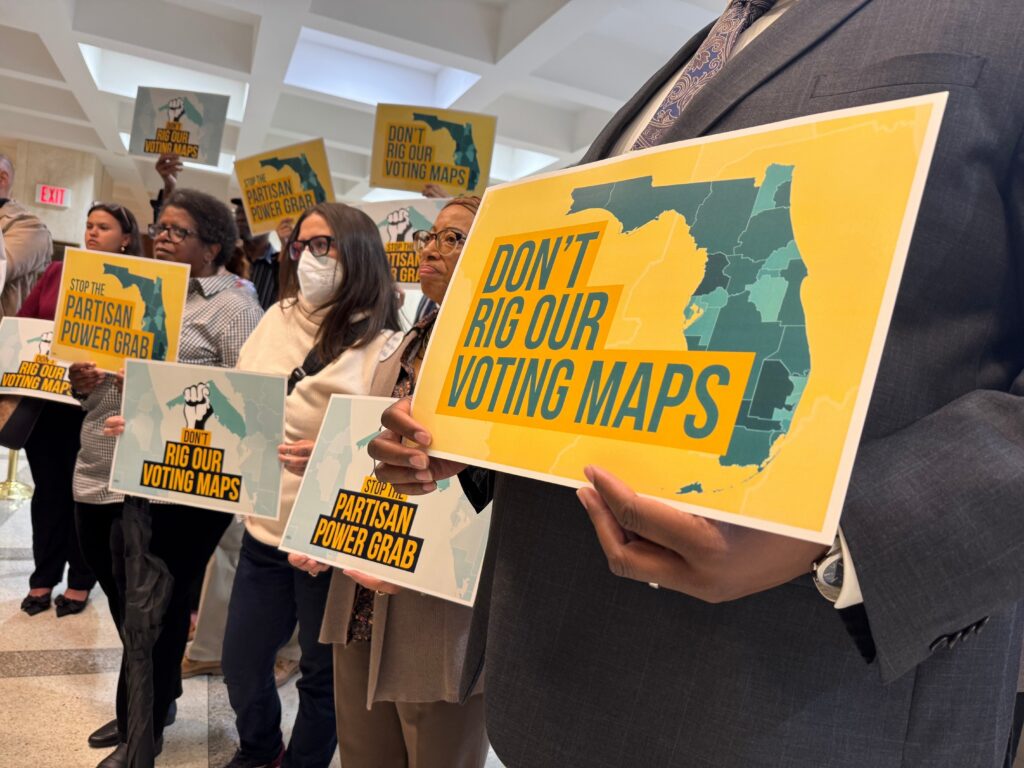
Pro-voting groups asked the Florida Supreme Court Thursday to block the state’s new GOP congressional gerrymander and let the 2026 elections move forward under the 2022 map, warning that Republican officials are trying to run out the clock before voters can get relief.
The emergency filing marks a dramatic escalation in the fight over Florida’s 2026 congressional map, which voting rights advocates say was drawn to lock in Republican power before the midterms.
The petitioners* are asking the state Supreme Court to step in now — before congressional qualifying begins Monday — after lower courts refused to stop the map from being used this cycle.
Get updates straight to your inbox — for free
Join 350,000 readers who rely on our daily and weekly newsletters for the latest in voting, elections and democracy.
“This petition presents a simple question: whether Florida’s political branches can openly defy the Florida Constitution and escape judicial review for an entire election cycle simply by attempting to run out the clock,” the petitioners wrote. “The answer from this Court should be a resounding no.”
At issue is Florida’s Fair Districts Amendment, the anti-gerrymandering reform voters approved in 2010 to stop politicians from drawing congressional districts to benefit themselves or their party.
The petitioners argue that the 2026 map was drawn in open defiance of that constitutional protection and that the Florida Supreme Court must act before the election calendar makes meaningful relief impossible.
The filing asks the court to issue a constitutional writ — an emergency order that allows the court to protect its power to decide a case before time runs out.
The petitioners say the danger is not theoretical.
The 1st District Court of Appeal denied their request to send the case directly to the Florida Supreme Court and also declined to speed up the appeal. Under the current schedule, the respondents would not even have to respond to the petitioners’ brief until June 29 — weeks after congressional qualifying ends.
“Respondents have not contested these facts,” the petitioners wrote. “Instead, they have calculated that they do not need to win on the merits. They only need to slow-walk this litigation.”
The timing is central to the emergency request. Florida’s congressional qualifying period runs from June 8 to June 12.
The petitioners argue that the looming deadline should push the court to act quickly, not give the state a pass to use the new map. They also say candidates could still rely on qualifying signatures they have already collected because, in an apportionment year, congressional candidates may submit signatures from registered voters anywhere in Florida regardless of district lines.
In a separate emergency motion, the petitioners asked the Florida Supreme Court to move at extraordinary speed: order the respondents to show cause by 2 p.m. Friday and allow the petitioners to reply by 8 p.m. that same day.
The stakes are enormous.
The petitioners are asking the court to temporarily block the 2026 map and run the next congressional elections under the 2022 plan — the map Florida used in the last two congressional elections and one the state itself drew and defended. Their core argument is that voters should not be forced through a federal election under a map they say was built for partisan domination while the courts slowly consider whether it violates the state constitution.
*The petitioners in this case are represented by the Elias Law Group (ELG). ELG firm chair Marc Elias is the founder of Democracy Docket.