Judges look likely to uphold Tennessee GOP’s aggressive gerrymander
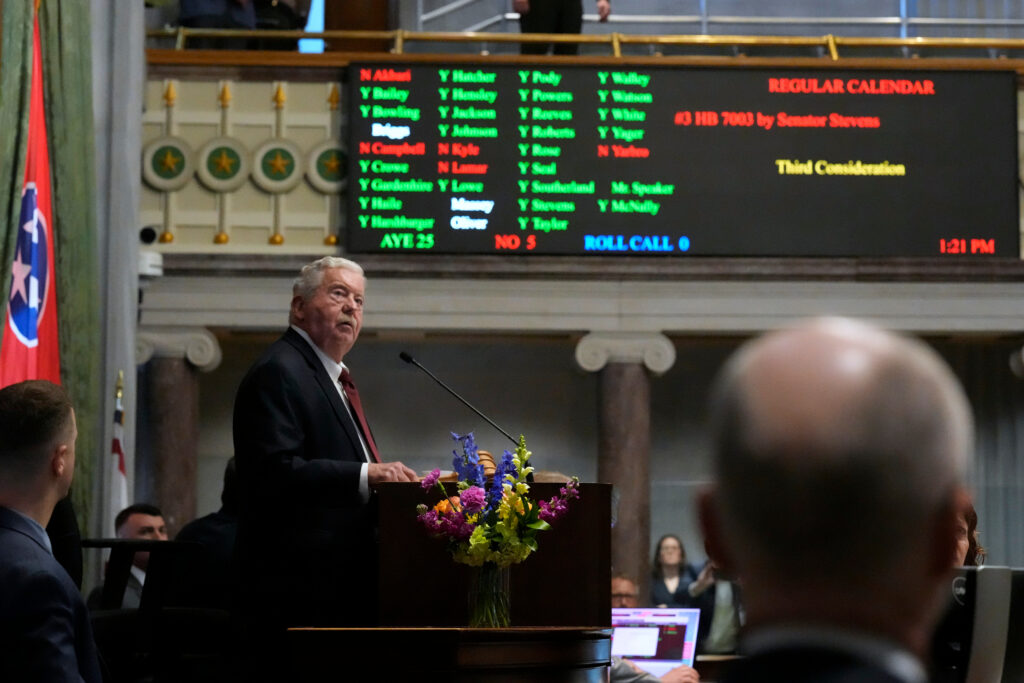
Federal judges in a court hearing Thursday appeared skeptical of pro-voting groups’ arguments that Tennessee Republicans intentionally diluted Black voting power through their recent aggressive gerrymander.
The panel, composed of two judges appointed by President Donald Trump and one appointed by President Barack Obama, seemed likely to deny the American Civil Liberties Union (ACLU) and the NAACP’s request for an injunction to pause the state GOP’s new congressional map.
Passed last month, the map eliminated Tennessee’s sole Black-majority congressional district centered around Memphis, one of the most heavily African American cities in the United States. Republican legislators claimed they relied exclusively on census data when drawing the new map.
Get updates straight to your inbox — for free
Join 350,000 readers who rely on our daily and weekly newsletters for the latest in voting, elections and democracy.
In the hearing Thursday, plaintiffs argued that partisan motivation alone — which is permissible in redistricting — couldn’t explain the new map. They asserted that state Republicans intentionally targeted Black voters to dilute their vote and deny them the ability to elect a candidate of their choice in violation of the 14th Amendment.
As evidence, they noted that the U.S. Census Bureau does not collect or include partisan data in its reports. It does, however, collect racial data. And plaintiffs argued that Republicans used that racial data to divide Shelby County’s Black population into “near-perfect thirds” across three new congressional districts.
The GOP enacted the new map days after the Supreme Court issued a ruling in Callais v. Louisiana that dismantled Section 2 of the Voting Rights Act, which prohibited states from drawing maps that discriminate based on race.
In that ruling, the nation’s highest court found that maps drawn for partisan advantage are permissible even if they dilute minority voting power, so long as the intent to discriminate based on race is not explicitly proven.
Tennessee Republican legislators repeatedly claimed that they pursued the new map to eliminate the state’s lone Democratic seat and secure an all-GOP federal delegation after the midterms.
Echoing the Supreme Court’s Callais ruling, one of the Trump-appointed judges Thursday asked plaintiffs whether Republicans could have produced a 9-0 map in their favor without breaking up Shelby County’s Black population.
Representing state defendants in the hearing, Taylor Meehan, an attorney with the Consovoy McCarthy law firm, argued that under Callais, plaintiffs now have a “special burden” to disentangle race and partisan motivation to prove intent to discriminate based on race. She added that the plaintiffs failed to do so in this case.
Meehan also said that the panel pausing the new map now would violate the Purcell Principle, a legal doctrine that federal courts should not alter election rules or maps close to an impending election.
Recently, the Supreme Court has applied Purcell unevenly, allowing Alabama and Louisiana to pass new electoral maps in the wake of Callais, despite elections already being underway.