Georgia lawmakers to consider GOP redistricting push for 2028 election
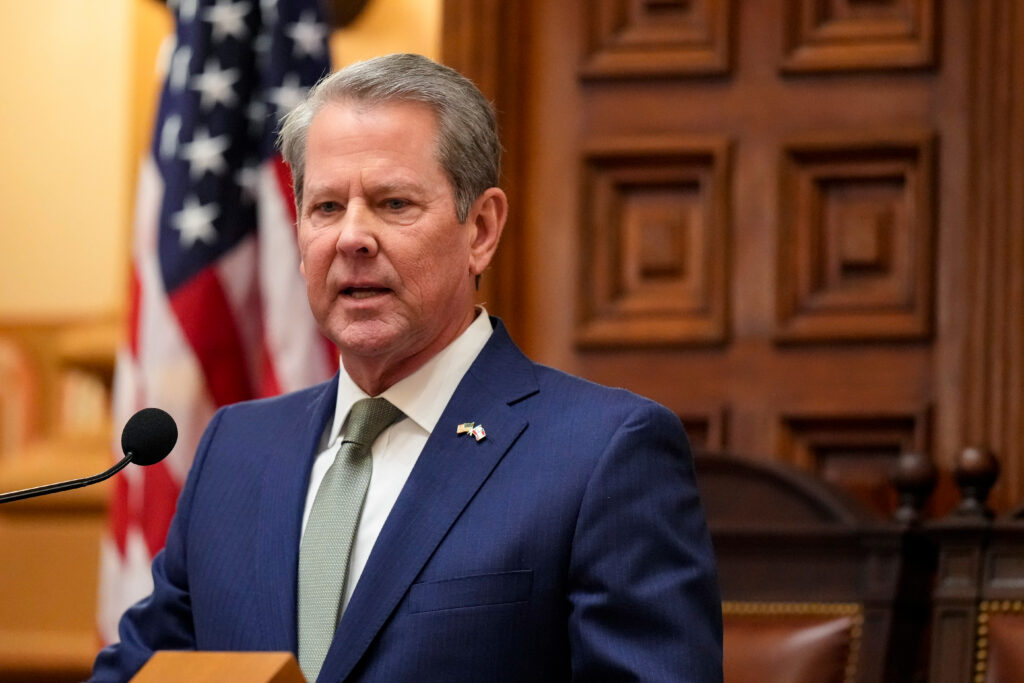
Georgia lawmakers will convene today and consider redrawing congressional and state legislative maps to favor Republicans during the 2028 election cycle.
The special session comes amid growing reluctance to redistrict from some Republicans and outrage from Democrats.
Opponents joined state Democratic leaders and packed the Georgia capitol building ahead of the proceedings, holding signs urging lawmakers to “protect Black voters” and “say no to Jim Crow.”
Last month, multiple Southern states rapidly redrew their maps ahead of this year’s midterms.
Unlike other Southern governors, Gov. Brian Kemp (R) didn’t try to gerrymander ahead of the midterms. But he nonetheless called a redistricting special session in response to the U.S. Supreme Court’s recent ruling in Louisiana v. Callais, which gutted minority voting protections in the Voting Rights Act and made it easier to gerrymander.
Now, Kemp has tasked lawmakers with drawing up new maps for state legislative districts, U.S. House of Representatives districts and “any other state office elected by district.”
But Kemp’s redistricting plan may not go as smoothly as he expected.
Get updates straight to your inbox — for free
Join 350,000 readers who rely on our daily and weekly newsletters for the latest in voting, elections and democracy.
The night before the special session, billionaire Rick Jackson defeated Georgia Lt. Gov. Burt Jones in the Republican governor primary runoff.
Although both candidates support redistricting, Jones’ loss will likely weaken his ability to wrangle support for the measure in the state Senate, where he also serves as president.
A day before Jones’ defeat, Amir Badat, southern states director at Fair Fight Action, said Georgia Republicans would likely try to rush through the redistricting process.
“They’re going to try to do it quickly. They’re going to try to do it without public input, requiring as little time as possible, so minority members don’t have the opportunity to meaningfully weigh in,” Badat said, adding that Democrats have not yet seen any proposed maps.
But he also noted that not all Republicans were on board with the gerrymandering push.
“I think that there’s still significant disagreement within their caucus about engaging in this process,” Badat said. “We don’t know yet what to expect exactly, but there’s certainly no guarantee that they’ll actually be able to get this done.”
Some Georgia Republicans are privately worried that redrawing the maps will energize Democratic voters — ultimately making Republican candidates more vulnerable this November, the Atlanta Journal-Constitution reported Tuesday.
Democrats, meanwhile, have made their position clear.
“We would not be here were it not for the Supreme Court, which is apparently right now, you know, extremists who feel emboldened,” Sen. Raphael Warnock (D-Ga.) said in a television interview this week. “They are behaving in a very partisan manner. I think they are steadily undermining the credibility of the court.”
Warnock cast blame on President Donald Trump for instigating a nationwide redistricting arms race last year.
“But with the Callais decision, the Supreme Court poured fuel on the fire,” Warnock added. “And what is happening is sad, but wholly predictable: this race all across the South to literally diminish the voices of its Black citizens.”
In the immediate aftermath of the Callais ruling, Louisiana, Alabama and Tennessee all scrambled to enact new maps that sharply weakened Black political representation. A similar plan in South Carolina failed to pass. Now, all eyes are on Georgia.
Redistricting is not the only item on the special session’s agenda. Kemp is also asking lawmakers to resolve an increasingly urgent, self-inflicted voting quandary.
The Georgia legislature passed a measure two years ago that banned the use of QR codes in the ballot counting process by July 1, 2026. But lawmakers didn’t approve funding to replace the system or give local election officials guidance on how to make the changes.
Now, with the cutoff date in sight, pro-voting groups like the ACLU of Georgia are asking legislators to push back the deadline to 2028 to prevent a needlessly confusing, rushed transition process.