Exclusive: Democrats unveil plan to protect elections from Trump, AI
Since Donald Trump’s return to the White House last year, the administration has worked unremittingly to make it harder for Americans to vote.
Now that Trump’s approval ratings are hitting historic lows five months before the midterms, many are expecting a blue wave come November. And some Democrats are looking to undo the damage his administration has already done and prevent it from happening again.
Republicans’ antipathy to voting isn’t the only anti-democratic phenomenon endangering U.S. elections. The rise of AI also threatens to flood elections with disinformation and enable — or intensify — the harassment of election administrators, posing a grave risk to future votes.
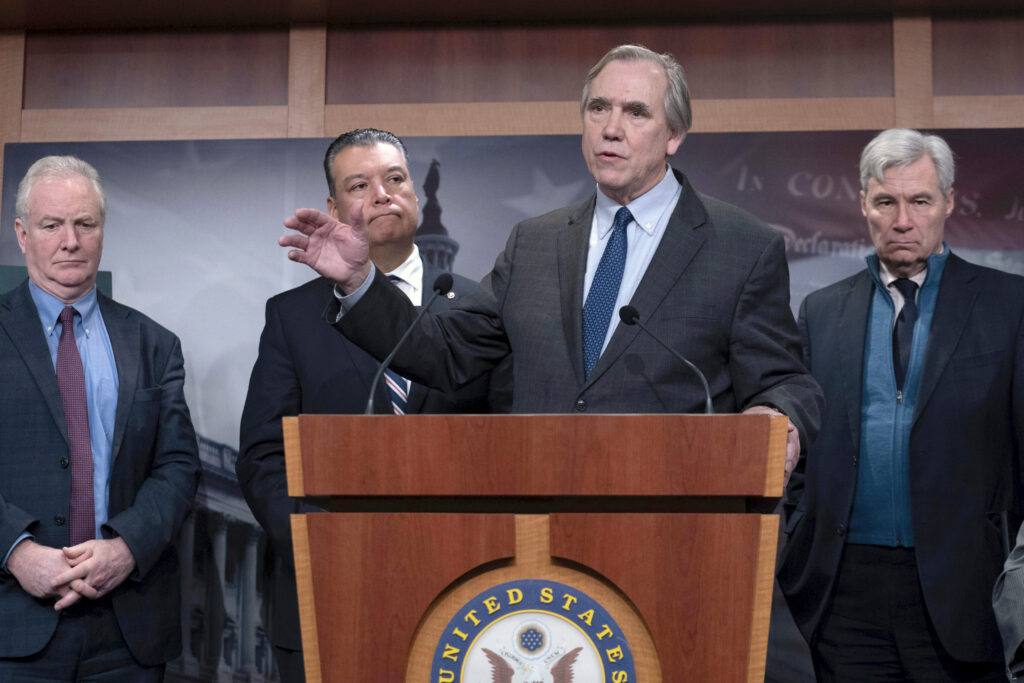
To combat both, Sen. Jeff Merkley (D-Ore.) introduced a new bill Thursday, shared exclusively with Democracy Docket: the Fraudulent Artificial Intelligence Regulations (FAIR) Elections Act.
The legislation would prohibit using AI-generated content to intimidate election officials or to knowingly spread falsehoods aimed at keeping voters from casting their ballots — like incorrect election deadlines or fake polling place locations. The measure would also prohibit the federal government from comparing federal data with state or local data for determining voter eligibility — a provision aimed squarely at blocking Trump’s attempts to create national citizenship and voter registration lists.
“The ballot box is the beating heart of democracy, and we must use every tool at our disposal to protect it,” Sen. Merkley said in a statement. “In the face of bad actors abusing AI to spread disinformation about voting to further dangerous voter suppression efforts, the FAIR Elections Actwill help take on this 21st-century threat and stand up to the Trump Administration’s anti-democratic efforts to target eligible voters they don’t like.”
Get updates straight to your inbox — for free
Join 350,000 readers who rely on our daily and weekly newsletters for the latest in voting, elections and democracy.
The measure would also update the National Voter Registration Act to prevent voters from being removed from registration rolls based on unverified information, and additionally allow anyone who was improperly removed to sue the federal government for damages.
That provision takes aim at the Department of Homeland Security’s (DHS) expansion of its Systematic Alien Verification for Entitles (SAVE) program to hunt noncitizens on state registration lists. Such searches have turned up thousands of false positives, highlighting the database’s danger as a tool for voter purges.
Merkley’s office started working on the legislation in 2024, following news reports about how election denialist organizations like True the Vote and the Election Integrity Network were trying to force election officials to cancel hundreds of thousands of voter registrations based on dubious data-mining.
Around the same time, AI deep fakes were beginning to proliferate, with internet trolls using the new technology to defame and harass their victims, including election officials and volunteers. So, Merkley’s office decided to combine restrictions on data-mined voter suppression with a ban on AI-powered harassment against poll workers
Since returning to power, Trump has signed anti-voting executive orders and pushed for restrictive election laws. Notably, DHS turned SAVE — a program designed for verifying an applicant’s eligibility for federal benefits — into a tool for checking voters’ citizenship, despite its obvious defects. The new bill aims to prevent SAVE — or other federal databases — from being used to potentially kick eligible voters off registration rolls.
With this legislative marker set, Merkley can now start working with others in the Senate to gauge how willing Democrats will be to push for reforms once they’re back in power, and also which provisions might attract bipartisan support today.
The office has little expectation, however, of anything passing until Democrats regain control of Congress. Instead, the hope is to get Democrats to coalesce around an idea for further regulation.
Democrats have long pushed for a pair of election reform bills — the For the People Act, which would ban gerrymandering and overhaul campaign finance laws, and the John R. Lewis Voting Rights Advancement Act, which would restore provisions of the Voting Rights Act nullified by the U.S. Supreme Court. Merkley’s legislation aims to add to those reform efforts, which Democrats were unable to push past the Senate’s filibuster when they were last in power. Merkley’s office is working with Sen. Alex Padilla (D-Calif.), the ranking member of the Senate Rules and Administration Committee, on the proposal.
Merkley’s bill isn’t the first legislation proposed to regulate how AI can be used in elections, or the first aimed at countering Trump’s policies, but it’s likely the first to see both as two sides of the same coin. Trump’s electoral lies have fueled a dramatic rise in threats against election officials, which AI has only turbocharged.
“The strength of our democracy relies on our elections being safe, secure, and accessible,” Padilla said in a statement. “As the use of AI spreads rapidly, we must ensure there are guardrails in place to prevent it from becoming a tool to suppress votes, spread disinformation, or purge eligible voters from the rolls. The FAIR Elections Act is an important step to help us protect our elections.”