Trump claims military is gunning for extreme anti-voting SAVE America Act
 Prefer us on Google
to see more of our voting rights news coverage when you search.
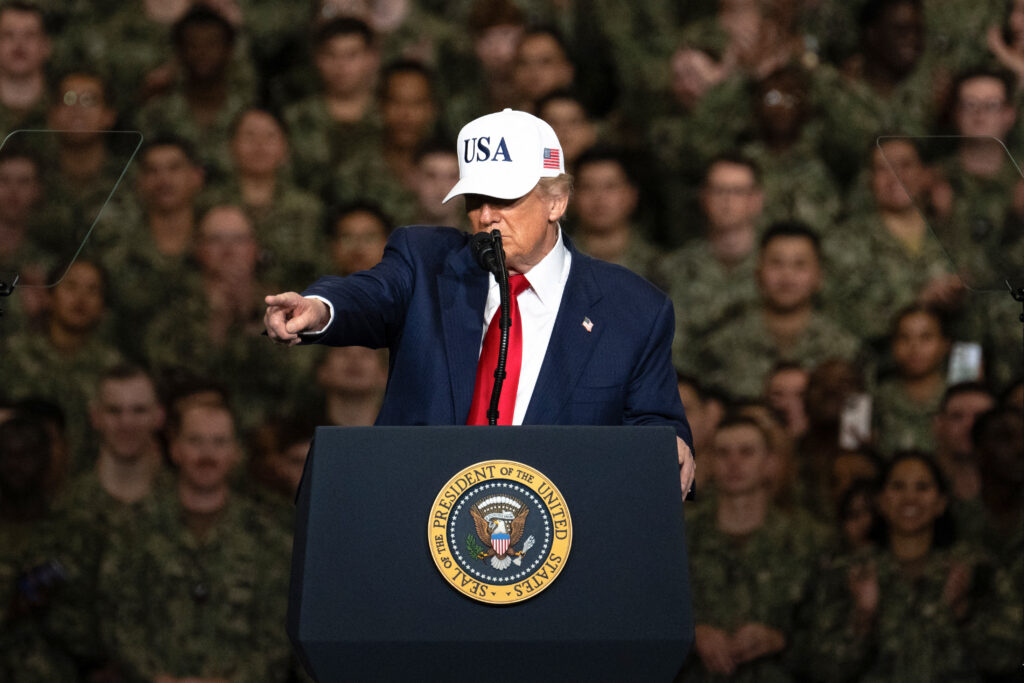
President Donald Trump said the Pentagon wants congressional Republicans to include anti-voting restrictions from the SAVE America Act in a multibillion-dollar defense bill.
That claim — which would be historically out of character for the Department of Defense (DOD) — represents Trump’s latest attempt to use the U.S. military to carry out his domestic partisan goals, including his longstanding desire to directly take control of elections.
Get updates straight to your inbox — for free
Join 350,000 readers who rely on our daily and weekly newsletters for the latest in voting, elections and democracy.
“I am hereby calling on Republicans in Congress to IMMEDIATELY advance and pass the forthcoming $350 Billion Reconciliation Bill (Recon 3.0) — which, at the request of our Great Department of War — will include THE SAVE AMERICA ACT as well,” Trump said in a social media post Wednesday night.
“No games, no delays, and no weak compromises! Do this ASAP,” the president added.
The DOD did not respond to Democracy Docket’s request to confirm whether, as Trump claimed, military leaders requested anti-voting measures be included in the reconciliation bill.
However, reacting to Trump’s post, Defense Secretary Pete Hegseth vowed that the department “will make this happen!”
Along with severely restricting mail voting, the SAVE America Act could disenfranchise millions of eligible voters by requiring them to show documentary proof of citizenship to register and to provide photo ID when they cast ballots.
Since passing the House in February, the act has stalled in the Senate because of the 60-vote threshold required to get past the filibuster and other legislative rules in the chamber.
Trump’s post was his most recent bid to slip the SAVE America Act, which he has termed his “No. 1 priority,” through the Senate by attaching it to a filibuster-proof reconciliation bill. His past efforts failed, and for several reasons, his latest demand is unlikely to succeed as well.
The Senate parliamentarian, the chamber’s legislative umpire, has objected to including the act in previous reconciliation bills, ruling that it is primarily policy rather than budgetary. Trump, in turn, demanded that Senate Republicans fire the parliamentarian.
In the past, lawmakers from both parties — but particularly defense hawks — have also been hesitant to load defense appropriations bills with non-defense policy riders, in part over fears of politicizing the military.
Trump doesn’t share those fears. Over the past year, he has repeatedly refused to rule out deploying troops or federal agents to the polls during the upcoming midterm elections. He also said he regretted not ordering the National Guard to seize ballot boxes during the 2020 election, raising fears he could do so in future elections.
His deployment of thousands of National Guard troops last year to Democratic-led states and cities was widely viewed as part of his campaign to punish his political enemies.