In Montana, attacks on voting risk disenfranchising people with disabilities
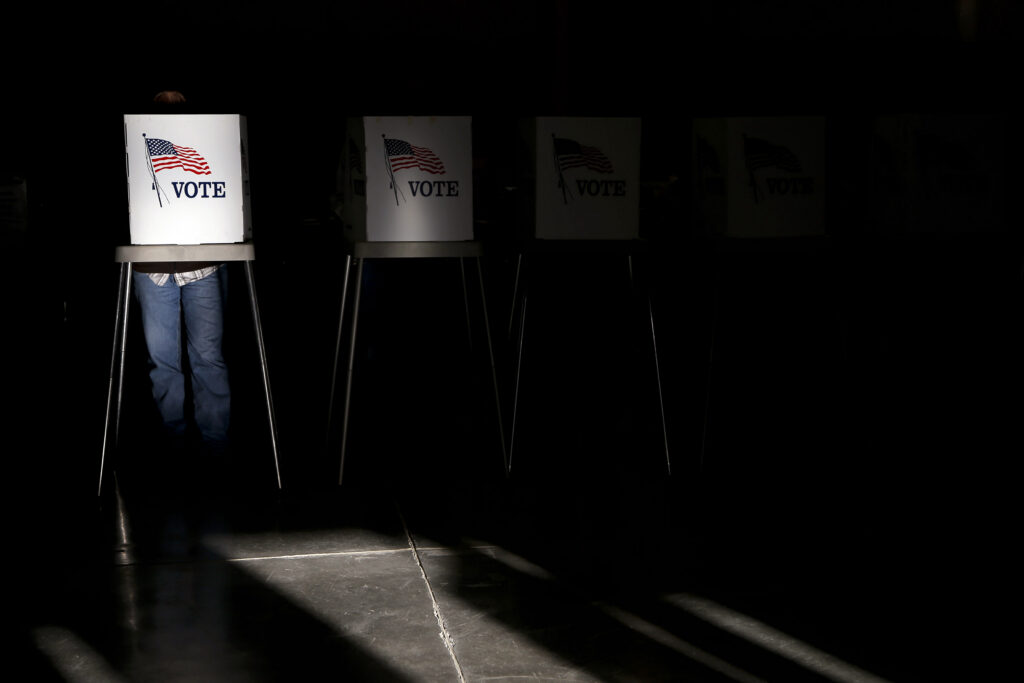
When Montana passed a law last year that would reject mail-in ballots over minor date errors, voting rights groups swiftly sued*.
The measure, House Bill 719, requires voters — including those with disabilities affecting mobility — to manually write their date of birth on absentee ballot applications and ballot envelopes in order for their vote to be counted. That could disenfranchise many voters in a state where 80% of people voted by mail in 2024, the voting rights groups argued.
Get updates straight to your inbox — for free
Join 350,000 readers who rely on our daily and weekly newsletters for the latest in voting, elections and democracy.
“By adding a new complication to a system that is already working, lawmakers will make Montana elections less robust and less representative, because it will lead to the exclusion of qualified voters’ ballots,” they said in their May 2025 legal complaint.
HB 719’s effects have already been felt. In local elections last November, nearly 3,000 ballots were rejected across Montana’s six largest cities, according to data from the Montana Free Press.
Now, nearly a year after that law’s passage, Disability Rights Montana — the state’s federally mandated protection and advocacy agency and a plaintiff in the court case — released a report that sounds the alarm about new state and national legislation that threatens to disenfranchise Montanans with disabilities further.
The voting rights group argues this would be a loss not just for the voters themselves, but also for both political parties.
Onslaught of legislation
HB 719 was just one of two restrictive voting bills that passed in Montana last year.
The second state law eliminated alternative forms of voter identification, such as a sworn statement explaining how a lack of transportation or illness prevents a voter from accessing identification documents.
It also eliminated some school IDs as acceptable forms of voter ID. Now, only IDs from colleges within the National Association of Intercollegiate Athletics are allowed.
Tal Goldin, an attorney and director of advocacy at Disability Rights Montana, said getting an ID in Montana is already difficult. This new law created additional challenges for students and people with disabilities, who already face disproportionate access barriers.
Additionally, a pro-voting bill that would have let people with disabilities return their ballots electronically instead of printing them failed during the same session.
It would have been an easy accommodation: Overseas Members of the military can already do this with “a secure, encrypted electronic transmission system approved by the secretary of state.”
In a notable departure from typical partisan trends, that bill was introduced by Republican state Sen. Jule Dooling.
Enter the SAVE America Act
To make matters worse, the Trump administration is now pursuing federal laws that broadly guard Americans’ right to vote.
The clearest example of this is the SAVE America Act, which would severely restrict mail voting. President Donald Trump has gone all-in on the bill, calling it his top priority. The House of Representatives passed it in February, but it is currently languishing in the Senate.
Although the bill is unlikely to pass, disability advocates are concerned as Trump continues to attack mail voting.
Meanwhile, the Supreme Court appears poised to undermine other legal guardrails protecting voting, like the Voting Rights Act and the Help America Vote Act.
Goldin said he is particularly concerned about new restrictions on voting because of Montana’s geography.
The state is so rural that a majority of it is considered “frontier” — the most remote category on the population spectrum. Most Montanans live in areas so isolated that their closest polling place may be many miles away.
That can pose a particular challenge for people with disabilities, who are less likely to drive or have access to transportation. The alternative is voting by mail.
Increased restrictions on voting will also disproportionately affect members of the disability community who live in group settings like nursing homes, shelters or community homes.
That’s a doubly serious problem for these Montanans. The act of voting may be one of the only ways they can make their voices heard. And it’s a right protected by Montana’s guardianship laws and the state constitution.
But it’s “more difficult to access civil rights when you’re a person in care,” Goldin said.
When living in a group home, for example, a person often cannot simply look in a drawer at home to find the documentation needed to vote. A birth certificate may be in an administrative office somewhere across the country.
Losing a ‘massive voting bloc’
Despite these restrictions, Disability Rights Montana’s report emphasizes that members of the disability community are actually more likely to be politically engaged than those without disabilities.
“In the voting space, what we’re really trying to emphasize is a massive voting bloc,” Goldin said.
By undermining the rights of voters with disabilities, legislators in both parties are simply missing out on votes, he added.
While efforts to restrict the vote can be partisan, the results are often indiscriminate across party lines in a state that is primarily Republican.
“It’s not like everyone with a disability is a Democrat,” Goldin said. “If you’re the Republican majority, you’re probably disenfranchising your voters, and I care that you can vote.”
The disability community has the potential to affect election outcomes if given the chance to exercise its rights, he added. Montana has a small population, with the third-lowest population density of all states.
This means that every vote counts — especially in state races.
“If [people with disabilities] voted as a bloc, they could sway any election in any direction,” Goldin said.
*Disability Rights Montana is represented by the Elias Law Group (ELG). Democracy Docket founder Marc Elias is ELG chairman.