Trump’s EAC firings threaten access for voters with disabilities, experts warn
 Prefer us on Google
to see more of our voting rights news coverage when you search.
Diane Golden helped secure accessible voting equipment when the Help America Vote Act (HAVA) passed in 2002, ensuring the right for people with disabilities to vote privately and independently.
Today, she’s concerned that right is at risk.
HAVA led to the widespread use of voting machines, which can include anything from ballot-marking devices to barcodes. It provided ways for people who cannot use a hand-marked paper ballot to vote.
But President Donald Trump has long questioned the security of the voting systems that provide access to one-sixth of all voters. He called them “terrible machines,” “dishonest, almost all,” “vulnerable” and “easily compromised” in a recent address to the nation.
Recently, Trump decapitated the U.S. Election Assistance Commission (EAC), the agency that develops guidelines for secure and accessible voting systems, by firing the agency’s remaining heads.
Get updates straight to your inbox — for free
Join 350,000 readers who rely on our daily and weekly newsletters for the latest in voting, elections and democracy.
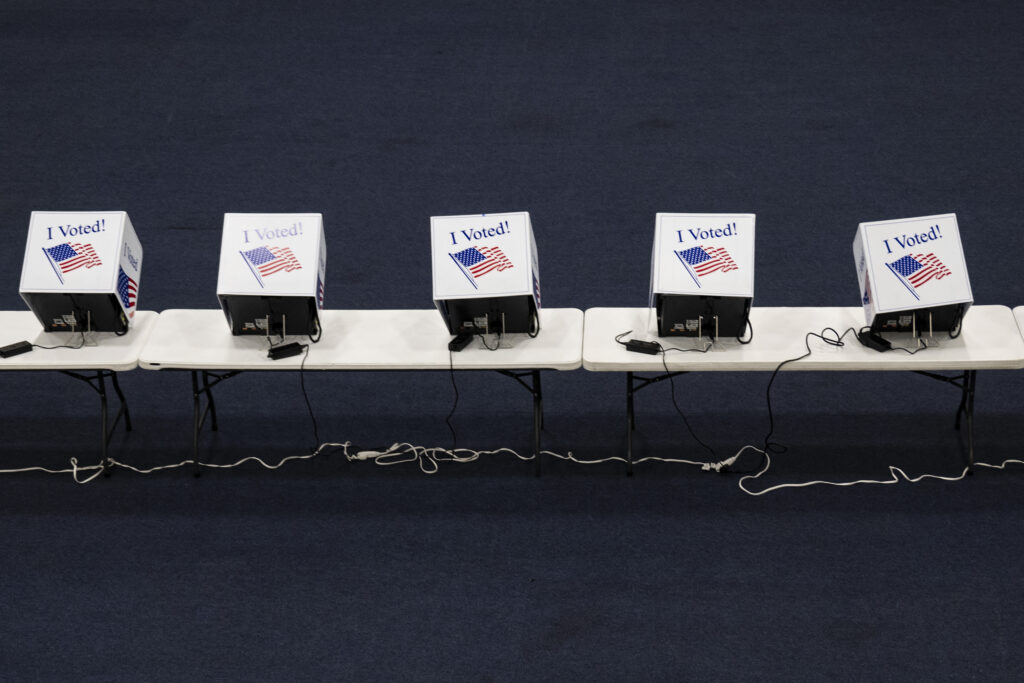
Now, elections experts worry about the future of one of the most prominent voting methods for voters with disabilities — ballot-marking devices — as Trump ramps up his anti-voting-machine rhetoric amid the EAC’s restructuring.
Golden is a member of the EAC’s Technical Guidelines Development Committee (TGDC), an advisory body that recommends standards for voting technology, and she herself has lived experience with disability. Unlike some, she wasn’t shocked when Trump forced out the EAC’s three remaining commissioners.
Without accessible voting equipment, “people with disabilities would just lose their private and independent vote,” Golden said.
Banning ballot-marking machines could cause discrimination. It’s also illegal
HAVA, which undergirds all voting system guidelines, requires at least one accessible voting device at every voting site. That means an attempt to rid the country of voting machines and use only hand-marked paper ballots, as Trump has suggested, would be illegal.
“The president cannot single-handedly remove it [the HAVA requirement] because it is enshrined in federal law,” said Wren Orey, director of the Elections Project at the Bipartisan Policy Center.
One way Trump has tried to sidestep this requirement is through a carveout for voters with disabilities. Orey said this exception is problematic because it could force those voters to single themselves out and disclose their disability at a voting site, or not vote at all out of fear.
“It creates the risk of discrimination and also risks that a voter with a disability would feel comfortable asking for the support that they need,” said Orey.
Americans with disabilities are not a small voting bloc. In fact, one in six voters across the country has a disability. And for these voters, mail-in voting and ballot-marking devices are some of the most popular voting choices.
Sachin Pavithran is the executive director of the U.S. Access Board, the federal agency that develops the accessibility standards to uphold disability rights, including civil rights.
Pavithran is also blind and said he uses a ballot-marking machine because it is the most private and accessible way to cast his ballot. He said if there were evidence suggesting this type of voting causes cybersecurity concerns, he would take it seriously.
But so far, there is none.
“It is the vehicle I’ve used to vote and if that vehicle is taken away, I don’t know how else I would vote,” Pavithran said.
Orey added that ballot-marking devices are beneficial for all voters because they ensure accuracy in voter intent. That’s because with any stray mark on a ballot, a person’s vote may be rejected by a tabulator or an election official. Ballot-markers prevent these erroneous counts.
While both the president’s rhetoric and actions are cause for concern, Orey said it’s unlikely any action to ban voting machines would be successful because of the legal and practical concerns.
For one, some states have already tried it and failed. In Wyoming, for example, a bill that sought to restrict ballot-marking devices to voters with disabilities didn’t make it past the introductory phase of legislation.
The bill, introduced in January 2026 and tabled just a month later, wanted to make pen and paper the “default method to mark ballots for elections in Wyoming.”
A section of the bill granted an exemption for voters with disabilities, like Trump’s order. However, even legislators in the GOP stronghold would not take a chance on the restrictive voting bill.
‘Those commissioners were on a short timeline’
Voting machines have long been the target of Trump’s election denial campaign, from when he lost the 2020 bid for president to two executive orders targeting accessible voting.
In his March 2025 order, Trump wanted to ban barcodes, mandate voter-verified paper ballots and direct the EAC to recertify existing voting systems under his new standards.
That order was largely blocked in court.
Golden said one of the biggest issues deals with voter-verified paper ballots.
“Above all, elections must be honest and worthy of the public trust,” Trump’s March 2025 executive order read. “That requires voting methods that produce a voter-verifiable paper record allowing voters to efficiently check their votes to protect against fraud or mistake.”
She said for disabled voters, it’s not that simple.
“I have to trust technology to have a voter-verified paper ballot. You may not, but I do,” Golden said. “If it’s so important to have a voter-verified paper ballot, either you have to let me do that using technology, or you have to admit you just excluded me from having that.”
This was one of the issues the EAC was grappling with as it worked on a new set of voting guidelines to update the old Voluntary Voting System Guidelines (VVSG) 2.0 to a 2.1 version, an update now stalled since the firings.
Sachin of the Access Board helped develop the current VVSG 2.0 guidelines when on the committee advising the EAC. HAVA requires two Access Board members on the EAC at all times to help provide technical expertise.
“Voting is on everyone’s mind, and voting has always been a challenge,” Pavithran said.
The guidelines Pavithran helped develop are different from earlier versions as they include upgraded access standards that emphasize “human-centered design.”
An even newer set of standards — VVSG 2.1 — was set to pass this year until the commission was asked to sign off on around 10 changes pulled directly from Trump’s March executive order, according to Golden. But her offshoot advisory committee could not reach a consensus to agree on changes.
Golden said the firings came shortly after the commission did not adopt the voting system standards within Trump’s executive order, adding “those commissioners were on a short timeline.”
This left the elections and voting community scrambling for answers. In a memo published the day after the EAC firings, the American Council for Election Technology outlined the established consensus of commissioner authority.
“The loss of three or more commissioners does not shut the EAC down,” the memo read. “Operations continue via staff and existing certifications remain legally defensible, but policymaking authority remains suspended until at least three commissioners are seated and concur.”
While advisory committees like TGDC can still develop guidelines without a quorum, they do not have the final say without commissioners. Essentially, the agency is in gridlock until new commissioners are appointed.
Orey of the Bipartisan Policy Center said the firings underscore the importance of state authority over elections.
“I think we see now with the way that the Election Assistance Commission is being maybe targeted by the executive branch that it is important for states to have their own standards for voting systems,” Orey said.
Voting equipment ages as funding remains stagnant
Over the past few decades, voting equipment has aged rapidly. If not replaced, the average age of voting equipment by the 2028 presidential election will be over nine years, according to data from the Bipartisan Policy Center.
This is important because as Trump decries voting machines as “vulnerable,” he has not called for updates that would make them more reliable and more secure.
Equipment updates would also allow deployment of new access standards. Currently, only two technology manufacturers are certified under the latest federal guidelines.
Golden, who has been in the accessibility space for decades, said she’s noticed this trend too.
“We’ve gotten nowhere in like 20 years,” Golden said of voting access, particularly for ballot-marking devices.
Orey said that funding is one of the biggest issues stalling progress. Despite a stringent focus on election security under the Trump administration, the age of voting equipment has increased as funding has plummeted.
And although elections have become increasingly partisan, it hasn’t always been that way. Election infrastructure had its first surge of $3.65 billion in 2002 when HAVA was first passed.
Now, the Bipartisan Policy Center’s report estimates it would take about $2.7 billion to replace all outdated election infrastructure across the country. It’s a steep cost, but not without room in Trump’s budget. This month, Trump promised to keep the National Guard stationed in the Capitol through the end of his term in 2029, a pledge that if kept, would cost the government an estimated $4 billion.
Orey said they attribute the lack of progress in addressing old voting machines, in part, to an increasingly partisan nature of elections.
But for Golden and others in the disability community, this means the future for accessible voting remains unclear.
“Honestly, it’s not been two steps forward, one back,” Golden said. “It’s kind of been one step forward and then two back.”