After Supreme Court ruling, mail voting is safe from GOP attacks. For now
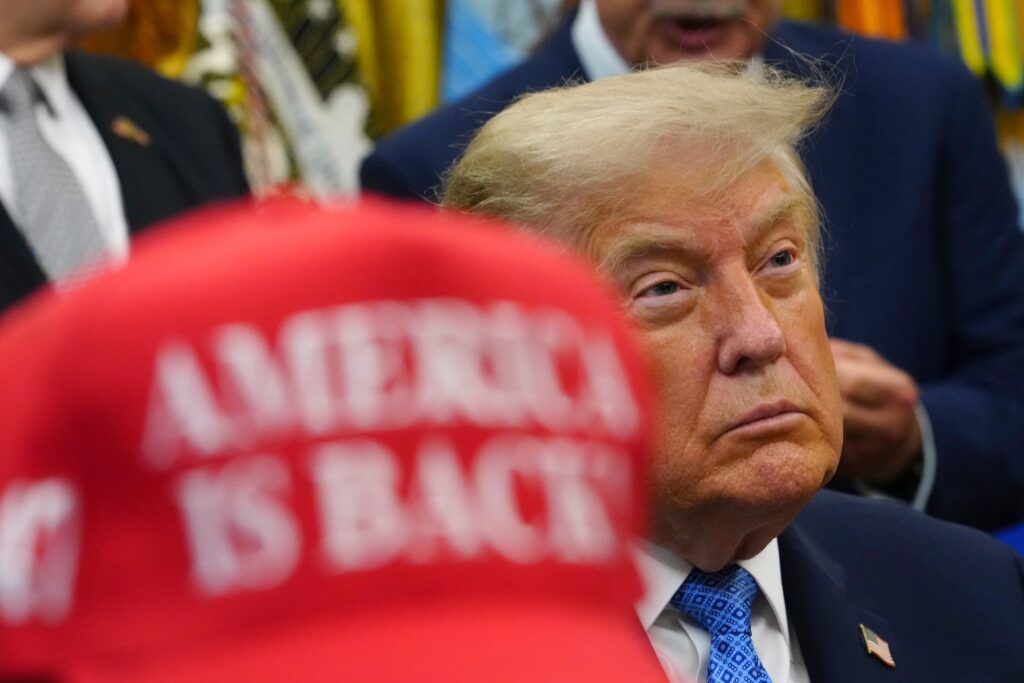
President Donald Trump’s multi-front attack on mail voting suffered a stinging judicial defeat Monday when the U.S. Supreme Court ruled against the GOP in Watson v. Republican National Committee.
It was the latest in a string of recent court losses for Trump’s attacks on free and fair elections.
While the Supreme Court’s ruling likely puts an end to one prong of the president’s attacks on voting, the battle isn’t over for Trump. He and his MAGA allies will now attempt to turn their fury at the courts into a catalyst for new federal and state voter suppression measures.
And they’re not being quiet about it. In the wake of Monday’s ruling, Trump again called on the Senate to pass his pet anti-voting legislation: the dead-on-arrival SAVE America Act.
“There is no excuse for a politician, or otherwise, to be against the above three requirements,” he thundered on social media. “There is only one reason to oppose — CHEATING!”
Trump takes a bruising in court
Despite repeatedly casting his own ballot by mail, Trump has baselessly blamed mail voting for his 2020 election loss. Upon his return to the White House, he declared war on the practice.
In March 2025, he issued a sweeping anti-voting executive order that attempted to pressure states into rejecting mail ballots that arrived after election day — an attack on the same kind of grace periods that the Supreme Court upheld in Watson. He also directed federal agencies to devote massive resources to uncovering and prosecuting the virtually nonexistent issue of noncitizen voting.
Get updates straight to your inbox — for free
Join 350,000 readers who rely on our daily and weekly newsletters for the latest in voting, elections and democracy.
In addition to Watson, the administration suffered a trio of defeats last week in its attempt to restrict mail ballots and expand the power of the executive branch over election administration.
First, a federal judge in Washington D.C. blocked the Department of Homeland Security’s (DHS) transformation of the Systematic Alien Verification for Entitlements (SAVE) program into a tool for checking voter registration rolls for noncitizens. Two days later, a U.S. District Court judge in Massachusetts permanently blocked some provisions in Trump’s first anti-voting executive order, including an attempt to force states to reject ballots that arrive after election day.
A day after that, another Massachusetts federal judge blocked federal agencies from implementing Trump’s second anti-voting executive order, which sought to force states to send DHS their voter registration lists and prevent the U.S. Post Office (USPS) from delivering mail ballots in states that didn’t.
While the administration is appealing those three rulings, legal experts doubt circuit courts will overturn the decisions given that the U.S. Constitution clearly empowers states and Congress — not the president — to run and oversee federal elections. Even if the appeals were ultimately granted, there would be little time left before the midterm elections for the administration to implement the mail-voting restrictions.
Assuming they stand, those decisions — together with Watson — spell doom for Trump’s hopes to throttle mail voting ahead of November.
Grace periods for all mail ballots postmarked by election day will remain in effect in 14 states and the District of Columbia, along with late-receipt protections for military and overseas voters in 29 states and D.C. And while the injunction on Trump’s second executive order may currently only apply to the 23 states that sued, forthcoming decisions in other legal challenges will probably lead to nationwide proscription.
Danger ahead for voting
But it wasn’t all good news for voting advocates Monday. The Supreme Court hinted that it would take up a case that could lead to thousands of mail ballots being rejected for minor mistakes on their return envelopes. And the Court agreed to hear the Republican National Committee’s (RNC) defense of a pair of Arizona laws that could disenfranchise voters. But decisions in those cases would come well after November’s midterms.
And dangers to mail voting remain. The USPS is changing its mail pickup procedures, which will lead to one- or two-day delays for delivery in rural areas. And whenever states take a long time to count votes — particularly mail votes — it will provide grist for conservative conspiracy mills, which will be used to justify state-level crackdowns on mail voting.
In the immediate wake of Watson’s release, right-wing influencers tried to galvanize conservative outrage in the hopes of turning one of the Supreme Court’s few disappointing decisions for their side into an electoral rallying call to rouse a listless Republican base.
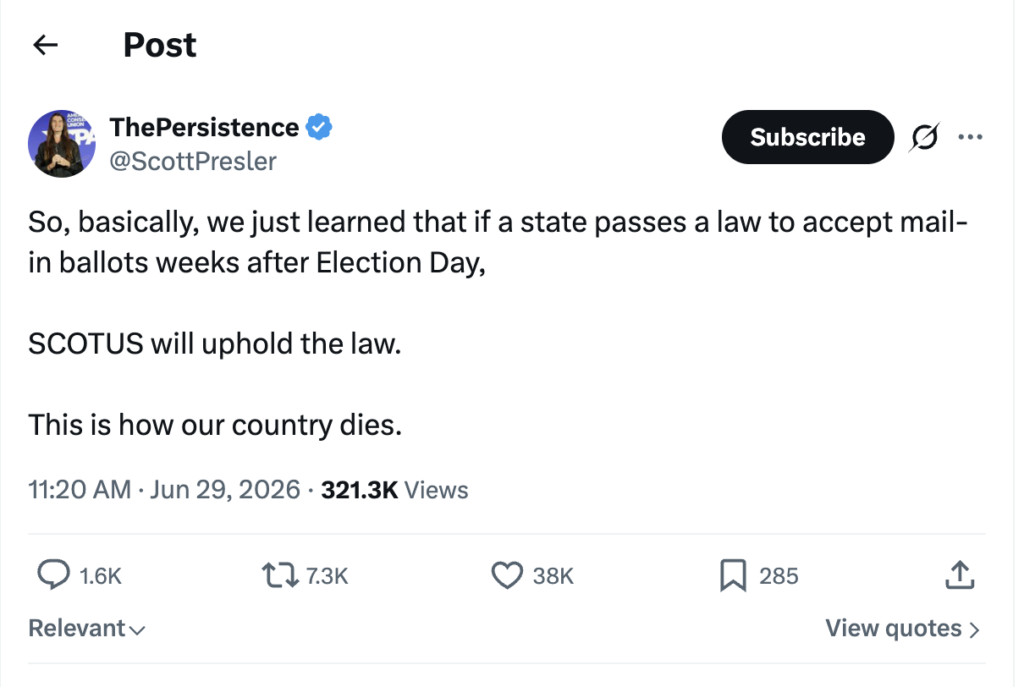
The Court’s decision will also encourage Republicans to redouble their efforts to pass new legislation restricting voting.
After news of the ruling broke, Sen. Eric Schmitt (R-Mo.) said on X that it represented “[a]nother reason we must pass the full SAVE American [sic] Act.”
While mail-in ballot grace periods have little to do with the contents of the SAVE America Act — the anti-voting package Trump desperately wants Congress to pass that would require documentary proof of citizenship when registering, photo ID when casting ballots, and would ban no-excuse mail-in ballots — that doesn’t mean the GOP won’t use Watson to push for its passage.
“In light of the tremendous loss in the Supreme Court today concerning Voter’s Rights, and the fact that ‘people’s’ votes are allowed to be counted LONG AFTER an Election is over, it is more important than ever to pass THE SAVE AMERICA ACT,” Trump posted on social media Monday afternoon.
“[O]ur five Republican Senate Hold Outs, Lisa Murkowski, Susan Collins, Thom Tillis, Bill Cassidy, and Mitch McConnell must vote to SAVE OUR COUNTRY,” Trump added, singling out the few Republican senators who have openly defied him on the legislation.
Despite the pressure, it’s unlikely the GOP opponents in the Senate will suddenly support the bill — and the extraordinary measures required to get around the filibuster to enact it by a simple majority. But that will not stop Trump’s MAGA allies from trying, and they won’t limit their efforts to Capitol Hill.
An hour after the Supreme Court handed down Watson, the Center for American Progress published a report on the GOP’s recent success in enacting new voter suppression measures in state houses across the nation. While the federal SAVE America Act has stalled in the Senate, 14 Republican-dominated state legislatures now have similar laws on the books, the CAP study found.
The RNC also swore to keep fighting after Watson. “If we want fair and secure elections, Election Day should mean exactly what it says, which is why this decision makes it even more imperative that Congress pass the SAVE America Act,” RNC Chairman Joe Gruters said in a written statement. “Democrats are inviting chaos at the ballot box by allowing elections to drag on for days and weeks after voters cast their ballots. Republicans are not going to be deterred by this decision, and the RNC will keep fighting to have elections end on Election Day as Americans want.”
In addition to the SAVE America Act, Republicans in Congress have introduced other bills that would end mail-ballot grace periods and impose other restrictions on voting. Those measures seem even less likely to advance than SAVE America. But should any of them become law, it’s more likely that they would survive judicial review.