House GOP passes sweeping anti-voting bill that could disenfranchise millions, sends measure to Senate
 Prefer us on Google
to see more of our voting rights news coverage when you search.
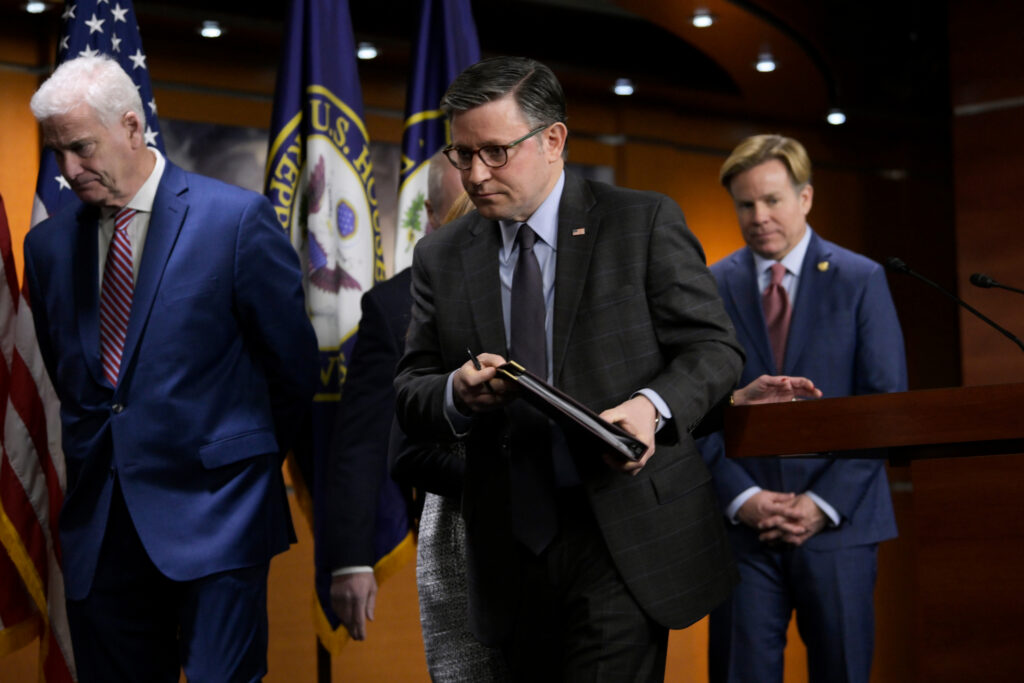
The GOP’s sweeping new anti-voting bill cleared the U.S. House Wednesday, setting up a high-stakes battle in the Senate.
The House voted 218-213 to pass the SAVE America Act, which experts have said could disenfranchise millions by requiring voters to show documentary proof of citizenship at registration and to provide photo ID when they cast ballots.
All Republicans present voted in favor of the bill. While all but one Democrat voted against it — Rep. Henry Cuellar of Texas.
Get updates straight to your inbox — for free
Join 350,000 readers who rely on our daily and weekly newsletters for the latest in voting, elections and democracy.
The proposal also directs election officials to conduct monthly voter roll purges to remove ineligible voters, which must utilize the Department of Homeland Security’s (DHS) Systematic Alien Verification for Entitlements program.
The GOP’s push for the measure was driven by blatantly false claims.
“They feel they’ve got to allow illegals to participate in elections so they can continue to win,” Speaker Mike Johnson said on Fox Wednesday. “We’ve got to stop that.”
Republicans have argued for voter ID broadly, pointing out that there isn’t much to prevent a noncitizen from casting a ballot in a federal election — besides the fact that it’s a felony, easily caught, and would lead to deportation all for the chance to cast one out of hundreds of thousands of votes.
There is, in fact, no evidence of noncitizens intentionally voting in significant numbers. Republican election officials have recently corroborated that with a series of lengthy reviews showing it’s a virtually nonexistent problem. Utah officials found just one noncitizen who was accidentally registered out of more than 2 million voters, while Idaho administrators identified 36 “likely” noncitizens. In 2024, Georgia uncovered only 24 noncitizens out of 8.2 million registered voters.
The SAVE America Act’s proof-of-citizenship requirements could potentially disenfranchise 21 million voters who lack ready access to a U.S. passport or a birth certificate to prove citizenship, according to a Brennan Center for Justice report.
The Center for American Progress estimates the measures would add voter hurdles for up to 100 million Americans.
Republicans counted that states that have introduced tough voter ID laws in recent years haven’t seen a drop off in votes. But that could be because of a partisan boomerang, firing up Democrats incensed by the new policies more than it keeps apathetic voters at home.
In recent weeks, GOP lawmakers have echoed President Donald Trump’s frequent demands for passing the bill, even as Trump has repeatedly said he wants to “take over” elections while once again spreading false conspiracy theories about the 2020 election.
Despite the GOP’s sudden sense of SAVE Act urgency, passage seems unlikely in the Senate, where it’s unlikely to clear the 60-vote threshold to break a filibuster.
Even though some of the bill’s Senate cosponsors have repeatedly demanded an end to the “zombie filibuster” and reinstatement of the talking filibuster, Thune has poured cold water on the idea. If the GOP brought the talking filibuster back, then Democrats would be able to gum up floor proceedings for months — perhaps even past November’s elections.
Senate Republicans said they’d get together this week to discuss the so-called “nuclear option.” But Sen. Thom Tillis (R-N.C.) told reporters Tuesday the pro-nuke crowd didn’t have the votes.
Even without the filibuster, it’s unclear whether Republicans have the votes in the Senate. Only 49 Republican Senators have come out in public support so far. And Sen. Lisa Murkowski (R-Alaska) posted her opposition on social media Tuesday, saying, “one-size-fits-all mandates from Washington, D.C., seldom work in places like Alaska.”
Alternatively, some Republicans want the SAVE America Act to hitch a ride on a must-pass bill, like the DHS appropriations bill for the current fiscal year or a reauthorization of the Foreign Intelligence Surveillance Act. But that would make already fraught bipartisan negotiations that much more difficult.
Ahead of the vote, the GOP adopted a “manager’s amendment” from House Administration Chairman Bryan Steil (R-Wisc.) that clarified the effective date on the SAVE America Act would be the enactment date.
His counterpart on House Administration, Rep. Joe Morelle (D-N.Y.) argued that if the law were enacted this year, it would be impossible for election officials to comply with it, given that primary elections have already begun in a number of states.
After Democrats noted that the bill’s original documentary proof of citizenship requirements to cast a ballot would block voters from simply using their driver’s license, Republicans amended that element to allow any government-issued ID work. Registrants will still need to prove citizenship. In most states, that would require showing a U.S. passport or a driver’s license along with a birth certificate. (Only five states use “enhanced” identification cards that provide citizenship proof.)
Under the proposal, voters submitting mail in ballots would need to send in a copy of their identification, except for the disabled and military service members stationed abroad and their spouses — other Americans living abroad, treated mostly the same as the military under the Uniformed and Overseas Citizens Absentee Voting Act, would still need to send in ID copies.
Speaking at a Rules Committee hearing Tuesday, Steil argued that the legislation would allow voters who had changed their names — without also updating their identification documents — to still vote by signing an affidavit.
Morelle needled Steil for all the last second changes to the proposal. “You told us the SAVE Act was just fine, now you scramble to apply some band aids and push it out the door in your rush to hand over control of the election to President Trump,” Morelle said. “So how can the American people trust any of this? This is amateur hour.”
Republicans have long supported stricter ballot laws, while Democrats have backed permissive voting policies, under the theory that less-active voters — the kind who are unlikely to fill out the extra paperwork to update their registration — usually vote blue. But since Trump took over the GOP, some political pundits argue that may no longer be true.
On Tuesday, the House Administration Committee held a hearing on another GOP voter ID bill, the Make Elections Great Act.
The House passed a narrower version of the SAVE Act in April 220-208, four Democrats — Reps. Ed Case of Hawaii, Henry Cuellar of Texas, Jared Golden of Maine and Marie Glusenkamp Perez of Washington — voted for it.
At a House Administration Committee hearing Tuesday, Chairman Bryan Steil (R-Wisc.) described his Make Elections Great Again (MEGA) Act as a common sense measure to secure elections against the nefarious threat of widespread noncitizen voting — a virtually nonexistent problem.
Steil introduced a more comprehensive MEGA Act would do all that, plus prevent states from counting ballots that arrive after Election Day, ban universal mail voting, in which states mail a ballot to all registered voters, bar the federal funding for voter registration by outside groups, and authorize lawsuits against election officials.
Voter ID polls well with the electorate, even as experts warn it’s a solution in search of a problem, but so do the pro-voting policies the MEGA Act would ban, like universal mail-in ballots.
Republicans have long backed stricter ballot laws, and Democrats more permissive, under the belief that less-engaged voters — who are less likely to put in the work to fix a faulty registration — tend to lean left. But some political pundits have questioned that, arguing that stopped being true when Trump took over the GOP.
The measures documentary proof of citizenship requirements would particularly burden the roughly 69 million married women who took their husband’s name — a group that leans to the right.
Over the weekend, Sen. John Fetterman (D-Pa.) said he supports voter ID, but added that he doesn’t expect any version of the SAVE Act to make it past the filibuster. Besides Fetterman, Democrats seem uniformly opposed, with Senate Minority Leader Chuck Schumer (D-N.Y.) calling the proposals “Jim Crow type laws” that would be a “poison pill that will kill any legislation that it is attached to.”