In about-face, DOJ says it has ‘no problem’ with block on federal agents as poll monitors
 Prefer us on Google
to see more of our voting rights news coverage when you search.
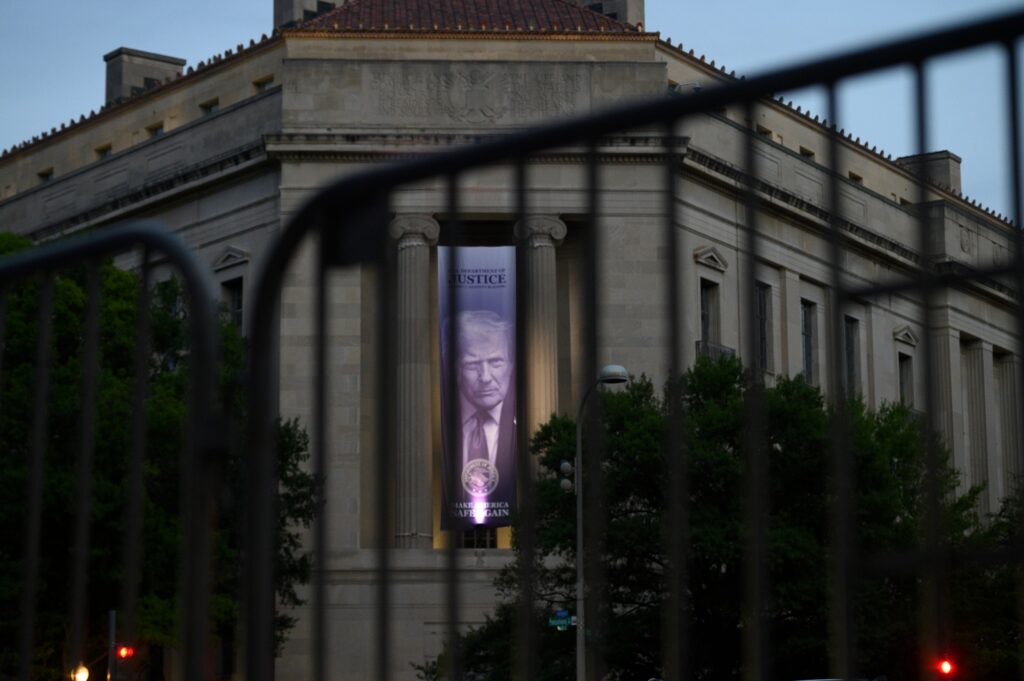
The Department of Justice (DOJ) told a federal judge Monday that it would have “no problem” with a court order preventing it from deploying law enforcement agents as poll monitors on Election Day.
“The defendants would have no problem with an injunction that would require DOJ to take reasonable efforts to exclude sworn officers from serving as polling monitors,” Justice Department attorney Kathryn Barragan told U.S. District Judge Reggie Walton.
It was an abrupt shift for the department.
Recent court declarations have said law enforcement officials could be dispatched in DOJ’s unprecedented effort to watch the polls Tuesday with around 1,000 monitors.
Get updates straight to your inbox — for free
Join 350,000 readers who rely on our daily and weekly newsletters for the latest in voting, elections and democracy.
The about-face came in a hearing to consider the NAACP’s emergency request that Walton bar personnel from law enforcement agencies from serving as monitors. Alternatively, the NAACP asked the judge to prohibit agents from carrying firearms, badges, camera equipment or conducting law enforcement activities if they do serve as monitors.
Walton appeared skeptical of the DOJ’s defense of its monitoring effort, though he also didn’t know if the NAACP had adequately shown the potential for irreparable harm needed for their request.
Walton, who was nominated by former President George H.W. Bush, said he would try to issue a ruling on the matter by 5 p.m. ET Monday.
Throughout the hearing, there was confusion over whether law enforcement agents would be deployed as monitors. A recent court declaration from Eric Neff, who leads the Civil Rights Division’s Voting Section, in a separate NAACP lawsuit heavily indicated they would be.
In that declaration, Neff said “employees” from the Bureau of Prisons (BOP), Drug Enforcement Administration (DEA) and Bureau of Alcohol, Tobacco, Firearms and Explosives (ATF) would watch polls Tuesday. He added that “those employees are prohibited from having any firearms with them, and they are prohibited from undertaking any action while monitoring” — a qualification that heavily implied that the employees would be sworn federal law enforcement agents.
Neff added that, while serving as monitors, the BOP, DEA and ATF employees “will not be acting as ‘law enforcement personnel,’ a ‘law enforcement officer,’ or a ‘law enforcement agent’ as commonly understood.”
In the hearing, Barragan told Walton that the BOP, DEA and ATF employees will be administrative or clerical personnel and that the Civil Rights Division took efforts to exclude law enforcement officials from its monitor efforts.
Walton noted that Barragan’s claim “appeared to be an inconsistency” from Neff’s declaration. He also reminded the DOJ of the dangers of making false representations to a court.
“I would have to hope and assume that an officer of the court would not misrepresent the reality of who these monitors are gonna be,” Walton said. “Because if there is some type of misrepresentation — and I don’t suggest there is — obviously there’d be hell to pay.”
Whether federal agents will be deployed is key, as it would mark a severe departure from previous election monitoring efforts. Past departments have used the DOJ’s election monitoring program to ensure voters have adequate access to polls as required by federal voting laws. To that end, they have sent civil attorneys or legal support staff from the Voting Section of the DOJ’s Civil Rights Division, not prosecutors or law enforcement agents.
The DOJ under President Donald Trump, however, sent both prosecutors and a law enforcement official to monitor primary elections earlier this year.
The DOJ did provide a few more details on the scope of its monitoring push. Barragan said it will involve “around 900” people — roughly 300 more than the number of monitors the Biden administration sent out during the 2024 presidential election.
When Walton pressed for why the monitor program was expanded to potentially include employees from law enforcement agencies, Barragan said she would provide more details by the end of the day.
The judge ordered the DOJ to also give him more details on how the locations the monitors will be sent were determined. He appeared to fear they could have been selected based on politics.
“I would hope that in our country that that would not be the norm by which locations are identified to have monitors,” he said.
Pointedly, he said he had “concerns” about the monitoring push in the context of the Trump administration’s lawsuits against the electoral process.
“I do have concerns,” he said. “But those concerns, I don’t know if they rise to the level of me being able to conclude that the plaintiffs have met that high burden of showing potential of irreparable harm.”