NAACP asks court to block DOJ from deploying federal agents as election monitors
 Prefer us on Google
to see more of our voting rights news coverage when you search.
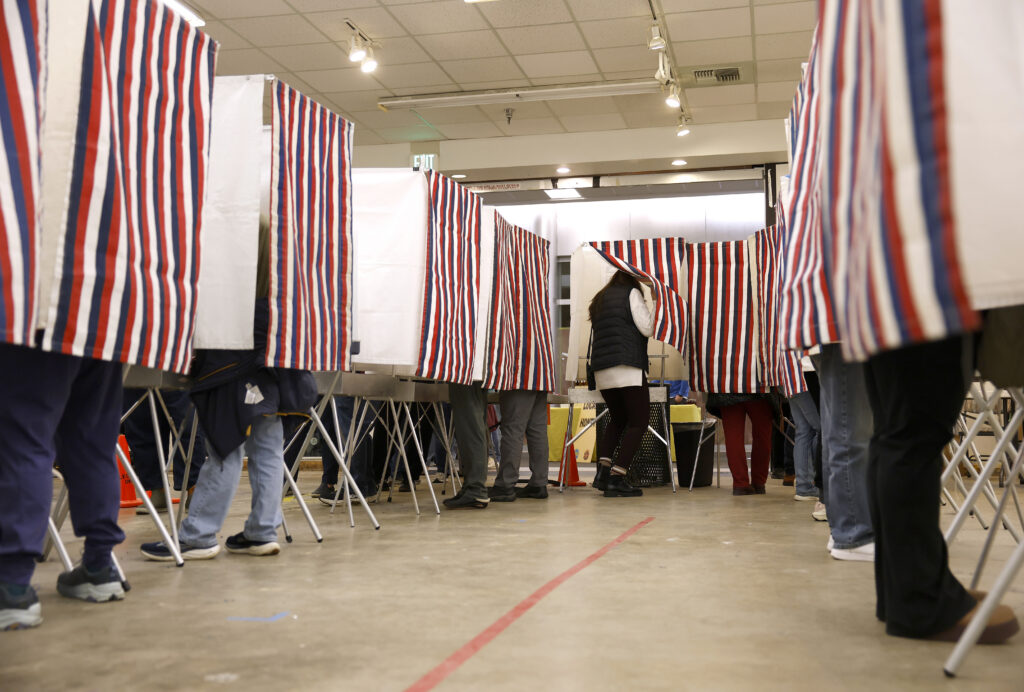
The NAACP asked a federal court to bar the Department of Justice (DOJ) from dispatching federal agents as part of its plan to deploy at least 1,000 election monitors across the country Tuesday.
In a filing Sunday, the civil rights groups cited recent statements from a senior official in the DOJ’s Civil Rights Division indicating that federal agents from several different federal law enforcement agencies could be used to watch the polls on Election Day.
“On October 28th, the Department of Justice … confirmed that it will deploy personnel from federal law enforcement agencies including the Bureau of Prisons (‘BOP’), Drug Enforcement Administration (‘DEA’), and the Bureau of Alcohol, Tobacco, Firearms and Explosives (‘ATF’) to polling sites across the country as poll monitors,” the NAACP said in its filing.
Get updates straight to your inbox — for free
Join 350,000 readers who rely on our daily and weekly newsletters for the latest in voting, elections and democracy.
Specifically, the NAACP is asking U.S. District Judge Reggie Walton to issue a temporary restraining order barring the Trump administration from assigning agents, officers or personnel from federal law enforcement agencies to serve in the DOJ’s election monitoring program.
Alternatively, the group requested that Walton, whom former President George H.W. Bush nominated, prohibit agents from carrying firearms, badges, camera equipment or conducting law enforcement activities while serving as monitors.
Walton ordered a hearing Monday at 1:30 p.m. ET on the NAACP’s motion.
The NAACP cited a recent declaration from Eric Neff, an attorney with a web of ties to election-conspiracy theorists who leads the Civil Rights Division’s Voting Section. In it, Neff claimed that the DOJ’s plan to deploy 1,000 monitors will be no different from the department’s practices during past races. He made that claim while disclosing an unprecedented departure from the department’s past monitoring efforts: the possible use of federal agents.
Neff said “employees” from the BOP, DEA and ATF would watch polls Tuesday. However, he also said that “those employees are prohibited from having any firearms with them, and they are prohibited from undertaking any action while monitoring” — heavily implying that those employees are law enforcement agents.
“Thus, while monitoring, the monitors will not be acting as ‘law enforcement personnel,’ a ‘law enforcement officer,’ or a ‘law enforcement agent’ as commonly understood,” Neff asserted.
In its filing Sunday, NAACP argued that the DOJ’s plan to deploy federal agents as monitors violates the Voting Rights Act’s prohibition on voter intimidation and marked a “whole cloth change” of the Civil Rights Division’s election monitoring program.
“Simply put, Defendants’ plans to deploy any federal law enforcement agent, investigator or personnel for the November 3, 2026, general election constitutes unlawful voter intimidation,” its filing read.
NAACP highlighted that the DOJ reported this year that almost all BOP employees are credentialed law enforcement agents, meaning any BOP employees deployed as monitors will likely be law enforcement officials.
Beyond Neff’s declaration, the civil rights group also noted that the Trump administration has already used federal law enforcement agents to pressure California election officials not to count ballots cast by people the federal government claims are noncitizens, and that election officials in other states have reported law enforcement officials stationed near election sites..
Documents obtained by Democracy Forward* earlier this year indicated the DOJ deployed at least one law enforcement official — an FBI agent — as a monitor during Arizona’s July primary election. Though the agent was detailed to the DOJ at the time, he was still a sworn federal law enforcement officer when he was selected to monitor the primary vote in Maricopa.
The DOJ’s decision to send criminal prosecutors to monitor primaries earlier this year also marked an abnormal departure from previous election monitoring efforts.
Past departments have used the DOJ’s election monitoring program to ensure voters have adequate access to polls as required by federal voting laws. To that end, they have sent civil attorneys or legal support staff from the Voting Section of the DOJ’s Civil Rights Division, not prosecutors or law enforcement agents.
*Democracy Docket Founder Marc Elias is the chair of Democracy Forward’s board.