Trump and his allies will lie about voting on Election Day and afterwards. Here’s how to be ready
 Prefer us on Google
to see more of our voting rights news coverage when you search.
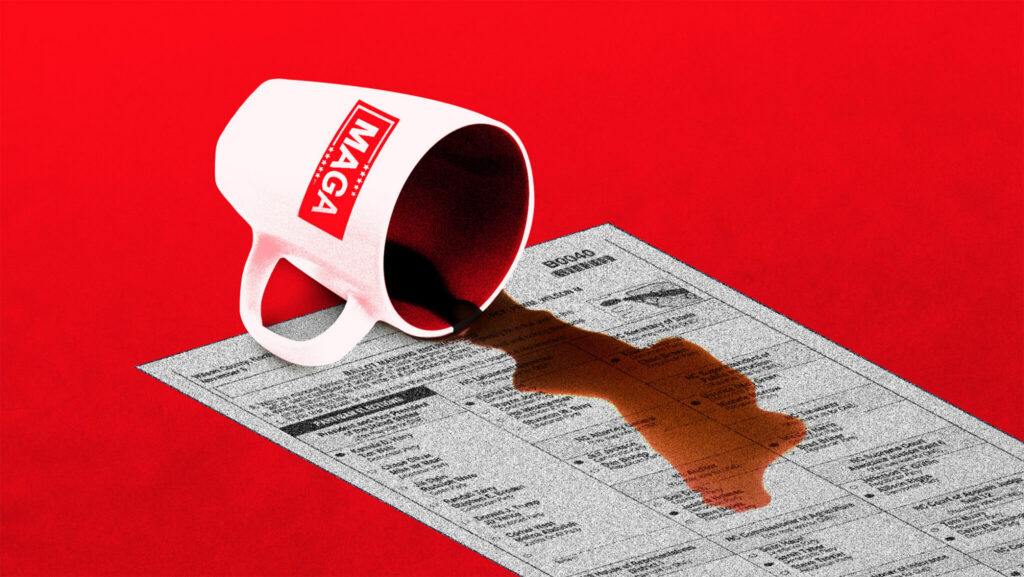
It isn’t hard to predict: By the time polls close Tuesday, President Donald Trump and his allies will have spread a slew of false and dangerous election conspiracy theories online.
They’ll be shrieking about late-arriving mail ballots. They’ll be falsely claiming votes from noncitizens have corrupted the midterms. They’ll be attacking election workers, as they count votes, for somehow rigging the result. And much more.
So keep in mind: Some races may take days or longer to be counted. A candidate’s lead may shrink or disappear as different batches of ballots are counted. Mail ballots cast on time may arrive after Election Day. None of those things are evidence of fraud.
But ordinary election procedures can look suspicious when stripped of context. And Trump and MAGA — with polls showing the GOP headed for a major defeat — will aim to exploit that confusion to portray routine events as evidence of a coordinated effort to rig or steal an election.
So before the first viral images or claims of a “stolen” race begin ricocheting across social media, here are some of the most predictable myths Americans are likely to hear on Election Day and in the days that follow — what those claims leave out and what’s actually happening.
Get updates straight to your inbox — for free
Join 350,000 readers who rely on our daily and weekly newsletters for the latest in voting, elections and democracy.
‘If we don’t know the winner on election night, something is wrong’
One of the most predictable claims this week will be that an election is suspicious simply because the winner is not known Tuesday night.
Expect variations of the same rhetoric Tuesday night: “Why are they still counting?” “They found another batch of ballots.” “The lead changed overnight.”
Election Night results are preliminary by definition. Election officials may still be counting mail ballots, provisional ballots and votes from military and overseas voters for days afterward, depending on state law.
Some states also require additional time to verify ballots, cure defects, conduct canvasses and audit results before they become final. The U.S. Election Assistance Commission says plainly that election-night results are “unofficial and never final.”
That has not stopped the claim from spreading before voting is even finished.
On Saturday, PBS NewsHour shared a PolitiFact explainer noting that it is normal to go to bed without knowing the winner of a congressional race — and normal for a candidate who was trailing to later pull ahead as more ballots are counted.
The White House’s Rapid Response account replied: “No, it isn’t.”
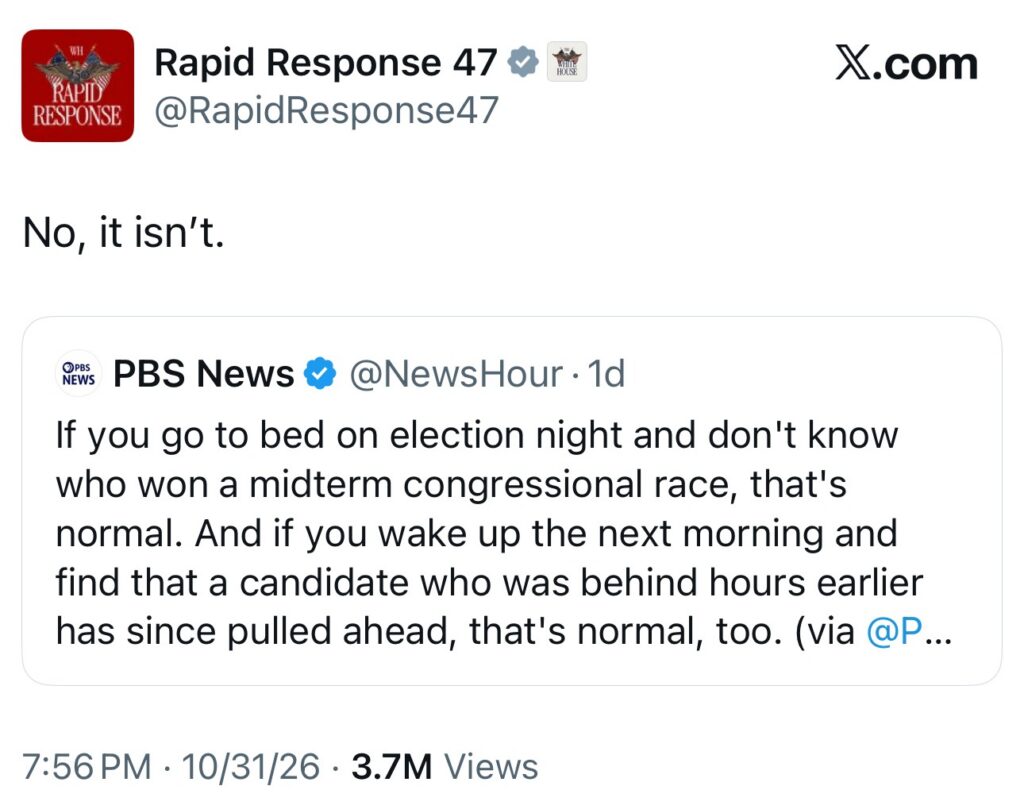
The response makes clear, if it wasn’t already, how Trump intends to falsely cast doubt on results as a centerpiece of his election night message.
‘Ballots counted after Election Day are illegal votes and evidence of cheating’
A ballot counted after Election Day is not a ballot cast after Election Day.
That distinction is crucial. States set different deadlines for when mail ballots must arrive. Thirty-five states generally require mailed ballots to be received by Election Day, while 15 states and Washington, D.C., allow at least some ballots that were cast and postmarked on time to arrive afterward and still be counted.
The U.S. Supreme Court settled a major fight over those rules in June. In Watson v. Republican National Committee, the Court ruled that those states can continue accepting ballots that arrive after Election Day, after the GOP tried get the practice banned.
Those deadlines are one reason vote totals can continue changing for days. California, for example, accepts qualifying mail ballots for seven days after Election Day. Election officials also continue reviewing provisional, military and overseas ballots after polls close.
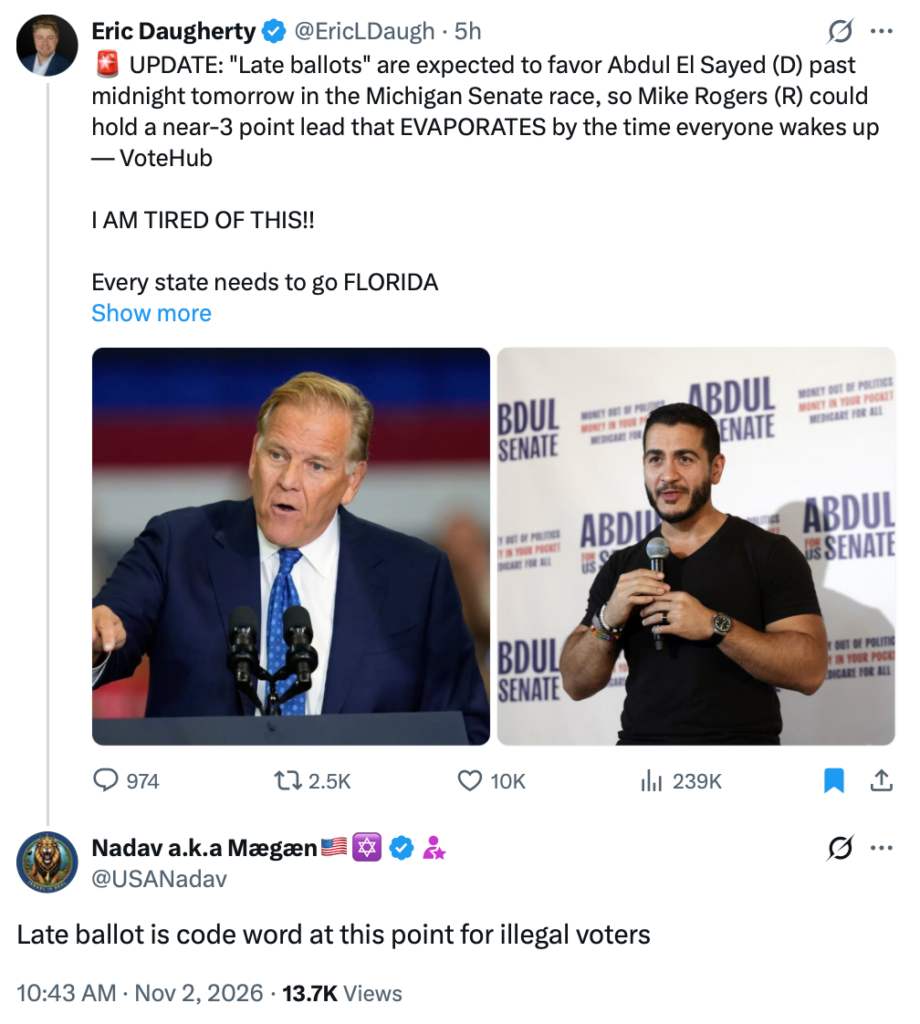
And rhetoric casting those later-counted votes as illegitimate has already started. On Monday, a prominent right-wing social media account claimed that Republican Mike Rogers could hold an early lead in Michigan’s U.S. Senate race only to see it “EVAPORATE” as later results were reported. That prompted many other accounts to reply that “late ballot” had become a “code word” for illegal voters.
But Michigan does not accept ordinary absentee ballots that simply arrive late. They generally must reach local clerks by 8 p.m. on Election Day. What can arrive late in the count are results from places such as Detroit, Ann Arbor and other large, Democratic-leaning areas, including batches of absentee ballots that take longer to process and report.
So when vote totals increase after Tuesday, you can expect claims that officials are “finding” new votes or counting ballots that should have been rejected.
They aren’t. What matters is not when a ballot appears in the unofficial tally, but whether it was cast and received according to that state’s law.
A vote counted late is not the same thing as a vote cast late.
‘Noncitizens are voting in huge numbers and deciding elections‘
Noncitizens are barred from voting in federal elections, and people who knowingly do so can face criminal charges. The Trump administration has made such cases a major focus of his agenda, announcing prosecutions across multiple states and saying its nationwide investigations have led to about 160 arrests since January 2025.
But despite its aggressive efforts, The cases identified so far represent a tiny fraction of the more than 200 million active registered voters nationwide. And repeated investigations continue to find that noncitizen voting is exceptionally rare and has never changed an election outcome.
The distinction has become especially important this fall because federal agencies are using immigration and voter-registration databases to identify people they say may be noncitizens.
In California, for example, the Department of Justice sent the state a list of more than 20,000 registered voters it said were likely noncitizens and asked officials to set aside their ballots. But an analysis filed in court by the UCLA Voting Rights Project found that 42% of the names did not match anyone on California’s current voter file. It also identified U.S. citizens on the list, and concluded that thousands of naturalized citizens were likely wrongly flagged. DOJ disputes that analysis. Courts have so far rejected federal demands to segregate the ballots.
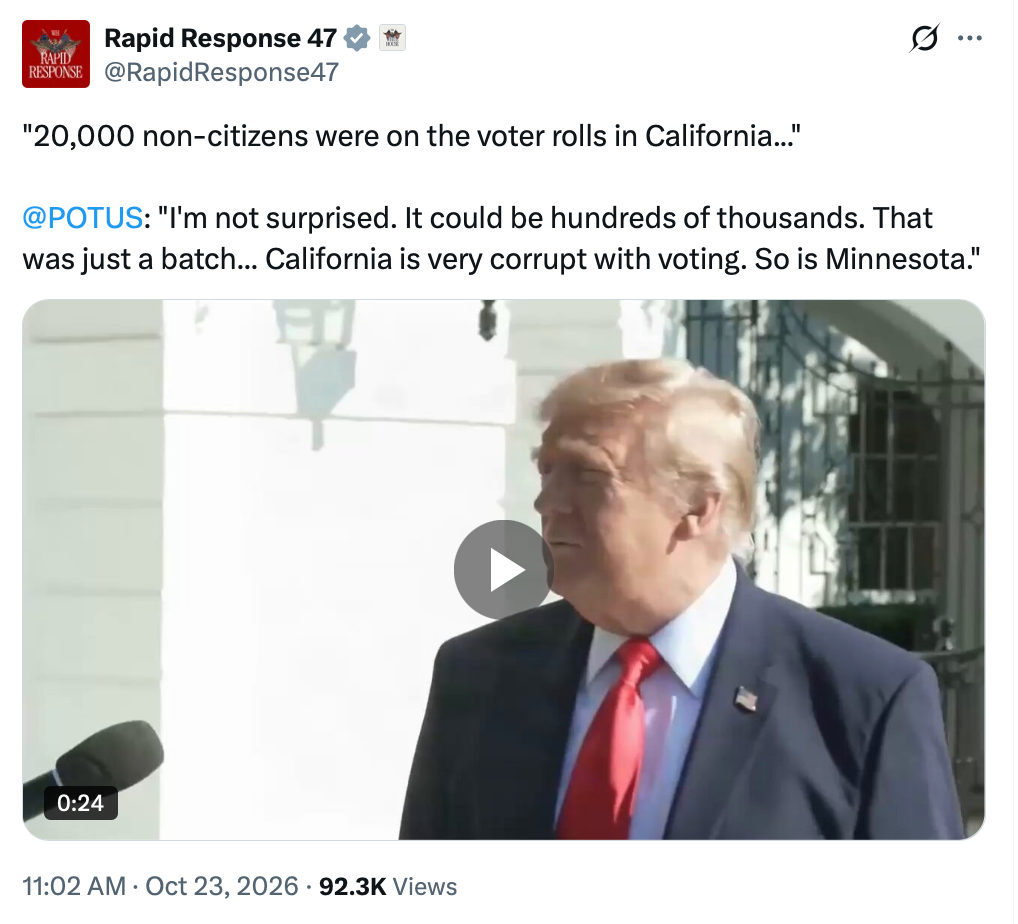
Trump has already used that disputed list to suggest the problem is vastly larger. Asked about the 20,000 names on Oct. 23, he said he was “not surprised” and claimed the true number “could be hundreds of thousands,” calling the 20,000 “just a batch.” He offered no evidence for that extrapolation and went on to call voting in California and Minnesota corrupt.
The episode illustrates how quickly a list of people merely suspected of being noncitizens can be transformed into a claim that hundreds of thousands of illegal voters exist. The government’s list itself has now been shown to contain apparent citizens, naturalized citizens and names that could not even be matched to California’s current voter file.
So expect to hear large numbers attached to phrases like “suspected noncitizens” or “potentially ineligible voters.”
Those phrases are not interchangeable with cases of confirmed noncitizens who actually cast ballots.
Being flagged by a database is not proof someone is ineligible. Being improperly registered does not prove that person voted. And isolated cases of unlawful voting are not evidence of a coordinated scheme capable of determining an election.
‘Mail voting makes it easy to manufacture, duplicate or steal ballots’
Claims that mail voting allows people to easily create fake ballots, vote twice or steal someone else’s ballot ignore the essential safeguards used before a returned ballot is counted. You might see viral photos or videos of ballots found in apartment buildings, mailrooms or other locations, with the claim that it must be evidence of illegal voting.
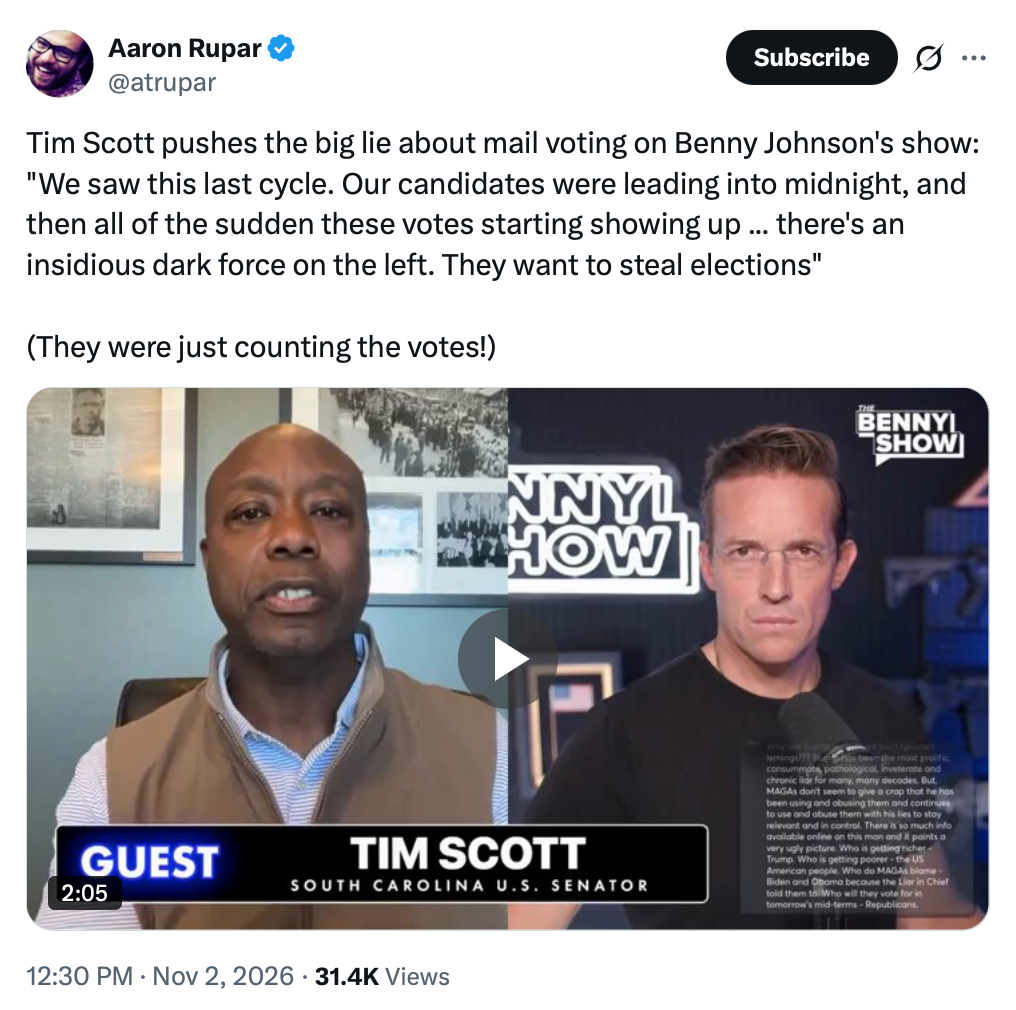
Leading Republicans are also already portraying the ordinary pattern of later-counted mail ballots as something more sinister. In an interview with right-wing host Benny Johnson circulating Sunday, Sen. Tim Scott (R-S.C.) recalled Republican candidates leading around midnight in a previous election before additional votes were reported and alleged that an “insidious dark force” on the left wanted to “steal elections.”
But a candidate losing an early lead as mail ballots are added does not show that ballots were manufactured or stolen. Different types of ballots are processed and reported at different times, and mail voters can have different partisan preferences than people who vote in person. The changing total reflects which lawful votes have been counted so far, not where the ballots supposedly came from.
It isn’t. Election officials track whether a voter has already returned a ballot, and states use measures such as unique ballot identifiers, voter records, signature verification and chain-of-custody procedures to detect duplicate or suspicious submissions. If a voter returns a mail ballot and later tries to vote again, election systems are designed to prevent two ballots from being counted.
Mistakes, theft and isolated fraud can happen, and election officials investigate those cases when they do. But the existence of unused or misdelivered ballots is not evidence that fraudulent votes entered the count. Just as noncitizen voting is extremely rare, so are other forms of illegitimate voting, including those done by manipulating mail ballots.
The important question is whether a ballot was actually returned, verified and accepted — not simply whether election mail existed somewhere it should not have.
‘Election workers are secretly altering, destroying or manufacturing ballots’
Election workers routinely handle, inspect, duplicate, sort and transport ballots as part of counting them. Those procedures can look suspicious in a short video or photo when the surrounding process is missing.
A damaged ballot, for example, may need to be duplicated onto a clean ballot so a scanner can read it. Workers may also open mail-ballot envelopes, separate ballots from identifying information, reconcile batches and transport sealed containers between secure locations. Those steps are governed by state procedures and are typically conducted under observation or bipartisan controls.
But routine election work has repeatedly been portrayed as evidence that officials are secretly creating or destroying votes.
After the 2020 election, Georgia election workers Ruby Freeman and Shaye Moss became the targets of false fraud allegations after surveillance footage of normal ballot counting was circulated out of context. The claims led to years of threats and harassment, and the two later won a defamation judgment over the accusations.
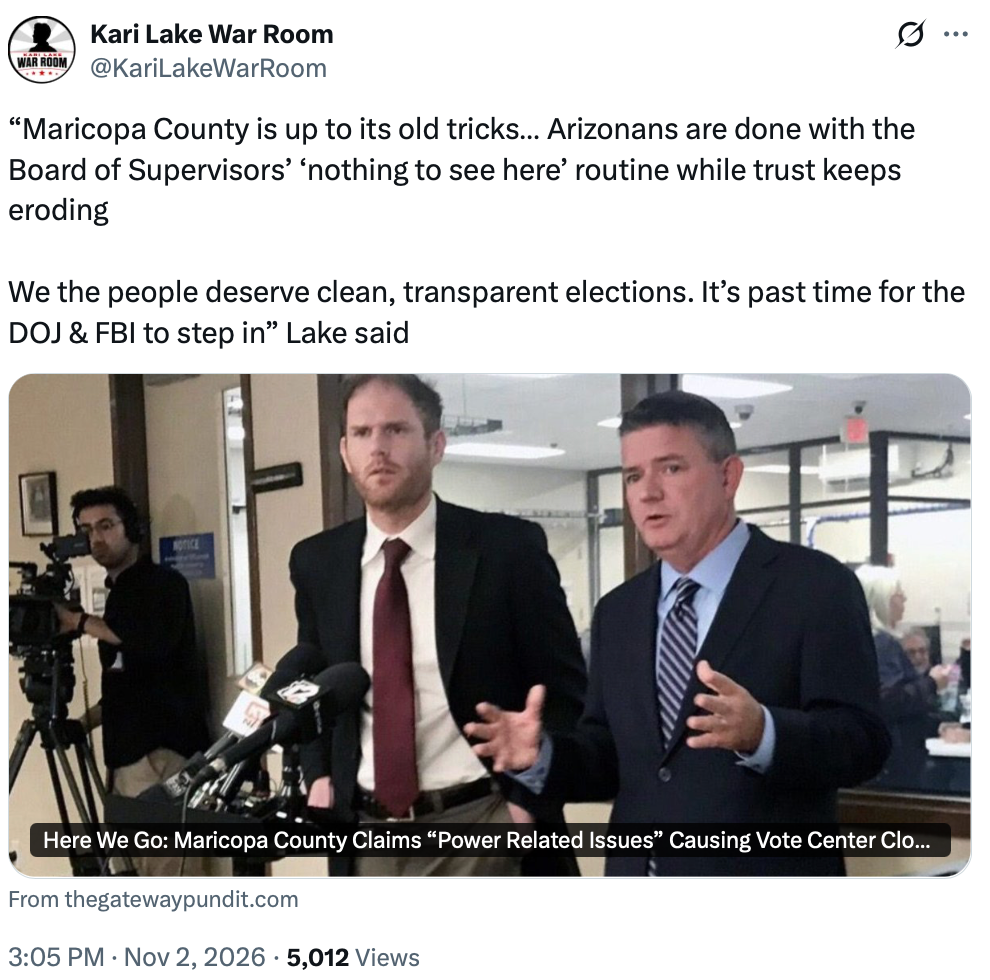
And mundane election disruptions are already generating similar suspicions this year. On Monday morning, two of Maricopa County’s roughly 150 vote centers temporarily closed because of power problems. Both reopened that morning, and voters could use any other county vote center in the meantime. Yet the outages quickly fed online speculation about election interference and renewed calls for federal authorities to scrutinize the county.
A power outage, scanner problem or temporary polling-place closure can be a genuine problem that election officials have to fix. But the existence of a problem is not evidence that workers deliberately created it to suppress or alter votes.
Similar claims are expected again this year, including allegations that workers are stuffing ballot boxes, destroying valid ballots or manufacturing mail votes.
A video showing an election worker touching or reproducing a ballot is not proof of fraud. The questions are what procedure is being performed, whether state law allows it and whether required chain-of-custody and observation rules were followed.
‘Officials can refuse to certify the results if they suspect fraud’
Local election officials do not get to overturn or veto results because they distrust them.
Certification is typically a mandatory, ministerial duty: Officials review the completed canvass and formally sign off on the results by deadlines set in state law. Claims of fraud, misconduct or ineligible ballots are handled through separate legal processes, such as recounts, election contests and court challenges. Certification is not supposed to become an investigation of every allegation circulating online.
That has not stopped officials from trying.
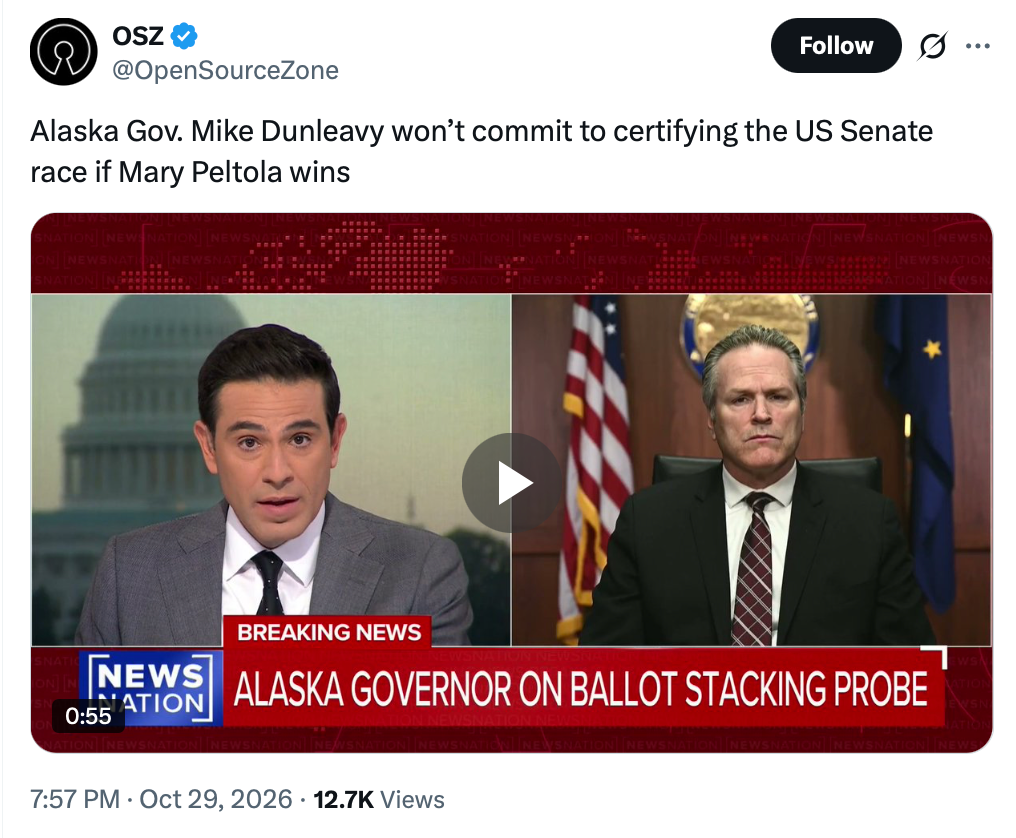
And in Alaska, that possibility is already being discussed before Election Day. Gov. Mike Dunleavy (R) declined last week to commit to signing off on the U.S. Senate result if Democrat Mary Peltola defeats Sen. Dan Sullivan (R) while a state investigation into allegations of “ballot stacking” remains open. Dunleavy claimed that if investigators find wrongdoing and “that means that the certification then is stopped or changed, then that’s what happens.”
But Alaska law does not give the governor discretion to decide who won the election. The state elections director is required to certify the candidate with the most votes after the official review. The governor has a separate federal duty to transmit the Senate winner’s credentials, and even withholding those credentials would not give him the final word: under the Constitution, the U.S. Senate judges the elections and qualifications of its own members.
Since 2020, local officials in states including Arizona, Michigan, New Mexico and Nevada have refused or threatened to certify results, often citing fraud claims or distrust of voting systems. And there were at least 17 attempts to interfere with certification during the 2024 election cycle alone. None succeeded in preventing the results from ultimately being certified. Courts and state officials intervened when necessary.
Courts can order reluctant officials to perform their legal duties, and some states allow officials to step in directly. Officials who refuse can also face removal or, depending on state law and the circumstances, civil or criminal consequences.
So expect to hear that a county’s refusal to certify proves something must be wrong with its election.
It doesn’t.
A certification standoff can delay results, trigger emergency litigation and fuel conspiracy theories. But an official’s personal suspicion is not evidence of fraud — and in most states, it is not legal authority to withhold certification.