Gerrymander foes urge Supreme Court not to revive GOP map in Missouri
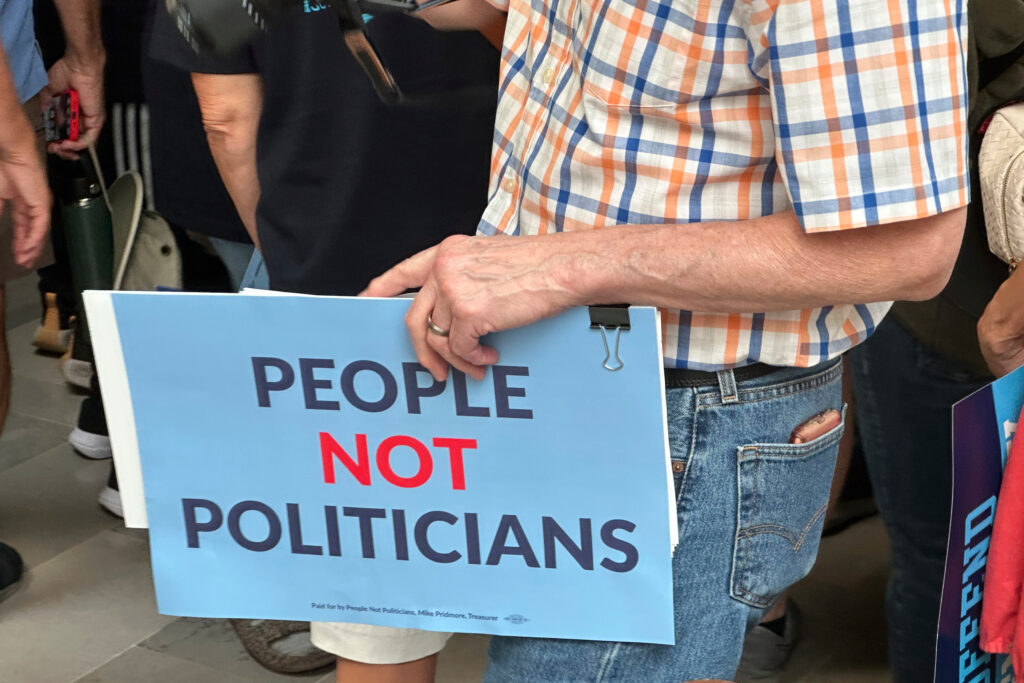
Gerrymandering opponents urged the U.S. Supreme Court on Monday not to restore a Republican-backed congressional map in Missouri for the midterms, arguing that the “adequate and independent state ground doctrine” renders the case unreviewable by federal courts.
Under that doctrine, the Supreme Court has no jurisdiction to review the case given that the Missouri Supreme Court’s unanimous ruling against the gerrymander last Thursday was not dependent on federal laws – the ruling was decided on state constitutional grounds.
Republican state officials on Friday asked the Supreme Court to overturn the Missouri Supreme Court’s ruling, which barred the gerrymander from going into effect until approved by voters and allowed a referendum on the issue to go onto the November ballot.
That referendum was authorized by the Missouri constitution, which allows voters to veto legislation if they gather enough signatures to put it to a direct vote. Roughly 100,000 signatures were needed to pause the gerrymander, officially known as HB 1. The gerrymandering opponents, People Not Politicians (PNP)*, collected more than 300,000 signatures last year, which invalidated the HB 1 law, as was decided by the Missouri Supreme Court.
Get updates straight to your inbox — for free
Join 350,000 readers who rely on our daily and weekly newsletters for the latest in voting, elections and democracy.
“The Attorney General is asking the Supreme Court of the United States to create a law that has never been the law in Missouri,” Richard von Glahn, PNP executive director, said in a statement. “It is an absurd request for a complete undoing of how laws are created. I am appalled that our Attorney General would seek to strip Missouri voters of their lawmaking authority in such a brazen power grab.”
Republicans drew the map last fall in response to President Donald Trump’s call for red states to redistrict to help the GOP gain extra seats in the U.S. House. It eliminated a majority-Black congressional district in Kansas City, which would have increased the GOP’s edge in the state’s congressional delegation from 6-2 to 7-1.
The seat is currently held by Rep. Emanuel Cleaver (D-Mo.), who has represented the district for 21 years*.
However, Secretary of State Denny Hoskins (R) delayed certification of the signatures until August, claiming that the veto provision in the constitution doesn’t apply to redistricting cases.
“Missouri’s Secretary of State waited until the last possible day—and only after he had implemented HB 1 in the congressional primary—to object to the referendum, in the hopes of running out the clock on the judiciary’s tolerance for a last-minute reversion to the 2022 districts,” von Glahn’s opposition brief reads. “Now that the Missouri Supreme Court has rejected his gambit, he asks this Court to deliver him the political victory to which he was never entitled under the Missouri Constitution. This Court cannot and should not reward the Secretary’s scheme to outsmart Missouri voters, Missouri law, and the Missouri Supreme Court by granting Applicants the extraordinary relief they seek.”
*The Elias Law Group (ELG) represents pro-voting parties in this case. ELG Firm Chair Marc Elias is the founder of Democracy Docket.
*Correction: This sentence originally said that Cleaver is the state’s only Black member of Congress. In fact, he is one of two — the other is Rep. Wesley Bell (D).