Blue states urge Supreme Court to uphold block on Trump’s anti-mail voting order
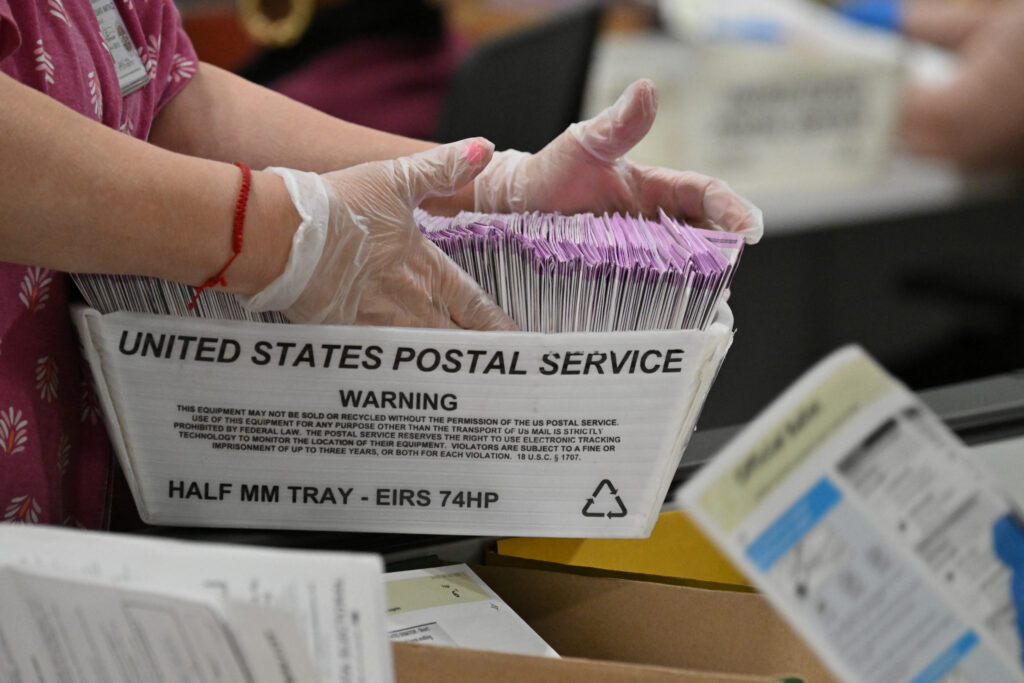
Almost two dozen Democratic-led states asked the U.S. Supreme Court Monday to uphold a block on President Donald Trump’s sweeping attack on mail voting, saying it poses “extraordinary threats to our democracy.”
In a new filing Monday, attorneys general from 22 states and the District of Columbia plus Pennsylvania Gov. Josh Shapiro (D) opposed the Department of Justice’s (DOJ) and a dozen Republican-led states’ recent emergency appeals asking the Court to let Trump move forward with restrictions on mail voting before the midterm elections in November.
The states and D.C. warned that lifting the block now “would allow the federal government to rush out an unprecedented, legally indefensible voter-verification and ballot-interception program that would, among other things, give the U.S. Postal Service far-reaching new powers and responsibilities.”
“The consequences of allowing such transformative changes to take effect so close to this fall’s elections would be extreme,” they added. “Because of the high risk of errors and the limited window for correcting mistakes, many of the millions of voters who rely on mail voting—especially voters with disabilities and those in rural areas—would likely be denied mail ballots and, as a result, disenfranchised.”
Get updates straight to your inbox — for free
Join 350,000 readers who rely on our daily and weekly newsletters for the latest in voting, elections and democracy.
Now that it has both the emergency applications and the Democratic-led states and D.C.’s opposition filing, the Court could rule at any moment.
Both the DOJ and the GOP-led states asked the Court last week to stay a lower court order against Trump’s March 2026 executive order, which directed the U.S. Postal Service (USPS) to only deliver ballots to voters on a list pre-approved by the federal government.
The two emergency applications came after a three-judge panel for the First Circuit Court of Appeals upheld U.S. District Judge Indira Talwani’s ruling against Trump’s order.
In June, Talwani, a Barack Obama appointee, found that Trump’s directive to USPS, as well as several other parts of his order, were “legally void” for exceeding the president’s power and violating the separation of powers by encroaching on states’ authority to administer elections.
Talwani’s decision largely barred USPS from moving forward with a proposed rule implementing Trump’s order. If enacted, the proposed rule would require all states to give USPS a list of voters who requested a mail ballot.
If voters aren’t on the lists, Postmaster General David Steiner told lawmakers in June that USPS would refuse to deliver their ballots.
Effectively, the proposal would establish a federal registration list for absentee voters while severely threatening mail voting — particularly for voters living in states that have refused to comply with the Trump administration’s demands for sensitive voter records.
In their applications, Solicitor General D. John Sauer, one of Trump’s former defense attorneys, and the GOP states claimed that Talwani’s order was premature because no federal agency had fully implemented a new policy stemming from Trump’s order yet.
In Monday’s filing, however, Democratic-led states and D.C. argued that because Trump’s order contained highly specific directions on strict timelines and agencies so far have been complying with the president’s directives, delaying a court order would cause chaos for both voters and state and local elections officials.
“Because the EO’s directives are plainly unlawful, it would not be sensible to force plaintiffs to wait several more weeks to sue—or even longer, if final implementation is delayed, as federal rulemakings often are,” they said.
Though Talwani’s order was limited to the 23 states and D.C. that challenged Trump’s order, USPS said it would not move forward with the proposal in any state while her ruling remained in place.
In addition to blocking the Postal Service’s proposed rule, Talwani also barred the Department of Homeland Security and the Social Security Administration from following through with Trump’s order that they create lists of verified U.S. citizens eligible to vote in each state.
Combined, the state-specific lists would amount to a nationwide voter registration list, which has never existed before in the U.S.
The DOJ’s emergency appeal marked the first time it asked the Supreme Court to directly weigh in on one of Trump’s anti-voting executive orders.
The Supreme Court does not have to act on emergency applications. However, in other cases, the Court’s conservative majority repeatedly sided with the Trump administration and paused lower court rulings, at times without explanation.
Alongside the states and D.C.’s filing, several groups filed amicus briefs urging the Supreme Court to reject the DOJ’s and GOP states’ emergency applications.
In one brief, 26 former Republican and Democratic governors said the Court should reject the applications because the U.S. Constitution “expressly delegates primary authority over elections to the states, subject to congressional—not federal executive—oversight.”
“The federal executive has no constitutional role in election administration beyond the enforcement of laws enacted by Congress pursuant to its Election Clause authority,” they argued.
Beyond the 23 states and D.C., pro-voting groups and Democrats have also challenged Trump’s order.
This story has been updated with additional information throughout.