Court blocks Trump ban on voter registration help for new citizens, finding likely intentional discrimination
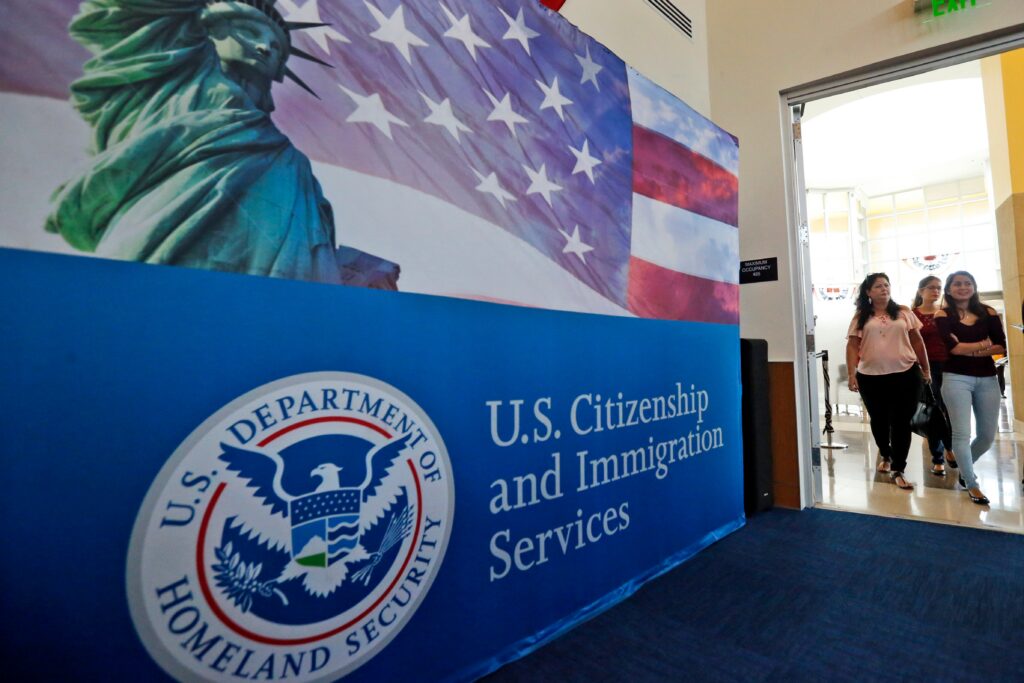
A federal judge Monday blocked the Trump administration’s ban on nonpartisan groups helping newly naturalized U.S. citizens register to vote — finding the ban was likely driven by intentional discrimination against new citizens.
U.S. District Judge Adam B. Abelson temporarily paused an August 2025 policy from U.S. Citizenship and Immigration Services (USCIS) that allowed only state and local election officials to offer voter registration services at naturalization ceremonies.
Pro-voting groups such as the League of Women Voters and National Council of Jewish Women (NCJW) were banned from providing voter assistance under the policy.
“NCJW has amply shown a likelihood of success on the merits of its claim that the Ban was motivated by discriminatory intent,” Abelson wrote. “The various statements by government officials leading up to the Ban that NCJW cites further support this conclusion, including USCIS Director Joseph Edlow’s statement that immigrants threaten to reshape the nation electorally by becoming citizens.”
Get updates straight to your inbox — for free
Join 350,000 readers who rely on our daily and weekly newsletters for the latest in voting, elections and democracy.
Monday’s ruling reinstates the USCIS policy manual from 2017 while the case moves forward. Under that policy, qualified nonpartisan nonprofits may provide registration services when state or local election officials cannot attend.
“When people become naturalized as United States citizens, they are entitled, like any other U.S. citizen whether naturalized or U.S.-born, to exercise the right to vote,” Abelson wrote. “USCIS has issued a new policy effectively banning all nongovernmental organizations from providing voter registration services at administrative naturalization ceremonies.”
For decades, civic groups helped new American citizens complete their voter registration forms immediately after taking the oath of allegiance.
USCIS abruptly ended that system, making the change effective immediately and offering no public comment period. The National Council of Jewish Women, Greater New Orleans Section sued in November, followed by the League of Women Voters and several of its state and local chapters.
The cases were later consolidated.
The pro-voting plaintiffs warned that the ban cut off the most effective opportunity to reach large numbers of new citizens at the moment they became eligible to vote.
In 2024 alone, the League of Women Voters helped register more than 122,000 new voters at naturalization ceremonies.
Abelson found the plaintiffs were likely to succeed on claims that the ban violated their First Amendment free speech rights and the Administrative Procedure Act, the federal law requiring agencies to follow lawful procedures and give reasoned explanations for major policy changes.
He also found the NCJW was likely to succeed on its equal protection claim.
The court rejected USCIS’ unsupported claims that nonprofit participation was too sporadic and that vetting nonpartisan organizations created an administrative burden.
Abelson found the record contained no evidence showing how the vetting process was burdensome and no adequate analysis supporting the sweeping ban.
And the ban did not emerge in a vacuum.
Senior Trump administration officials have repeatedly portrayed immigrants’ political participation as an electoral threat.
Vice President JD Vance accused Democrats of encouraging an immigrant “invasion” to “bring a large number of new voters to replace the voters we already have.” Edlow, the USCIS director, alleged that the Biden administration sought to naturalize nonwhite immigrants and disperse them around the country to change its demographics.
That rhetoric has accompanied a wider campaign placing naturalized citizens under heightened suspicion, including through the expanded use of immigration databases for voter roll checks that routinely flag naturalized citizens as noncitizens.
The decision is not a final ruling on the policy’s legality, but it pauses the ban while the litigation continues.
The immediate effect is clear. USCIS must return to the earlier system that gave civic organizations a role in helping America’s newest citizens claim one of citizenship’s most fundamental rights.