California Supreme Court puzzled by GOP sheriff’s ‘bizarre’ defense for seizing ballots
 Prefer us on Google
to see more of our voting rights news coverage when you search.
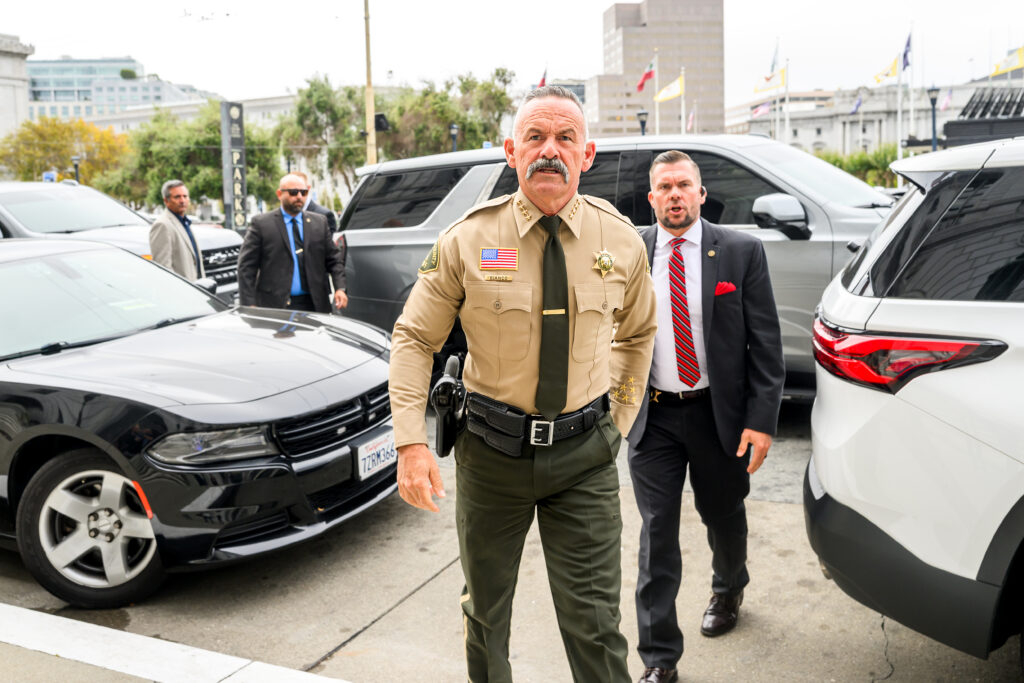
The California Supreme Court appeared skeptical Monday of several sweeping legal theories advanced by Riverside County Sheriff Chad Bianco to defend his seizure of roughly 650,000 ballots from last year’s special election. The court repeatedly pressed his lawyer with hypotheticals that exposed what the justices suggested could be extreme — and at times bizarre — consequences of his position.
The hearing also revealed that Bianco never sought a legal opinion before seizing the ballots, and included an embarrassing admission from Bianco’s lawyer that the use of AI had led to the inclusion of false information in a brief.
Perhaps the starkest moment came not over the ballots themselves, but over how much power California’s attorney general has to rein in an elected sheriff.
A justice asked Bianco’s attorney, Bradley W. Hertz, to imagine a sheriff in another county who openly announces that he obtained a warrant to target a political adversary as an act of retaliation.
“Some other county, [a sheriff] says, ‘Yeah, I got a warrant. I’m going after this political adversary, and this is payback,’” the justice said, emphasizing that the hypothetical sheriff had admitted his motive publicly. “Would the attorney general have the authority to step in and either pause or terminate that investigation?”
“I believe no,” Hertz responded. Instead, he said, it would be up to the target to challenge the action and argue that “this crime didn’t occur or it’s motivated from an improper place with some sort of hostility.”
The exchange crystallized the breadth of Bianco’s position in one of two cases the court heard Monday arising from his extraordinary seizure of ballots cast in Riverside County’s November 2025 special election.
Bianco, who watched the proceedings from the courtroom gallery, maintains that ordinary criminal search-warrant authority permitted his department to take custody of the ballots. His lawyers also contend that Attorney General Rob Bonta, a Democrat and California’s chief law enforcement officer, has only limited power to tell an independently elected sheriff when to stop.
The questioning suggested the justices were receptive to at least one piece of relief sought by the challengers: returning the ballots to Riverside County Registrar of Voters Art Tinoco.
How much further the court will go — particularly in defining the attorney general’s authority over county sheriffs — was less clear.
Get updates straight to your inbox — for free
Join 350,000 readers who rely on our daily and weekly newsletters for the latest in voting, elections and democracy.
In the first case, brought by four Riverside County voters, the court considered whether California’s detailed election laws permitted Bianco’s department to remove voted ballots from election officials in the first place and whether the voters are entitled to an order directing that the ballots be returned.
The justices repeatedly tested whether Bianco’s interpretation had any clear stopping point.
One justice asked whether, under his broad view of search-warrant power, a sheriff could seize mail ballots even before Election Day, before they had been counted.
Hertz argued that he did not believe a sheriff could do so while an election was underway, but struggled when the justices asked what legal principle would make those ballots off-limits before certification while allowing law enforcement to take them afterward.
When another justice asked where the court would derive such a rule, Hertz ultimately invoked a kind of “rule of reason,” explaining that seizing ballots before an election was complete would “obviously wreak havoc.”
The court also focused on another unusual consequence of Bianco’s position.
His lawyers argued that one of California’s strongest ballot-custody protections applies during a formal criminal prosecution, but not during the earlier investigative stage.
A justice questioned why lawmakers would impose strict ballot-handling rules once charges have been filed while leaving ballots less protected during an investigation, when allegations have not yet resulted in a prosecution. Another justice took the argument to its logical conclusion: law enforcement could seize ballots during an investigation, only to potentially have to return them once prosecutors actually filed a case.
“That seems bizarre,” the justice observed.
Complicating Bianco’s position further is that Tinoco — the county official legally responsible for the ballots — also wants them back.
Tinoco is formally a respondent because the voters sued both him and Bianco.
But his attorney, Dale K. Larson, told the court that the registrar “agrees that the ballots and other seized materials should be returned immediately to his custody.” Tinoco’s narrower disagreement with the voters is over whether he should be faulted for surrendering the materials when deputies appeared with facially valid, sealed warrants.
The second case shifted from who controls ballots to who controls a sheriff
Bonta’s office argued that the California Constitution makes the attorney general the state’s “chief law officer” and gives him “direct supervision” over county sheriffs. State law further says the attorney general “shall direct the activities” of a sheriff concerning the investigation or detection of crime.
Those words received unusually literal attention Monday.
“What does chief mean to you?” one justice asked Hertz.
When pressed on what “direct supervision” over a sheriff means, Hertz compared the attorney general’s role to that of an “elder statesman” who could tell a sheriff that other departments do things differently and try to convince him to change course.
The justices appeared unconvinced that mere persuasion fit the constitutional language. One noted that the provision does not describe “dotted line authority or persuasive authority.”
“It says that it’s direct supervision and authority,” the justice said.
The argument also returned repeatedly to the shaky factual premise that set the entire dispute in motion.
A right-wing group of so-called election skeptics, Riverside Election Integrity Team, had claimed that Riverside County’s records showed roughly 46,000 more votes counted than ballots received. But Tinoco publicly explained the purported discrepancy during a February Board of Supervisors meeting, walking through the records and explaining why the group’s informal tally did not match the county’s official data.
The justices wanted to know why that explanation was not laid out for the judge considering Bianco’s second warrant application.
Hertz acknowledged that while the meeting itself was referenced, Tinoco’s substantive explanation did not appear until a later, third warrant affidavit.
“Do you think it’s relevant?” a justice asked.
Hertz initially defended the affidavit, but eventually acknowledged that, “in hindsight,” the registrar’s explanation would have been relevant information for the judge to see.
Then came an even stranger exchange.
A justice raised an argument made by the state: If there really were tens of thousands of fraudulent additional ballots, substantial numbers of Riverside County residents should presumably have received ballot-tracking notifications indicating that they had voted when they had not.
Hertz said he was unfamiliar with the notification system, then offered another possibility.
“If I had to guess, the ballots were run through twice,” he said.
“Do you have any basis for that guess?” the justice asked.
“Only 35 years of election law experience,” Hertz replied.
The attorney general’s office, by contrast, told the justices that after reviewing the documentation Bianco eventually provided, it “has not identified any evidence to support probable cause of criminal wrongdoing.”
Samuel T. Harbourt, arguing for Bonta, said the attorney general originally sought a temporary pause — expected to last weeks, not months — while the state reviewed what Bianco had uncovered.
There were other moments that underscored the extreme nature of Bianco’s undertaking.
When a justice pressed his lawyer on what election expertise the sheriff himself possessed, the response was that Bianco “has had to be a candidate several times at the local and state level.”
Hertz added that Bianco is not an attorney and said, “I assume he doesn’t have a copy of the Elections Code.”
The justice responded simply: “The office that he occupies is not in charge of elections.”
Another justice elicited that Bianco apparently did not seek a legal opinion from Riverside County counsel before proceeding with the seizure.
And in perhaps the most surreal aside of the morning, a justice confronted Bianco’s side over a quotation included in an earlier Supreme Court filing that was not actually in the case it purported to quote and, according to the justice, appeared contrary to what the decision said.
Hertz said the citations had not been verified before filing and acknowledged the use of artificial intelligence.
They went in “with the help or use — or not help — of AI,” he said. “That was a terrible, a terrible problem.”
“That is what we’re all learning about AI: It cannot be relied on, and lawyers have to look and make sure that what they’re saying is accurate,” Hertz continued.
“What a concept!” a justice replied.
Behind the occasionally surreal exchanges is a consequential question for California elections.
The high court must now decide whether the state’s extensive rules governing who may possess, open and handle voted ballots can be displaced by a single county sheriff using debunked election-fraud claims to seize hundreds of thousands of voted ballots while resisting orders from the state’s chief law enforcement officer to stop.