Slower USPS pickups and postmarks could delay voter registrations, mail ballot applications, and actual votes
 Prefer us on Google
to see more of our voting rights news coverage when you search.
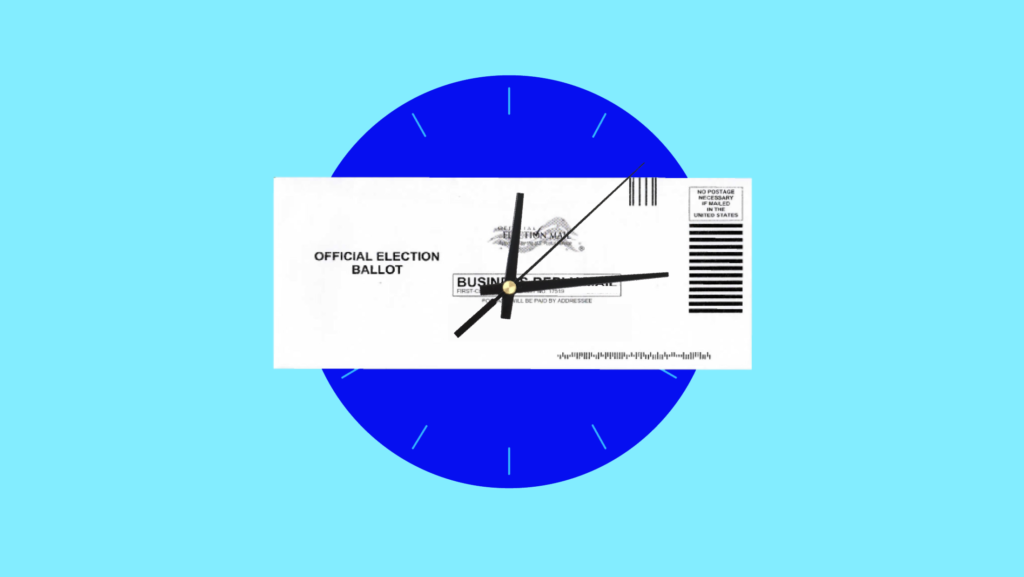
Local election officials across the nation have started warning voters about changes to mail pickup policies that can delay the postmarking of mail-in ballots, putting them at risk of going uncounted.
The risk is particularly acute in states that allow grace periods for late-arriving ballots that were postmarked on or before Election Day, but the headaches caused by the new U.S. Postal Service (USPS) rules, which Democracy Docket reported on extensively in October, extend to every corner of the nation and begin well before Election Day.
“If you would have asked me two months ago, ‘Hey, Rebecca, as a national voting rights leader, what do you think is going to be the biggest threat or the biggest challenge in Americans attempting to vote in 2026?’ I would have told you, it’s likely going to be intimidation. We’re probably going to see federal agents, maybe ICE agents, showing up in or around polling locations,” said Rebekah Caruthers, president of the Fair Elections Center. “I think [mail voting] is what the issue is actually going to be, because we can’t just look at this new post office rule in a vacuum.”
USPS is in the process of eliminating evening mail pickups from post offices more than 50 miles away from a regional processing facility, which are located mostly in large metropolitan areas. The changes, already in effect for roughly 16% of the U.S. population, will mean mail will be postmarked and delivered at least one day later than before.
Caruthers worries that the changes will keep new voters from ever getting their ballots, let alone mailing them. In many states, voters can apply to register or request a mail-in ballot by mail. But, like the votes themselves, those forms are often mailed at the last minute.
When the new postmarking rules were finalized in December, USPS said they were merely clarifying existing practices that had most mail time stamped as placed in the mail when they arrived at centralized processing facilities, not the local post office.
“So, if it’s not going to get postmarked there, but it’s going to be postmarked at either a regional sorting facility, then how long does that take? Is that one day? Is that two days? Is that three days?” Caruthers said. “It’s not a clarification of a rule. Instead, it’s more confusion.”
The new mail pick up schedule was implemented as part of a series of controversial cost-cutting reforms launched in 2021 by then-postmaster general Louis DeJoy, a major donor to President Donald Trump.
By the time the USPS pickup overhaul is fully implemented, it’ll impact roughly 24,000 of the country’s 33,700 post offices, which serve roughly 149 million Americans across 70% of U.S. zip codes.
State and local election officials have grown increasingly worried about the changes, worried that the USPS is failing to warn its customers about the delivery and postmark delays, which could lead to not just late registrations and uncounted mail-in ballots but blow deadlines in legal or tax matters.
Oregon Secretary of State Tobias Read lamented the “disconnect” between USPS and officials like him across the country, citing the changes as an election administration challenge on par with the disinformation spread by the likes of Elon Musk.
“What the US Postal Service is trying to — to be charitable to them — is that they are trying to manage for efficiency,” said Read. “But efficiency is not what we need when it comes to votes. We need ballots to be postmarked, we need them to be delivered quickly.”
Caruthers is less charitable. She sees the changes as part of a multipronged attack on voting rights launched by this White House, pointing to the president’s executive order in March that attempted to usurp broad control over elections that the Constitution reserves to the states and Congress.
“The President doesn’t have the authority to do that, but what he can do is use the agencies, the departments, the things under the executive purview, to make things more challenging,” Caruthers said. “All he has to do is just keep interjecting more friction into the process. Each time you add a new layer, a new barrier, that’s 1% 2% 3% of people who might say, ‘it’s not worth it’ or ‘I don’t have time to actually vote.’”
Read and Caruthers are both urging voters to fend off the natural proclivity to procrastination and submit all their voting-related mail early. Read said voters in Oregon can ensure their ballots count by relying on county drop boxes, an option Caruthers said state and local election officials should offer more broadly.
According to federal data, nearly 104,000 mail-in ballots were rejected in 2024 because they arrived too late. While Democrats are more likely to vote-by-mail, the practice is popular in heavily-Republican rural areas, making the partisan impact of USPS’ new pickup rules hard to prognosticate.