Supreme Court expansion is ‘a concerted effort to intimidate the court,’ Justice Alito says
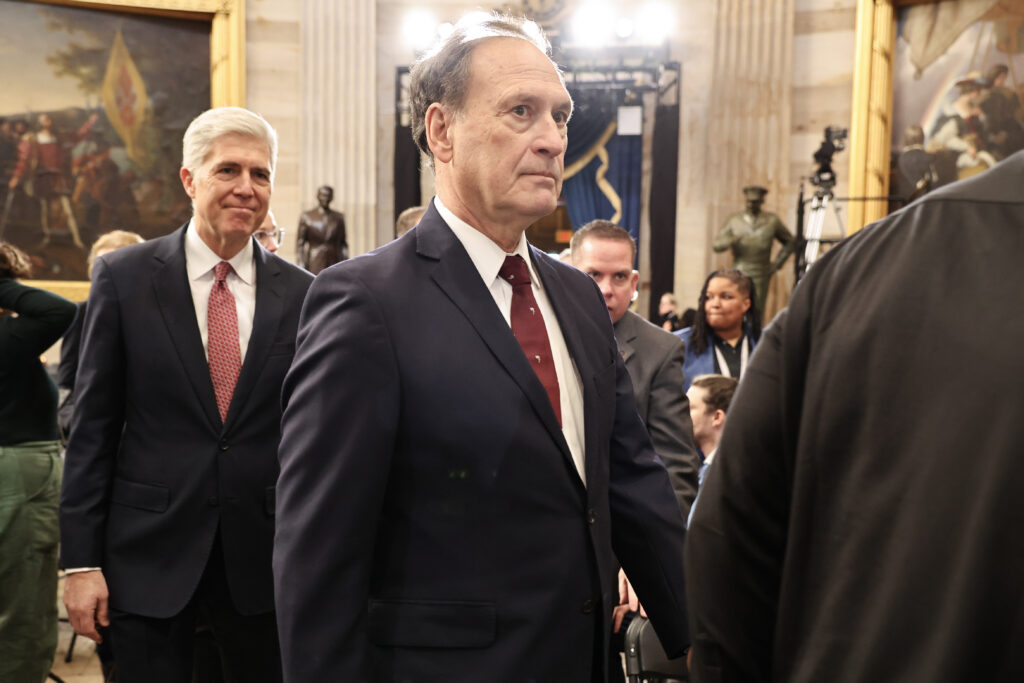
U.S. Supreme Court Justice Samuel Alito rejected the growing chorus demanding reforms at the high court on Fox News Sunday, saying the current justices are actually victims of intimidation.
Alito has been among President Donald Trump’s staunchest allies on the Supreme Court. He authored two opinions instrumental in gutting the Voting Rights Act’s racial gerrymandering protections, and he would have allowed Trump’s anti-mail voting measures to take effect just weeks before the midterm elections.
Alito told Fox News host Shannon Bream on Sunday that Democrats’ calls to expand the court are a political attempt to influence the justices’ decisions.
“I am concerned that there has been a concerted effort to intimidate the court, and justices on the court, to try to influence us to decide cases differently from the way in which we have been deciding them,” Alito said. “I am concerned about the future of the court. I think it’s an important institution. It has not always done the right thing, but I think on the whole it has been fundamental in protecting our constitutional structure and the rights that all Americans enjoy.”
Get updates straight to your inbox — for free
Join 350,000 readers who rely on our daily and weekly newsletters for the latest in voting, elections and democracy.
Americans’ trust in the Supreme Court has steadily eroded in recent years. The high court opens its newest term with only 12 percent of respondents telling Gallup they have a great deal of confidence in the justices.
Despite those concerns, Alito said he has not discussed court expansion or age and term limits with the other justices.
The calls for court reform have grown louder as the Supreme Court has delivered several controversial rulings in recent years.
Alito penned the majority opinion in this year’s Louisiana v. Callais decision, which dismantled Voting Rights Act (VRA) protections against racial discrimination in redistricting matters. In that opinion, Alito relied on faulty data on voter turnout rates by race to conclude that non-white voters no longer needed VRA protections.
The Callais decision was nearly a nail in the coffin for the Voting Rights Act, which had already been severely kneecapped by SCOTUS’s 2013 Shelby v. Holder and 2021 Brnovich v. Democratic National Committee decisions.
Alito wrote the majority opinion for Brnovich, which significantly narrowed the VRA’s reach by making it more difficult to challenge voting restrictions as racially discriminatory. In that opinion, Alito wrote that “some [racial] disparity in impact does not necessarily mean that a system is not equally open or that it does not give everyone an equal opportunity to vote.”
But even in the rare occasions in which the SCOTUS majority has ruled in favor of preserving voting rights, Alito has been known to write dissenting opinions.
Most recently in September, Alito found himself flummoxed by the Supreme Court’s 6-3 decision to pause President Donald Trump’s attempts to disrupt mail voting and usurp states’ constitutional authority to administer elections.
In his dissent, Alito peddled unsubstantiated allegations about mail voting fraud, even after both Democratic- and Republican-appointed federal judges rebuked the Trump administration for failing to provide any evidence of it happening.
It’s worth noting that not long before SCOTUS ruled in favor of racial gerrymandering in this year’s Callais case, it was against it. In 2023’s Allen v. Milligan, the Supreme Court ruled that the Voting Rights Act required Alabama to draw a new congressional map because Republicans had reduced the number of majority-Black districts. Alito strongly dissented in that case as well.