Hegseth urges military to vote as Trump administration makes it harder for them to cast ballots
 Prefer us on Google
to see more of our voting rights news coverage when you search.
Defense Secretary Pete Hegseth says he wants the military to vote.
In a video posted Friday, Hegseth directed commanders and supervisors across the Department of Defense (DOD) to conduct a one-day voting “stand down” this month to give service members and their families time to register, request ballots and cast their votes.
“We all agree that voting is important,” Hegseth said. “So, how about we make sure those who serve our country have every single opportunity to vote?”
But Hegseth’s push comes as the Trump administration and Republican allies have pursued a series of legal and administrative changes that could make it harder for the same military voters and their families to cast ballots.
The administration eliminated a federal email-to-fax service that helped service members return election materials, made last-minute changes to the federal forms they use to register and request ballots and tried to overhaul mail ballot rules before courts blocked those efforts for the midterms.
Get updates straight to your inbox — for free
Join 350,000 readers who rely on our daily and weekly newsletters for the latest in voting, elections and democracy.
The tension is especially significant for military voters, who often face obstacles overseas civilians may not.
Service members may be stationed far from their voting residence, move frequently, deploy or transfer overseas on short notice and rely on mail, fax, federal voting forms and voting assistance officers to cast a ballot.
Hegseth acknowledged as much in Thursday’s video, saying voting has been “time consuming and complex” for many service members because they often live outside their home state and face “unnecessary, difficult ways of obtaining, completing, and returning absentee ballots while serving far from home.”
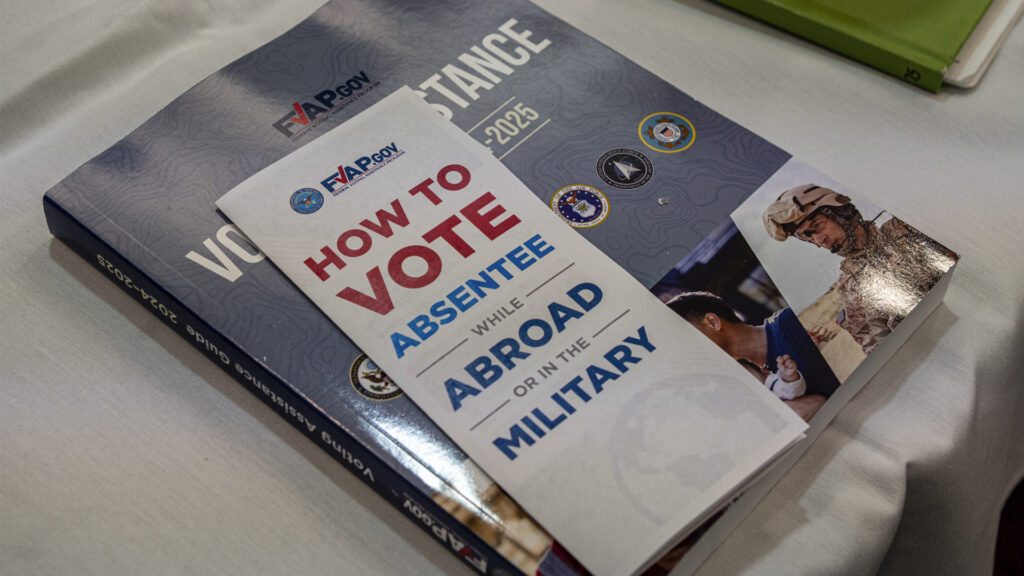
A week earlier, Hegseth urged “warfighters, their spouses, and eligible family members” to go to FVAP.gov — the Federal Voting Assistance Program — and register to vote, saying the federal postcard application and federal write-in absentee ballot processes are “straightforward and protected by law.”
But even as Hegseth tells service members to vote, an essential federal tool that helped military voters return election materials is already gone.
Under the current Trump administration, FVAP quietly discontinued its Department of Defense Fax Service, a tool that had allowed military and overseas voters to email election materials to FVAP and have the agency fax them to local election officials. The service was intended for voters who needed to return materials by fax but did not have access to a fax machine.
The practical effect is simple: military and overseas voters who once could use FVAP as an email-to-fax bridge now must fax materials directly to their local election office or use another return method allowed by their state.
But FVAP’s discontinued service did more than substitute for a physical fax machine. It acted as a centralized federal bridge between military voters and thousands of local election offices, helping route election materials to the correct county officials in states where fax remains an authorized return method.
In California, for example, military and overseas voters may now receive ballots electronically but can no longer return ballots by email; some may be able to return ballots by fax, but must do so directly to their county election officials.
Without that bridge, service members and their families must identify the correct local official, confirm whether fax return is allowed and transmit materials directly — all while dealing with the same deployment, distance and deadline pressures Hegseth acknowledged in his video.
The administration has also changed federal overseas voting forms.
The current Federal Post Card Application (FPCA), which military and overseas voters use to register and request absentee ballots, now creates a more explicit hierarchy for identification information: voters are first asked for a state driver’s license or ID, then the last four digits of their Social Security number if they do not have a state ID, then alternative identification such as a passport or military ID if they have neither.
The previous FPCA asked for a driver’s license and a Social Security number only, but the revised form turns that into a hierarchy that first asks for a state ID then alternative documents — a change that could create added confusion for mobile military voters whose identification documents do not neatly match their voting residence.
DOD has said the change is meant to align the form with federal law and avoid unnecessary collection of Social Security numbers when voters have a valid state ID. But for military voters, who often move and may not hold a current driver’s license from the state where they vote, even small changes to federal forms can create confusion or delays.
The form changes are at the center of a new lawsuit filed by the Democratic National Committee against DOD and the Office of Management and Budget.
That lawsuit focuses primarily on U.S. citizens born abroad who have never lived in the United States, but the forms at issue are the same ones used by service members, military spouses, dependents and overseas citizens to participate in elections.
These changes are not the only recent attempts by the administration to restrict voting rules that could have significantly impacted military voters. Some of those efforts have failed, at least for the midterms, after courts intervened.
The administration also tried to impose new restrictions on mail voting through the U.S. Postal Service. A March executive order directed federal action on mail ballots, and USPS later proposed rules tied to that order. A federal court blocked USPS from implementing the restrictions, finding they were likely unconstitutional and likely to disenfranchise voters ahead of the midterms.
The blocked USPS rule could also have affected service members stationed away from their voting residence inside the United States.
Military advocates warned that the rule threatened military members who rely on mail voting. National Security Leaders for America, a coalition of former senior military, diplomatic, and national security officials, filed a brief arguing that USPS had not shown how it would reliably identify and protect UOCAVA ballots from the rule’s new ballot-mail restrictions.
Republicans have also threatened state-level policies that military voters depend on.
In Watson v. Republican National Committee, the GOP challenged Mississippi’s law allowing mail ballots postmarked by Election Day to be counted if they arrive up to five business days later. The Trump administration supported the RNC’s challenge.
The Supreme Court rejected the RNC’s argument in June, holding that federal election day statutes do not require ballots to be received by Election Day.
That issue matters acutely for military voters. A brief filed by Vet Voice Foundation and the Mississippi Alliance for Retired Americans* noted that 17 states apply similar post-election receipt rules specifically to military and overseas voters, and more than 30 states, the District of Columbia and several territories allow at least some ballots mailed by Election Day to be counted if received afterward.
The brief also pointed to the federal MOVE Act, which requires military officials to ensure overseas service members’ ballots are delivered to election officials by the applicable state-law receipt deadline — not necessarily Election Day — arguing that Congress has long recognized that state deadlines vary.
Hegseth has framed the voting stand-down as a way to ensure service members have time to participate.
“Every warrior deserves an opportunity to cast his or her ballot and be confident that it will be counted,” he said.
But the recent record shows voting access is not just about encouragement from military leadership. It also depends on whether the federal government preserves the tools, deadlines and guidance that military voters and their families rely on.
*The Elias Law Group (ELG) represented the pro-voting parties in this case. ELF firm chair, Marc Elias, is the founder of Democracy Docket.