DHS chief says ICE could make arrests at polling places — ignoring federal ban on armed agents at voting sites
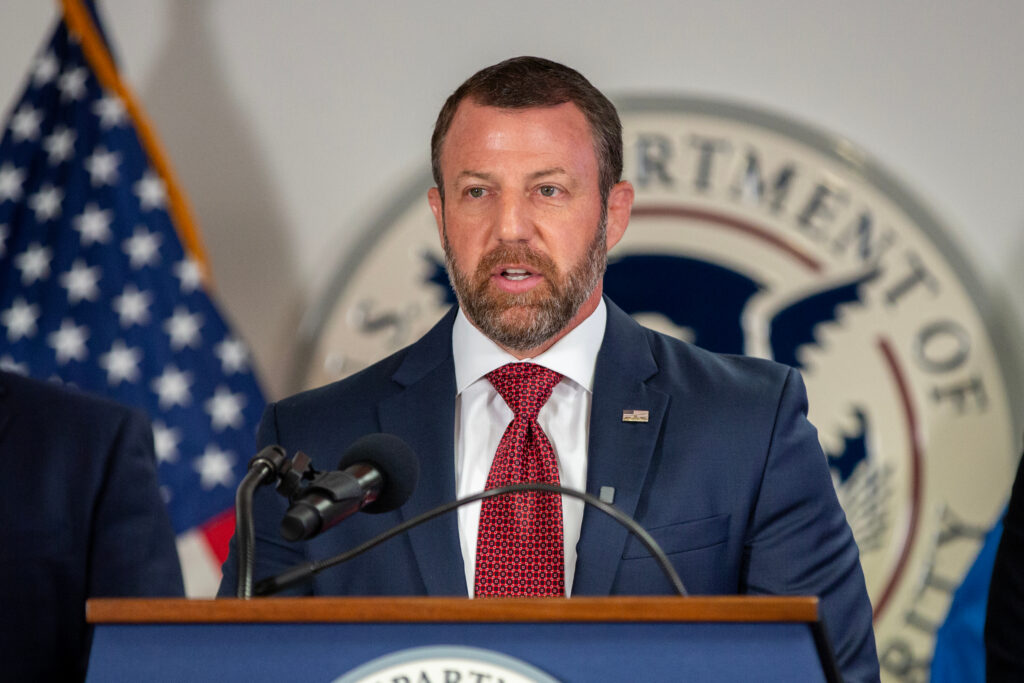
Department of Homeland Security (DHS) Secretary Markwayne Mullin said Tuesday that Immigration and Customs Enforcement (ICE) agents could enter polling places to make arrests this November, raising fresh concerns about the Trump administration contemplating actions that federal law has long prohibited.
Speaking to reporters in New York, Mullin insisted that “ICE isn’t there to patrol the polling places,” but said agents could nevertheless enter voting locations in certain circumstances.
“The only reason why we would be at polling places is if there is a threat to that polling place or we’re serving a warrant on someone that we have been actively tracking down,” Mullin said. “If we’re serving a warrant we will be where we need to be.”
The comments represent some of the Trump administration’s clearest statements yet about circumstances in which armed immigration agents could appear at voting sites.
Get updates straight to your inbox — for free
Join 350,000 readers who rely on our daily and weekly newsletters for the latest in voting, elections and democracy.
Mullin previously told senators during his confirmation hearing that agents could be deployed for a “specific threat,” while DHS has maintained that ICE is not planning operations targeting polling locations.
But federal law imposes extraordinary restrictions on armed federal personnel at elections.
Under 18 U.S.C. § 592, a federal official who orders, brings or keeps “troops or armed men” at a location where a general or special election is taking place can face up to five years in prison and disqualification from federal office. The law contains only a narrow exception when such force is necessary to “repel armed enemies of the United States.”
The Department of Justice’s own longstanding election-crimes guidance has interpreted the prohibition to mean that FBI agents cannot conduct investigations inside polling places on Election Day and deputy U.S. marshals cannot be stationed at open polls because they are armed while on duty. DOJ guidance has similarly said federal prosecutors have “no authority to send FBI Special Agents or Deputy U.S. Marshals to polling places.”
That history raises a direct question about Mullin’s suggestion that ICE agents could enter an operating polling place simply because they are attempting to arrest someone.
A dozen senators warned Mullin, then-Acting Attorney General Todd Blanche and Defense Secretary Pete Hegseth in July that deploying armed federal agents to voting sites would be illegal.
“Senior Trump administration officials have repeatedly refused to rule out deploying federal law enforcement officers at November 2026 mid-term election polling places and other election sites, despite such action being illegal under federal law,” the Democratic senators wrote.
The senators specifically singled out Mullin’s earlier testimony, noting that he “might send armed federal law enforcement to the polls ‘if there was a specific threat’” but had not explained how such a threat would overcome federal law.
“Americans should never have to wonder whether the federal government intends to police the ballot box with armed agents,” they wrote.
Blanche has himself repeatedly declined to categorically rule out sending federal agents to polling places.
Before becoming acting attorney general, Blanche asked at the Conservative Political Action Conference, “Why is there objection to sending ICE officers to polling places?” and added that noncitizens cannot legally vote.
Then, while serving as acting attorney general, Blanche brushed aside concerns about the prospect during an interview about ICE and the midterms.
“I am not sure of the uproar of the risk of having a Border Patrol or an ICE agent at a polling location,” Blanche said. “And so what’s the risk?”
During his July confirmation hearing, Sen. Amy Klobuchar (D-Minn.) asked whether Blanche understood why eligible voters might be intimidated by armed federal agents at voting sites.
“I’m not aware of that concern,” Blanche responded, while repeatedly promising only that he would “follow the law.”
The administration’s openness to a federal law enforcement presence comes as Republican candidates have increasingly embraced similar proposals.
Maine GOP gubernatorial nominee Bobby Charles said last month he plans to ask Trump border czar Tom Homan to send ICE agents and U.S. marshals to polling places. In Michigan, Republican Senate candidate Mike Rogers said his campaign wanted retired or off-duty police officers as poll watchers, joking that voters could see a badge when an officer opened his jacket.
“The Constitution and federal law prohibit ICE agents from being stationed at polling places,” Maine Secretary of State Shenna Bellows (D) recently told Democracy Docket. “As Secretary of State and Maine’s Chief Elections Official, we’re not going to stand for this lawless and reckless suggestion.”
Mullin’s latest comments also go beyond simply responding to an emergency. He expressly contemplated ICE agents entering a polling location to execute a warrant against a person they had been pursuing — an ordinary law enforcement function that DOJ’s own guidance has historically treated very differently from responding to an immediate emergency at a voting site.
DHS did not immediately respond to a request for comment.