‘Contrary to Law’: Federal Judge Blocks Trump’s Military Occupation of Los Angeles
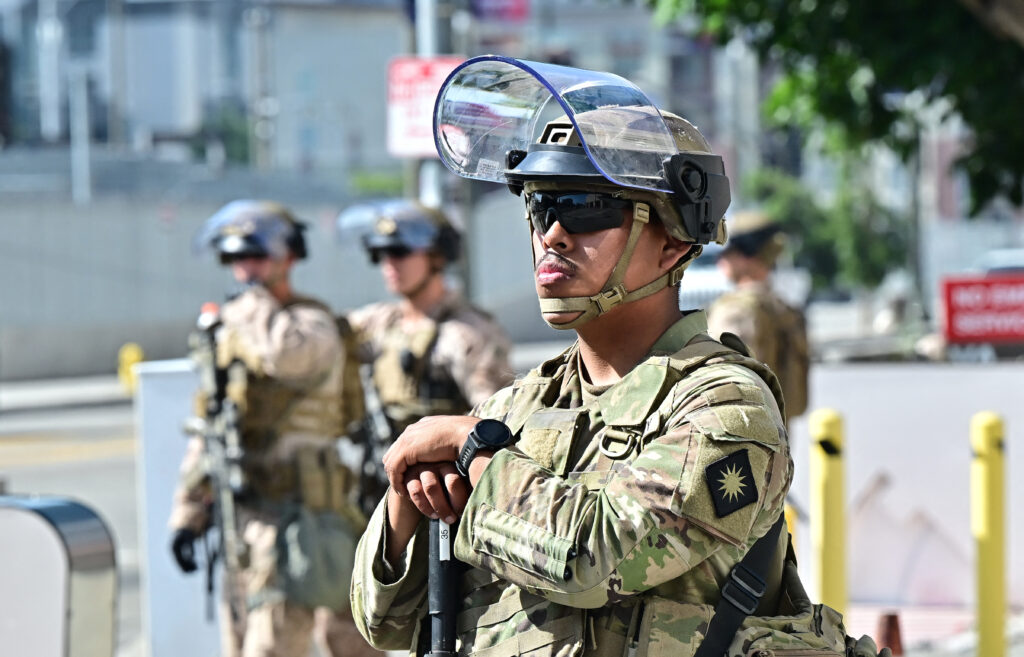
A federal judge Wednesday again attempted to prevent President Donald Trump from keeping hundreds of federalized California National Guard members stationed in Los Angeles.
U.S. District Judge Charles Breyer, appointed by former President Bill Clinton, said Trump’s ongoing deployment in the country’s second largest city was “contrary to law” and risked “creating a national police force made up of state troops.”
Get updates straight to your inbox — for free
Join 350,000 readers who rely on our daily and weekly newsletters for the latest in voting, elections and democracy.
“Six months after they first federalized the California National Guard, Defendants still retain control of approximately 300 Guardsmen, despite no evidence that execution of federal law is impeded in any way—let alone significantly,” Breyer wrote.
Monday’s order marks the second time Breyer has blocked Trump’s unprecedented seizure of California’s National Guard earlier this year. The judge’s first order, issued in June, was later stayed by the Ninth Circuit Court of Appeals.
Perhaps anticipating another appeal to the Ninth Circuit, Breyer stayed his latest order until Dec. 15.
Trump took control of thousands of California Guard troops over six months ago in response to protests over the federal government’s aggressive immigration raids throughout the city. In addition to California Guard members, Trump also sent hundreds of Marines to the city.
Trump federalized the troops over the summer by invoking 10 U.S.C. 12406 (Title 10), an archaic, rarely used law. It allows the president to take control of Guard forces during a foreign invasion, when the U.S. government faces rebellion or when the president is unable to execute laws using regular forces.
The president claimed that protests against his immigration raids in the city amounted to a “rebellion” against the federal government and prevented him from enforcing the law. He also argued that troops were needed to protect federal personnel and property.
At the peak of the Los Angeles deployment, the Trump administration placed around 5,000 troops — roughly 4,000 federalized California National Guard troops and 700 Marines — in the city.
Though unrest in the city has long subsided, the Trump administration has continued to maintain hundreds of federalized troops in Los Angeles for unclear reasons.
In a hearing last week, Department of Justice (DOJ) lawyers argued that unrest hasn’t sufficiently subsided in the federal government’s view.
Despite the DOJ’s claim that unrest in Los Angeles remains out of control, the Department of Defense moved California Guard troops out of the state to support Trump’s attempted military deployments in Portland, Oregon, and Chicago.
In rebutting legal challenges to Trump’s military deployments in Los Angeles and other major Democratic-led cities, the DOJ has also repeatedly argued that judges cannot review a president’s decision to federalize state troops and that the president can control state troops as long as he sees fit.
In his order Monday, Breyer, the brother of former Supreme Court Justice Stephen Breyer, strongly rejected those arguments, calling them “shocking.”
“Adopting Defendants’ interpretation of Section 12406 would permit a president to create a perpetual police force comprised of state troops, so long as they were first federalized lawfully,” the judge wrote.
“The Founders designed our government to be a system of checks and balances. Defendants, however, make clear that the only check they want is a blank one,” Breyer added.
He also noted that the Trump administration appeared to be maintaining troops in Los Angeles in anticipation of new protests against the president, not because of any clear risk to federal personnel and property.
“Every protest, and indeed any large gathering of people in public, carries with it a risk of violence, however unlikely,” Breyer wrote. “But the specter of a protest that is not a current impediment to the President’s ability to execute the laws becoming a future impediment is not adequate.”
“It is profoundly un-American to suggest that people peacefully exercising their fundamental right to protest constitute a risk justifying the federalization of military forces,” he added.
Breyer also weighed in on an issue currently before the Supreme Court: whether “regular forces” in Title 10 refers to the full-time, professional military, such as members of the Army, Navy and Air Force.
Currently, the Supreme Court is assessing whether to uphold a district court block to Trump’s attempted military occupation in Chicago based on the technical, though important, question.
If the court finds that “regular forces” does refer to the armed forces, it could undermine almost all of the president’s deployments because he never attempted to use traditional soldiers to assist or protect federal personnel or property in any of his deployments.
Breyer said he initially believed the regular forces referred to “civilian law enforcement.” After reviewing the history of Title 10, however, Breyer said he now thought his initial assumption “might have been in error” and that the law likely refers to the traditional military.
This story has been updated with additional details throughout.