Trump DOJ asks judge to let USPS mail voting restrictions take effect, despite another court’s block
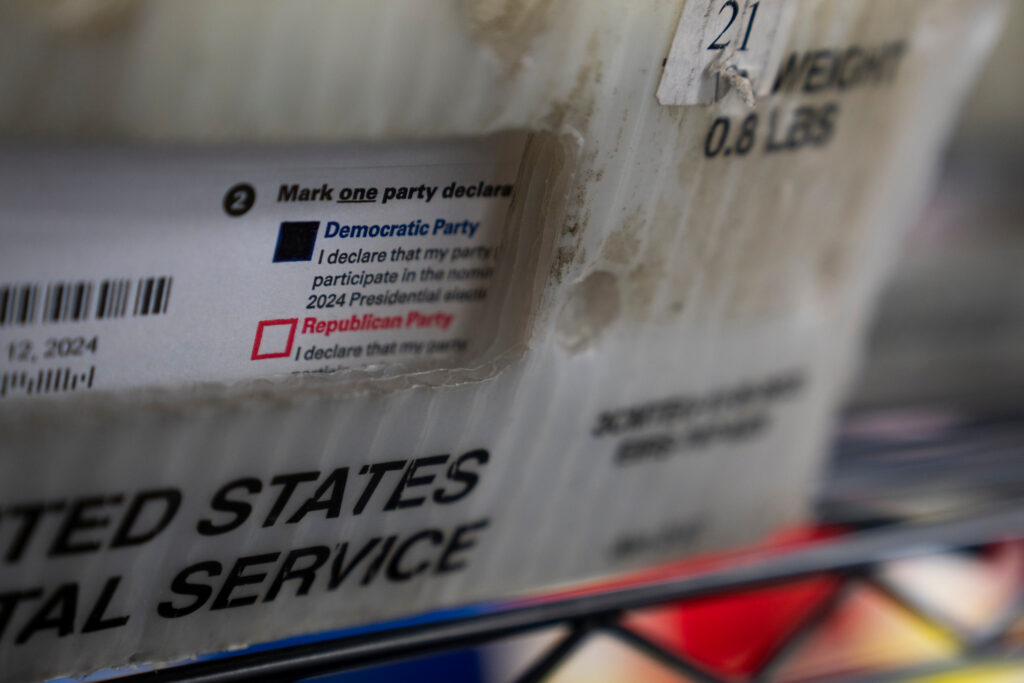
The Trump administration Friday urged a federal judge in Washington, D.C., to let the U.S. Postal Service (USPS) impose sweeping new mail ballot restrictions for the midterms.
The request came hours after another federal court blocked those same restrictions, finding they could disenfranchise millions of voters.
In its latest filing, the Department of Justice (DOJ) asked U.S. District Judge Carl Nichols to reject renewed requests from Democrats and voting rights groups seeking a preliminary injunction against USPS’ final mail ballot rule.
The Democratic Senatorial Campaign Committee, other Democratic organizations, and Senate and House Democratic leaders are challenging the rule before Nichols.
Get updates straight to your inbox — for free
Join 350,000 readers who rely on our daily and weekly newsletters for the latest in voting, elections and democracy.
DOJ characterized the rule as a “modest” regulation of the mail rather than an attempt to take control of election administration.
“The Final Rule imposes modest informational requirements on senders of outbound federal ballot mailings,” DOJ wrote, arguing that states would retain control over which voters receive ballots and that USPS would not decide voter eligibility, ballot deadlines or which ballots are counted.
“The Rule does not displace a single State election law,” DOJ added. “And it need not and should not prevent a single voter from voting by mail.”
That description sharply contrasts with findings issued just hours earlier, in a separate challenge, by U.S. District Judge Indira Talwani in Massachusetts.
Talwani granted a preliminary injunction blocking mandatory enforcement of the same USPS rule through the November election. After reviewing declarations from election officials across the country, she found that implementing the requirements roughly two months before Election Day would force thousands of jurisdictions to redesign ballot envelopes, obtain USPS approval, reprint materials and transfer voter information into a federal portal that was not yet operational.
Talwani concluded that disenfranchisement was “practically inevitable” and said immediate implementation threatened the voting rights of millions of Americans. She also found the record contained “no evidence relating to fraudulent mail voting to support the rushed implementation of the Final Rule.”
Her ruling is not binding on Nichols, who is separately considering the D.C. plaintiffs’ challenges.
DOJ nevertheless argued Friday that blocking the rule could itself create election disruption.
“Although Plaintiffs’ filings emphasize their fears of last-minute confusion and chaos, they ignore the mirror-image problems that are likely to result from the granting of their motions,” DOJ wrote. “Especially on the heels of the Supreme Court’s stay and the subsequent vacatur of the previous court orders that had erroneously constrained the Postal Service’s authority.”
The administration also maintained that USPS has broad statutory authority over the handling of mail and can therefore impose sweeping conditions on ballot envelopes. It again compared the agency’s authority over election mail to special requirements USPS has adopted for other sensitive items, including cremated remains and replica explosives.
DOJ further argued that the rule “leav[es] the administration of elections firmly in the hands of the States” because election officials, not USPS, determine who is eligible to vote by mail. The government says USPS would merely check whether ballot mail complies with envelope, barcode and portal requirements.
But Talwani found that distinction unpersuasive in the Massachusetts litigation.
Election officials in roughly half the states and Washington, D.C., submitted evidence indicating compliance would likely be impossible before the midterms, and USPS has said it could withhold noncompliant mailings. Talwani found those risks concrete enough to support the challengers’ claims of likely disenfranchisement.
Nichols previously declined to block Trump’s executive order because USPS had not yet issued a final rule, a decision later upheld on ripeness grounds. But USPS finalized the restrictions last month, prompting the plaintiffs to renew their requests for an injunction.