Supreme Court could take up these critical election cases as new term begins
 Prefer us on Google
to see more of our voting rights news coverage when you search.
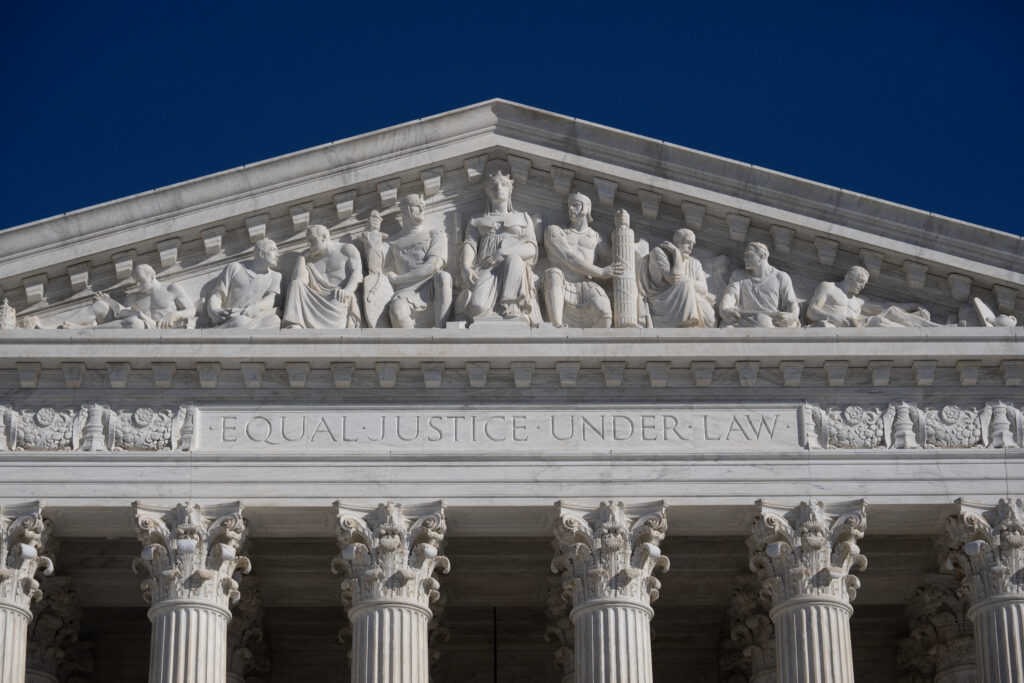
The U.S. Supreme Court’s fall term kicks off Monday with the “long conference,” when the justices gather to decide which cases they will hear over the coming months. This time around, some of them could impact U.S. democracy.
While it’s in session, the Supreme Court regularly holds conferences to pick which certiorari petitions it’ll grant. But Monday’s conference is the first of the new term — i.e., the first one in a few months. That means there’s a bit of a backlog of lawsuits to review, so it will last a while — hence, the “long conference.”
We won’t know which cases the Court decided to take up for a few days still — perhaps on Monday, Oct. 5, when the justices will hear the first oral arguments of the term, which were scheduled for the fall before the Court’s summer recess. And even if a case isn’t included in the first announcement, it could still get scheduled after a later conference.
Still, out of thousands of lawsuits currently seeking the Court’s review, Democracy Docket’s Research Team has identified five voting rights and elections cases we’ll be looking out for.
Pennsylvania Undated and Wrongly Dated Mail-in Ballots Challenge
Eakin v. Adams County Board of Elections*
In Pennsylvania, election officials didn’t count mail ballots that had missing or incorrect dates on the return envelope. That meant that otherwise legitimate ballots regularly got tossed out over a technicality.
Voters and Democrats challenged that practice, saying it violates the 14th Amendment and the materiality provision of the Civil Rights Act, which bars officials from rejecting ballots over minor paperwork errors. The district court held the practice was unconstitutional and violated the Civil Rights Act, and the 3rd Circuit Court of Appeals affirmed that decision, meaning that county election officials cannot spike a mail ballot solely for a missing or incorrect date.
Get updates straight to your inbox — for free
Join 350,000 readers who rely on our daily and weekly newsletters for the latest in voting, elections and democracy.
Then, the Republican National Committee (RNC) and Pennsylvania’s Republican attorney general petitioned the Supreme Court in a bid to get the decision overturned.
The case was distributed for conference on June 25, but the Supreme Court hasn’t yet decided whether to take it up. On June 29, SCOTUS invited the Department of Justice (DOJ) to file a brief expressing the views of the United States. But, so far, the DOJ hasn’t done that.
The Supreme Court’s docket for this case is here.
Florida Census Statistical Method Challenge
University of South Florida College Republicans, et al. v. Lutnick, et al.*
In this case, Republicans are challenging the statistical methods used by the U.S. Census Bureau in 2020 to estimate populations in group housing while protecting residents’ confidentiality. They want to block the agency from using the same methodology during the 2030 census.
Republicans claim that this approach undercounted Florida’s population, costing the state a seat during congressional reapportionment. A three-judge district court panel dismissed the case in July, and the plaintiffs appealed to the Supreme Court.
(Certain types of lawsuits, like this one involving the census, are heard by three-judge panels and then appeals are sent straight to the Supreme Court.)
If the Court does decide to hear this case, it will need to settle a procedural question before it turns to the merits: In cases like this, should courts apply the four-year statute of limitations for challenging an act of Congress or the six-year limitations period covering “every civil action commenced against the United States”?
The Supreme Court’s docket for this case is here.
Washington Legislative Redistricting Challenge (Garcia)
Washington Legislative Redistricting Challenge (Soto Palmer)
Garcia v. Hobbs and Soto Palmer v. Hobbs
Imagine two plaintiffs challenging the same legislative map, one arguing it harms Hispanic voters, and the other claiming it gives them an unfair advantage.
That’s essentially what happened in these two cases, which have the same underlying facts and feature overlapping legal questions. If the Supreme Court accepts one, it will probably also accept the other and consolidate them.
After Washington redrew its legislative map in 2022 following the 2020 census, the plaintiffs in Soto Palmer sued, arguing that Hispanic voters were intentionally “cracked” into several districts in the Yakima Valley region to dilute their voting strength. That violated Section 2 of the Voting Rights Act (VRA), the plaintiffs alleged. The district court agreed and ordered new maps in 2024. All the appeals failed and the issue seemed settled.
Around the same time, Benancio Garcia III also challenged the 2022 map. But Garcia argued, essentially, that the map gave Hispanic voters too much voting power — that race was the predominant factor used to draw the 15th Legislative District, making it an unconstitutional racial gerrymander. The district court dismissed that case, noting that the recently decided Soto Palmer case — and the new legislative map — made it moot. Once again, all the appeals failed and the issue seemed settled.
But then, earlier this year, the Supreme Court gutted Section 2 of the VRA in Louisiana v. Callais, which found that court-ordered redistricting to remedy the dilution of minority voters’ power itself violated the 14th Amendment’s Equal Protection Clause.
So the Republican intervenor-defendants in Soto Palmer and the plaintiffs in Garcia returned to court — part of the ongoing fallout from the Callais decision.
In Soto Palmer, the Court faces two questions. First, it must decide whether a voter who is moved into a new district and a legislator whose district is reconfigured by a court-drawn remedial map have standing to challenge that map or the underlying determination of VRA Section 2 liability that caused the remedial map to be drawn. If they have standing, then the Court will also consider whether a map drawn to fix racial vote dilution is subject to strict scrutiny under the Equal Protection Clause.
In Garcia, the question before the Court is whether a plaintiff’s Equal Protection Clause racial gerrymandering claim is rendered moot when the challenged legislative district is replaced in a different proceeding by a judge-ordered map that arguably makes the plaintiff’s racial classification injury worse, when that other proceeding is still subject to ongoing appellate review.
The Supreme Court’s docket for Garcia is here.
The Supreme Court’s docket for Soto Palmer is here.
Hawaii Voter Roll Access Challenge
Public Interest Legal Foundation v. Nago
In this case, the conservative Public Interest Legal Foundation (PILF) sued Hawaii’s chief election official, arguing the state’s law delegating the responsibility of maintaining electronic voter registration systems to counties and keeping voter registration information confidential violates the National Voter Registration Act. The district court dismissed the case, and the 9th Circuit Court of Appeals affirmed the dismissal. So PILF turned to the Supreme Court.
While certiorari is pending here, it’s unlikely that the justices will consider it at the long conference. The Court gave Hawaii until Oct. 26 to file its response and probably won’t make a decision before then.
The Supreme Court’s docket for this case is here.
Arizona proof-of-citizenship case
Finally, on top of those cases the justices might pick, the Court has already scheduled oral arguments in Republican National Committee v. Mi Familia Vota for Dec. 8. The RNC wants the Supreme Court to overturn the 9th Circuit Court of Appeals decision in Mi Familia Vota v. Fontes, which found that two Arizona election laws ran afoul of the National Voter Registration Act (NVRA).
One law requires voters to prove their citizenship status with documentation when they register to vote. The other Arizona law forces county officials to cancel voter registrations if they get information showing the registrant was ineligible.
If the Court rules for the RNC, it will clear the way for Republican state lawmakers across the country to impose new burdens on registering voters and casting ballots. It could also make it easier for election officials to get around the NVRA’s 90-day quiet period that prevents systematic registration purges ahead of an election.
That would mean that if Arizona (or any other state adopting a similar law) got a list of allegedly ineligible voters from the federal government or a political group just days before an election, the state might remove them from the rolls. And that would leave little to no time for improperly flagged eligible voters to correct their registration before Election Day.
*The Elias Law Group (ELG) represents parties in this case. ELG Firm Chair Marc Elias is the founder of Democracy Docket.