With nothing but losses, here’s how Trump’s DOJ could try to sell its voter roll crusade to the Supreme Court
The Justice Department has yet to convince a single court it is entitled to states’ unredacted voter rolls, but now the Trump administration hopes to spin those losses into a win at the U.S. Supreme Court.
Though DOJ is now 0-23 in district courts and was just rebuffed by the full U.S. Court of Appeals for the Sixth Circuit, a handful of federal judges on the losing side are offering arguments the administration hopes will win over the top court’s conservative majority.
Assistant Attorney General Harmeet Dhillon made the strategy unusually explicit Monday while announcing DOJ’s plans to deploy roughly 1,000 election monitors for the November midterms.
“We just got a ruling in the Sixth Circuit that had some very good language in the en banc from several very respected judges,” Dhillon said. “And so you may see us making a next stop at the Supreme Court on that.”
Get updates straight to your inbox — for free
Join 350,000 readers who rely on our daily and weekly newsletters for the latest in voting, elections and democracy.
DOJ is celebrating dissents
After the full Sixth Circuit declined to rehear DOJ’s Michigan loss last week, Dhillon reposted news of the ruling with an enthusiastic assessment: “Very powerful dissents!”
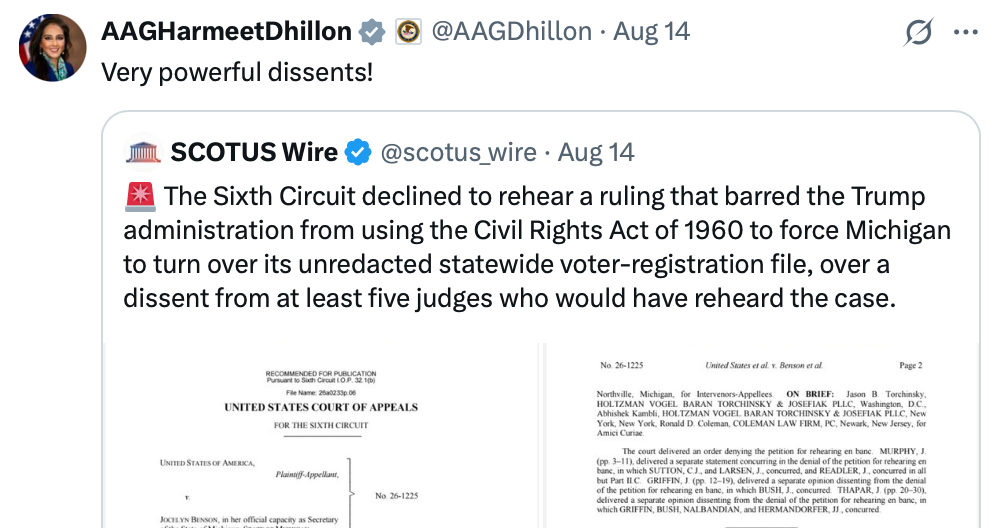
Principal Deputy Assistant Attorney General Jesus Osete went further.
“While a majority of the Sixth Circuit decided not to review the split panel decision now, nine judges believe that decision is deeply flawed,” Osete wrote. “We are assessing our next steps.”
That characterization requires some very creative accounting.
Five judges publicly backed rehearing: Judges Amul Thapar, Richard Griffin, John Bush, John Nalbandian and Whitney Hermandorfer. But the remaining four Osete appeared to count — Judges Eric Murphy, Jeffrey Sutton, Joan Larsen and Chad Readler — voted against rehearing the case.
Murphy, joined by Sutton and Larsen and mostly by Readler, did express some doubts about portions of the panel decision. Murphy wrote that he “likely would have agreed with much” of Nalbandian’s original dissent had he served on the panel.
But his conclusion was still clear that it was “not the proper time” for the full court to intervene. The formal Sixth Circuit order says less than a majority voted to rehear the case.
In other words, only five judges said rehear it. Four others said, essentially, there may be problems but it’s not worth rehearing at this time.
Still, those separate writings may provide DOJ with its first substantial body of favorable judicial reasoning after months of never-ending losses.
Argument No. 1: DOJ may have just written a bad letter
Murphy’s concurrence to the majority opinion may be the most useful — and most awkward — opinion for the department.
He characterized DOJ’s Michigan loss as potentially resulting from “curable procedural problems — not incurable limits” on federal access to voter records.
The Sixth Circuit was divided over how to interpret the multiple letters DOJ had sent Michigan seeking the voter rolls, ultimately deciding no one letter on its own satisfied the requirements of Title III of the Civil Rights Act.
But Murphy noted that nothing prevents DOJ from sending Michigan a new letter that would satisfy those objections.
“That path strikes me as more efficient than an en banc rehearing in which some 17 judges might spend more time parsing the meaning of the letters than the meaning of the law,” Murphy wrote.
That offers DOJ a potential path forward. But it also creates a potentially fatal problem with using Michigan as the vehicle for immediate Supreme Court review: one of the judges whose language DOJ is touting thinks the department could first try writing a better letter.
Murphy went even further, saying additional decisions from other courts would help resolve the issue.
“These issues are not going away,” he wrote. “And further percolation will enhance our court’s — and ultimately the Supreme Court’s — ability to decide the issues correctly.”
That sounds less like an invitation for immediate Supreme Court intervention than an argument for waiting.
Argument No. 2: The Sixth Circuit got the meaning of words wrong
Griffin’s dissent gives DOJ a more traditional Supreme Court argument: the majority misread the statute itself.
The dispute turns heavily on Title III’s requirement that election officials preserve records that “come into” their possession.
The Sixth Circuit majority interpreted that language to cover records that officials obtain from outside sources — such as voter registration applications — rather than a statewide database officials themselves create.
Griffin argued that the phrase did not carry that distinction when Congress enacted the law in 1960. Contemporary legal usage, he wrote, treated “come into possession” as identifying when legal possession began, not where a record originated.
That could give DOJ an original-meaning argument tailored to a Supreme Court whose conservative majority frequently emphasizes statutory text and history: that the lower courts have grafted an “external source” limitation onto a statute Congress never wrote.
Argument No. 3: DOJ is clearly entitled to those records by the text of the law
Thapar offered another way around the Sixth Circuit’s reasoning.
Even accepting the panel’s premise that Title III reaches records state officials receive from outside sources, he argued, the statewide voter file is composed of information drawn from precisely those individual registration records.
“The aggregate file, by definition, comprises records that have separately come into Benson’s possession,” Thapar wrote, which means they should be provided to DOJ
He also argued that the panel went too far when it scrutinized the format of DOJ’s demand letters, including whether the department properly stated its factual basis and purpose.
Thapar called the panel’s analysis “quibbling” and said it “exceeded the proper scope of review under the statute.”
That dovetails with another argument DOJ has repeatedly made: courts have an extremely limited role when the attorney general invokes Title III.
Nalbandian’s original dissent relied heavily on the Fifth Circuit’s 1962 decision in Kennedy v. Lynd, which said courts generally could not examine the factual support behind an attorney general’s stated basis and purpose for a Title III demand.
So DOJ could ask the Supreme Court to decide not only what records the attorney general can demand, but how much power judges have to question those demands in the first place.
And then there’s DOJ’s own legal opinion
The department could also argue it has support from one other prominent legal authority: itself.
In May, DOJ’s Office of Legal Counsel (OLC) issued a 41-page opinion concluding that the Civil Rights Division has authority to obtain statewide voter lists and share them with the Department of Homeland Security to identify potentially ineligible voters. OLC said Title III permits DOJ to compel states to produce those databases and described the law’s basis-and-purpose requirement as imposing “relatively minimal burdens.”
Federal courts have not been persuaded.
A Nevada judge last week expressly rejected DOJ’s reliance on the opinion, writing that the OLC analysis “is not warranted deference when it conflicts with the language of the CRA.” The court then “join[ed] every court to have addressed this issue” in holding that statewide voter lists are not records states must produce under Title III.
So, DOJ could attempt to cite its own lawyers. What it still cannot cite is a court that adopted their conclusion.
DOJ doesn’t need a circuit split — but one would certainly help
So far, DOJ has lost at every level while demanding the voter rolls. However, it has cases pending before other federal appellate courts. A single win there would create a circuit split that could make the case more compelling to the Supreme Court.
Or the Supreme Court could decide that the dispute represents “an important question of federal law that has not been, but should be, settled” by the justices even without a division at the appellate level.
For now, DOJ appears ready to make the most of what it has before the high court.
It has its own OLC opinion. It has an argument that the dispute presents an important federal question. And after losing before the Sixth Circuit and failing to convince the full court to rehear the case, it finally has something it did not have before: some dissents to quote.