Did the data for DOJ’s California voter lawsuit come via election denier Heather Honey?
 Prefer us on Google
to see more of our voting rights news coverage when you search.
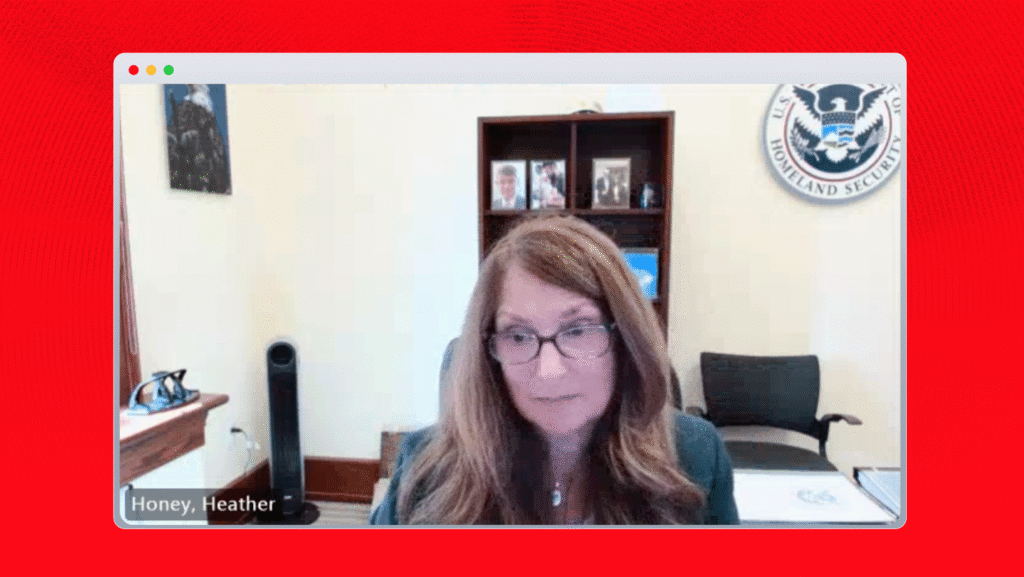
Throughout its lawsuit to block California from counting tens of thousands of ballots, the Trump administration has refused to disclose how it obtained the state’s registration records.
But recent Department of Justice (DOJ) filings in the case offer signs that Heather Honey, a leading anti-voting activist whom the Department of Homeland Security (DHS) hired last year to a senior post, could have obtained the voter data from an undisclosed party outside of the federal government.
The filings don’t settle the question. But if Honey obtained and handled the California voter data that served as the basis for DHS’s extensive search for alleged noncitizens on the voter rolls, it would further call into question the reliability of the department’s accusation against the state.
Before the DOJ filed its extraordinary lawsuit against the state, it gave California officials a DHS-produced document containing the names, addresses, and birth dates of around 20,000 alleged noncitizens illegally registered to vote in the state.
Get updates straight to your inbox — for free
Join 350,000 readers who rely on our daily and weekly newsletters for the latest in voting, elections and democracy.
Honey has a long history of promoting false claims about American elections. In 2020, she led an effort in Pennsylvania to cast doubt on the election results. To that end, she misrepresented incomplete voter roll data to push the false claim that the state had more votes reported than registered voters — a claim that President Donald Trump famously echoed during his speech on Jan. 6, 2021, hours before the deadly riot at the U.S. Capitol.
The DOJ, DHS and U.S. Immigration and Customs Enforcement (ICE) — which have all been involved in searching state voter rolls — did not respond to Democracy Docket’s detailed list of questions about Honey’s potential role in the California data’s acquisition.
While the exact identity of the source that provided the voter data to DHS remains unknown, there are several pieces of evidence that point to Honey.
An Oct. 26 declaration from Eric McLoughlin — a senior official at Homeland Security Investigations (HSI), which is ICE’s investigative arm — disclosed that “a DHS senior counselor” gave the investigative agency “what appeared to be the California voter list” on March 19, 2026.
That title aligns with Honey’s current position in the department. DHS originally appointed her in August 2025 as deputy assistant secretary for election integrity — a position it created specifically for her. However, according to Office of Personnel Management (OPM) employee records, it promoted her to senior counselor in June 2026.
Honey’s promotion occurred after the date McLoughlin said HSI received the California data, though he may have backfilled her title in his declaration. And while OPM records indicate DHS headquarters employs several senior counselors, Honey is DHS’s point person on “election integrity” efforts.
Moreover, HSI documents the legal nonprofit Democracy Forward* obtained through a records lawsuit last month indicated that Honey, months before her promotion, obtained large amounts of voter data from unnamed sources that she turned over to the investigative agency.
“48.4 million records were obtained by DAS Heather Honey through independent sources of information,” a May 2026 record stated.
The reports — a series of internal HSI reports detailing its elections-related investigations — did not specify which states Honey’s data came from.
The same records showed that the DOJ gave HSI another 50.6 million records on California, Pennsylvania, New Jersey, Minnesota, Michigan, Arizona, Florida, Georgia and Ohio.
Honey has been involved in an expansive DHS effort to scour state voter records for noncitizens. That effort appears to be the same process the department used to produce its document of 20,000 alleged noncitizens registered in California.
After Homeland Security Secretary Markwayne Mullin similarly alleged in July that thousands of noncitizens were registered in Nevada, New Jersey and Pennsylvania, Honey personally met with officials from those states and backtracked on some of Mullin’s claims.
At a hearing Tuesday, Bill Essayli, the Trump loyalist leading the DOJ’s voting lawsuit against California, confirmed that the process DHS used to identify alleged noncitizens in California was the same process it used for its allegations against Nevada.
Nevada officials have maintained that all people DHS flagged are citizens eligible to vote.
Honey is the founder of Pennsylvania Fair Elections (PFE), a state partner of the anti-voting Election Integrity Network (EIN) led by Cleta Mitchell. In that capacity, she has pushed to purge voters from Pennsylvania’s voter rolls — using data culled from unreliable apps built by election deniers, like EagleAI and IV3.
Honey also co-founded the Pennsylvania-based anti-voting organization the Election Research Institute (ERI) with Karen DiSalvo, another prominent election denier now working with her at DHS. ERI was behind a recent conspiracy theory that Iran hacked Alaska’s elections in 2020.
Additionally, Honey led efforts to pressure states — especially Pennsylvania — to withdraw from the Electronic Registration Information Center (ERIC), a nonpartisan organization that helps states coordinate accurate voter registration data.
While Honey’s potential involvement would contextualize DHS’s acquisition of California’s voter records, it would not resolve the open question of who purchased the data from the state and what may have occurred after that purchase.
“We have no idea what the provenance of the information actually is,” Branden Lewiston, an attorney representing Services, Immigrant Rights and Education Network (SIREN) and Mi Familia en Acción as defendants** in the DOJ’s California lawsuit, said in the Tuesday hearing.
“In fact, the secretary’s office asked for the details about the data and the underlying methodology in writing, and the federal government refused to provide it,” Lewiston added. “I leave it up to your honor to speculate why that might be.”
California has some of the strongest voter data protections in the country. The California Secretary of State’s office has said explicitly that the state’s voter file “is not public and is considered confidential under state law.”
Only political candidates and parties, ballot measure committees, and people who can demonstrate a specific qualifying purpose — election, scholarly, journalistic, political, or governmental — can purchase the roll, and the Secretary of State must confirm all purchases.
When someone attempts to purchase the list, they must first submit a detailed request explaining intended use and agree that data can’t be shared or transferred without Secretary of State approval. The California election code also explicitly bars large commercial data brokers from collecting and selling its voter data.
Along with his Oct. 26 declaration, McLoughlin attached a document that appears to show the voter data HSI received was originally purchased from the California Secretary of State. However, the purchaser’s name and the purchase date are both redacted.
The DOJ, DHS and ICE did not respond to Democracy Docket’s detailed questions about the buyer’s identity and the purchase date.
The unnamed DHS senior counselor who gave HSI the California voter data may not have received the data from the original purchaser.
In a separate declaration, McLoughlin appeared to imply that the California voter data was over a year old: “I believe that the voter file provided to HSI accurately reflects the actual voter rolls in California that, as of August 2025, may be used for the 2026 federal election.”
*Democracy Docket Founder Marc Elias is the chair of Democracy Forward’s board.
** SIREN and Mi Familia en Acción are represented in the case by the Elias Law Group (ELG). ELG Firm Chair Marc Elias is the founder of Democracy Docket.