Trump-Appointed Judge Rules His Portland Military Takeover Was Unconstitutional
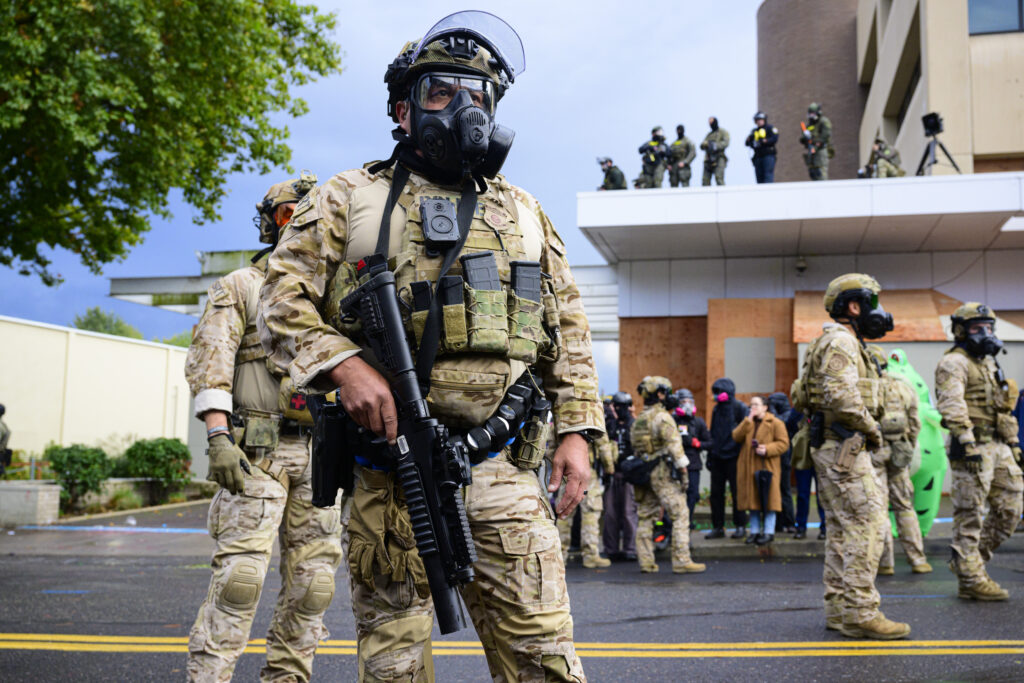
President Donald Trump violated the Constitution and federal law by ordering hundreds of National Guard soldiers to Portland, Oregon, earlier this year, a federal judge ruled Friday.
The finding from U.S. District Judge Karin Immergut, a Trump appointee, deals a major blow to the president’s authoritarian bid to militarize U.S. cities and to integrate soldiers into routine policing.
Get updates straight to your inbox — for free
Over 450,000 readers rely on our daily and weekly newsletters for the latest in voting, elections and democracy.
Alongside her determination, Immergut indefinitely barred the Trump administration from carrying out the deployment, becoming the first federal judge to permanently block one of Trump’s military interventions in a major Democratic-led city.
“This Court concludes that even giving great deference to the President’s determination, the President did not have a lawful basis to federalize the National Guard under 10 U.S.C. § 12406,” Immergut wrote. “Therefore, the President’s unlawful federalization of the National Guard violates the Tenth Amendment, which ‘reserves to the States’ any powers not expressly delegated to the federal government in the Constitution.”
The judge’s decision marks a significant victory for Portland and Oregon, which sued Trump shortly after he announced the deployment in late September. It follows a closely watched three-day bench trial last week on Trump’s deployment.
One of the central questions of the trial was whether sustained protests outside of an Immigration and Customs Enforcement (ICE) facility in southwest Portland legally justified Trump’s use of 10 U.S.C. 12406 (Title 10).
An archaic and rarely invoked law, Title 10 allowed the president to federalize members of the National Guard — which are normally under state control — when the country faces foreign invasion, when the U.S. government faces rebellion or when he is unable to execute laws with regular forces.
Attorneys for the Department of Justice (DOJ) claimed that Trump was authorized to federalize hundreds of Oregon National Guard members for deployment in Portland because the protests, which started in early June, amounted to a violent rebellion and overwhelmed federal resources to a degree that required military assistance.
The DOJ attorneys during the trial attempted to paint protests outside of the ICE building as awash in violence and chaos, echoing Trump’s earlier claims that Portland was “war ravaged” and “under siege” by “domestic terrorists.”
Lawyers representing the state and city, however, argued that Trump had no authority to federalize the Guard troops in response to the protests, which were overwhelmingly peaceful. Any violence that did break out was isolated and contained by local police and the federal government already had resources to handle crowd control at the ICE building, they also said.
In lacking authority but federalizing the troops anyway, Trump violated Title 10 and Oregon’s 10th Amendment right to state sovereignty, Portland’s and Oregon’s lawyers argued.
The judge’s decision marks a significant victory for Portland and Oregon, which sued Trump shortly after he announced the deployment in late September. It follows a closely watched three-day bench trial last week on Trump’s deployment.
One of the central questions of the trial was whether sustained protests outside of an Immigration and Customs Enforcement (ICE) facility in southwest Portland legally justified Trump’s use of 10 U.S.C. 12406 (Title 10).
An archaic and rarely invoked law, Title 10 allowed the president to federalize members of the National Guard — which are normally under state control — when the country faces foreign invasion, when the U.S. government faces rebellion or when he is unable to execute laws with regular forces.
The DOJ attorneys during the trial attempted to paint protests outside of the ICE building as awash in violence and chaos, echoing Trump’s earlier claims that Portland was “war ravaged” and “under siege” by “domestic terrorists.”
Lawyers representing the state and city, however, argued that Trump had no authority to federalize the Guard troops in response to the protests, which were overwhelmingly peaceful. Any violence that did break out was isolated and contained by local police and the federal government already had resources to handle crowd control at the ICE building, they also said.
In lacking authority but federalizing the troops anyway, Trump violated Title 10 and Oregon’s 10th Amendment right to state sovereignty, Portland’s and Oregon’s lawyers argued.
“The Founders ‘embodied their profound fear and distrust of military power in the Constitution and its Amendments,’ which has lived on through the decades as ‘a traditional and strong resistance of Americans to any military intrusion into civilian affairs,’” the judge added. “In the Supreme Court’s words, ‘slight encroachments create new boundaries from which legions of power can seek new territory to capture.’”
Immergut’s findings Friday weren’t entirely unexpected, as she previewed them in a preliminary injunction shortly after the trial. In that order, she strongly rejected the Trump administration’s argument, saying federal lawyers failed to prove that a rebellion was imminent or that ICE could not enforce the law with the resources it had on hand.
The Trump administration will likely appeal Immergut’s permanent injunction to the Ninth Circuit Court of Appeals.
Earlier this year, a Ninth Circuit panel upheld his seizure of thousands of California National Guard troops for deployment in Los Angeles.
A separate panel last month stayed one of Immergut’s orders in a broadly written ruling that astonished experts on presidential emergency powers. That ruling set off en banc proceedings that were rendered moot by Friday night’s ruling.
The Portland deployment case could ultimately reach the Supreme Court.
In addition to Portland, Trump has invoked Title 10 to deploy troops to Los Angeles and Chicago. He used separate authorities and statutes to send troops to Washington, D.C., and to use troops as part of a federal law enforcement operation in Memphis, Tennessee.
Trump’s attempted Chicago deployment has reached the Supreme Court through the Trump administration’s emergency appeal of a district court block.
The high court last week took the unexpected move of asking for additional briefing — a rare move in emergency appeals, which are typically resolved with quick rulings. Justices appear to want to find out if the “regular forces” that Title 10 mentions refers to the regular armed forces, like the Army, Navy and Air Force.
Legal experts note that the question has the potential to undermine Trump’s Title 10 military deployments.