Appeals Judges Greenlight Trump’s Portland Military Deployment
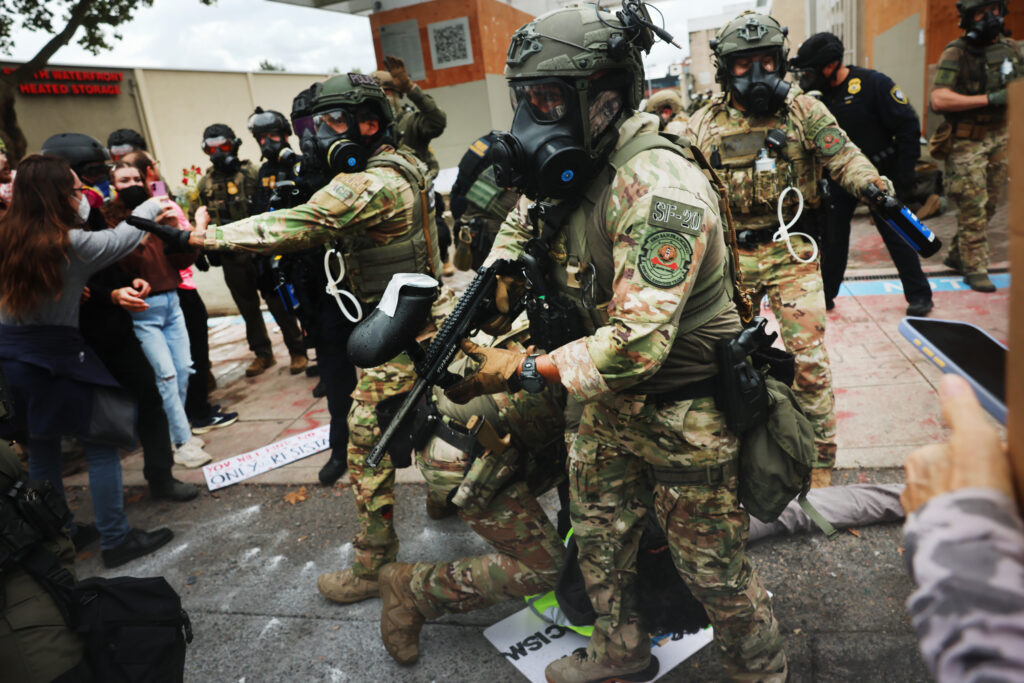
A federal appeals court Monday all but cleared the way for President Donald Trump to deploy National Guard troops into Portland, Oregon.
A three-judge panel for the Ninth Circuit Court of Appeals voted 2 to 1 to fully stay a district court order that prevented Trump from sending federalized troops into the city over the objections of Oregon Gov. Tina Kotek (D) and local officials.
Two judges appointed by Trump voted to stay the lower court order, while an appointee of former President Bill Clinton voted to uphold it.
The full Ninth Circuit will vote on whether to rehear the administration’s appeal, after one of the judges on the court requested an “en banc” review soon after the panel made its ruling.
A second district court order that bars Trump from deploying federalized troops in the state remained in effect. However, in light of the Ninth Circuit’s ruling Monday, the Department of Justice will likely ask that the second order be dissolved, which would allow Trump to officially move troops in.
Late last month, Trump declared he was federalizing Oregon National Guard troops and sending them to Portland in response to largely peaceful protests outside of an Immigration and Customs Enforcement Facility (ICE).
Trump said the troops were needed to protect federal immigration agents from “domestic terrorists” who had the city “under siege” and were rebelling against the federal government.
The president federalized the Oregon troops under under 10 U.S.C. 12406 (Title 10), an archaic and rarely used statute that allows the president to federalize state Guard troops when the country faces foreign invasion, when the U.S. government faces rebellion or when the president is unable to execute laws with regular resources.
After Portland and Oregon sued, U.S. District Judge Karin Immergut, who was appointed by Trump in his first term, blocked the federalization of Oregon troops and their deployment, finding that Trump’s assessment of conditions in the city “was simply untethered to the facts.”
Immergut found that recent protests in the city could not be considered a “rebellion” against the federal government, as the Trump administration claimed.
In court filings, top law enforcement officials in Oregon said protests near the ICE facility were largely sedate gatherings of a few dozen people that could be managed by local and state resources.
After the Trump administration attempted to send federalized California Guard troops to Portland, she issued a second order fully blocking Trump from deploying troops in Oregon.
In Monday’s ruling, Ninth Circuit Judges Ryan Nelson and Bridget Bade, two Trump appointees, said Immergut did not give Trump’s interpretation of the facts enough deference.
“Instead, the district court substituted its own assessment of the facts for the President’s assessment of the facts,” Nelson and Bade wrote.
In response to Trump’s military deployment in Los Angeles this summer, a separate panel for the Ninth Circuit rejected the DOJ’s argument that a president’s decision to federalize state Guard troops under Title 10 cannot be reviewed by the courts. However, that panel added that a court’s review of Title 10 federalization must be “highly deferential” toward the president.
Nelson and Bade claimed that Immergut incorrectly applied the “highly deferential” standard by considering the facts on the ground.
The Trump appointees also said Immergut should not have questioned Trump’s decision to cite events occurring beyond Portland in justifying a deployment in the city, asserting that a president’s use of Title 10 is not “limited by undefined temporal restrictions.”
“Section 12406 contains no such limitations,” they wrote. “The statute delegates the authority to make that determination to the President and does not limit the facts and circumstances that the President may consider in doing so.”
“The President can, and should, consider the totality of the circumstances when determining whether he ‘is unable with the regular forces to execute the laws of the United States.’”
Nelson and Bade also claimed the district judge erred in adopting an incorrect reading of “rebellion.”
Writing in the minority, Susan Graber, the Clinton appointee, described the ruling as “absurd.”
“It erodes core constitutional principles, including sovereign States’ control over their States’ militias and the people’s First Amendment rights to assemble and to object to the government’s policies and actions,” the judge wrote.
“In the two weeks leading up to the President’s September 27 social media post, there had not been a single incident of protesters’ disrupting the execution of the laws,” she added. “I repeat: not a single incident for two weeks.”
Graber encouraged the rest of her colleagues on the Ninth Circuit to “swiftly” vacate Monday’s order “before the illegal deployment of troops under false pretenses can occur.”
“Above all, I ask those who are watching this case unfold to retain faith in our judicial system for just a little longer.”
This story has been updated with new details throughout.