‘Dangerous and Legally Flawed’: Experts Slam Trump Judges’ Green Light for Portland Military Takeover
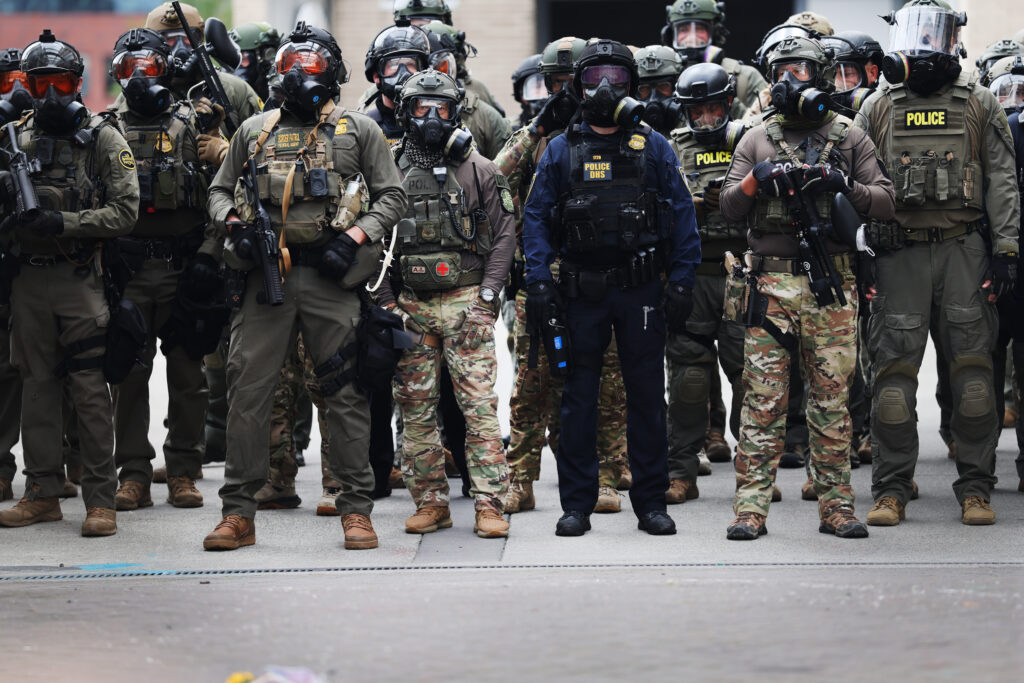
Legal experts are sounding the alarm on a shocking federal appeals court ruling that all but permitted President Donald Trump’s deployment of National Guard troops into Portland, Oregon. They warn that, if upheld, the order would give Trump unbridled power to use the military domestically.
Two Trump appointed judges on a three-judge Ninth Circuit Court of Appeals panel voted Monday to stay a lower court ruling blocking Trump’s deployment in the City of Roses.
The full 9th Circuit is set to vote on whether to rehear the case.
Get updates straight to your inbox — for free
Join over 350,000 readers who rely on our daily and weekly newsletters for the latest in voting, elections and democracy.
The two circuit court judges claimed that U.S. District Judge Karin Immergut, who was also appointed by Trump, incorrectly questioned the president’s decision to federalize 200 Oregon National Guard members and deploy them to the city late last month.
Trump’s deployment is still blocked by a second order from Immergut that remains in effect. However, shortly after the Ninth Circuit panel’s ruling, the Department of Justice (DOJ) asked Immergut to dissolve her second order, which would officially allow Trump to move soldiers into Portland.
Elizabeth Goitein, a senior director at the Brennan Center for Justice and an expert on presidential emergency powers, wrote on social media Tuesday it was “one of the most dangerous and legally flawed court decisions I’ve seen this year.”
Goitein noted that Judges Bridget Bade and Ryan Nelson — the Trump appointees on the panel — significantly expanded the president’s ability to federalize and deploy Guard troops domestically by arguing that he should be allowed to cite prior unrest in Portland, or even unrest in other parts of the country, to justifying a military intervention in a city.
“By this logic, Trump should be able to deploy the military today—in Portland and many other cities—to address conduct that occurred during the 2020 protests over the police killing of George Floyd,” Goitein wrote.
The ruling, Goitein wrote, was “clearly” an incorrect reading of 10 U.S.C. 12406 (Title 10), the archaic statute Trump used to federalize Oregon’s troops. It allows the president to federalize state Guard troops when the country faces foreign invasion, when the U.S. government faces rebellion or when the president is unable to execute laws with regular resources.
Goitein added that through their ruling, Bade and Nelson undermined First Amendment rights by upholding the Trump administration’s conclusion that the president was unable to execute the law in Portland without the Guard’s assistance.
Trump claimed in late September Guard troops were needed to protect Immigration and Customs Enforcement (ICE) agents from “domestic terrorists” who had an ICE facility in the “War ravaged” city “under siege.” The Trump administration further claimed that the recent anti-ICE demonstrations in the city amounted to a “rebellion” against the U.S. government.
State and local police officials pushed back on Trump’s interpretation of conditions in the city, saying in court filings that demonstrations near the facility were largely sedate gatherings of a few dozen people that could be managed by local and state resources.
“It is hard to overstate how misguided and dangerous this ruling is,” Goitein wrote. “Even where protests involve acts of violence, deploying the military is illegal unless that violence reaches a level where state and local law enforcement are completely overwhelmed.”
Writing in a minority opinion Monday, Susan Graber, appointed by former President Bill Clinton, also criticized Nelson and Bade’s ruling for threatening freedom of speech.
“It erodes core constitutional principles, including sovereign States’ control over their States’ militias and the people’s First Amendment rights to assemble and to object to the government’s policies and actions,” Graber wrote.
Athul Acharya, the executive director of the nonprofit civil-rights law firm Public Accountability, pointed out that Nelson, through a concurring opinion, took a more extreme position than Bade.
Nelson adopted the Trump administration’s argument that courts have no authority to question a president’s decision to federalize troops under Title 10. In taking that position, he was disagreeing with precedent set by a separate Ninth Circuit panel over Trump’s deployment in Los Angeles.
In that case, the other panel rejected the Trump administration’s arguments that courts can’t review Title 10 federalizations but also held that any judicial review must be “highly deferential” to the president.
That was the position Bade took as well, though she found that Immergut misapplied the “highly deferential” standard by disagreeing with Trump’s assessment of unrest in Portland.
“Love that ‘the president can use the National Guard to invade Portland’ is the moderate position here,” Acharya wrote on social media. “Ryan Nelson would’ve held that as long as Trump recites some magic words, he can do whatever he wants with the National Guard, whenever, wherever.”
Marty Lederman, a Georgetown Law professor and former DOJ attorney, highlighted that while Bade and Nelson at length argued why they were deferring Trump’s determination that he was unable to execute the law in Portland, they never recognized such a determination from the president.
Trump announced the Portland military deployment through a series of social media posts. In oral arguments, the DOJ argued that the posts were Trump’s formal determination that troops were needed. Bade and Nelson, however, ultimately rejected that argument, leaving no formal determination from the president.
In addition to being heavily criticized by legal experts, Bade and Nelson’s ruling may soon be scrutinized by their colleagues as well. Shortly after they issued their order, a Ninth Circuit judge requested that the court vote on whether a larger panel should rehear the Trump administration’s appeal of Immergut’s ruling.
This is known as an “en banc” — or “on the bench” — hearing and usually means that all judges in the appellate court, rather than a smaller panel, hear a case.
However, the Ninth Circuit’s en banc process is unique given its size. As the largest appellate circuit in the country, it has 29 active judgeships, which is far too many to participate in a rehearing.
Instead, the full court takes a vote on whether to rehear an appeal. If approved, a limited en banc court composed of 11 judges — the chief judge and 10 others drawn at random — convenes for a rehearing.
Steve Vladeck, a Georgetown Law professor, noted that due to this unique process, the full Ninth Circuit, which leans liberal, will likely vote to rehear the Trump administration’s appeal, but the limited en banc court could uphold Bade and Nelson’s ruling depending on which judges are drawn.
It’s unclear exactly which Ninth Circuit judge called for an en banc hearing, but in her dissent, Graber urged her colleagues to “swiftly” vacate Monday’s order “before the illegal deployment of troops under false pretenses can occur.”
A separate Ninth Circuit panel is set to hear oral arguments Wednesday over Trump’s LA deployment. It will consider whether U.S. District Judge Charles Breyer was correct in finding that Trump’s use of troops in the city earlier this year violated a law that largely bars the use of the military in law enforcement.