As White House threatens midterms, states are working to Trump-proof the vote
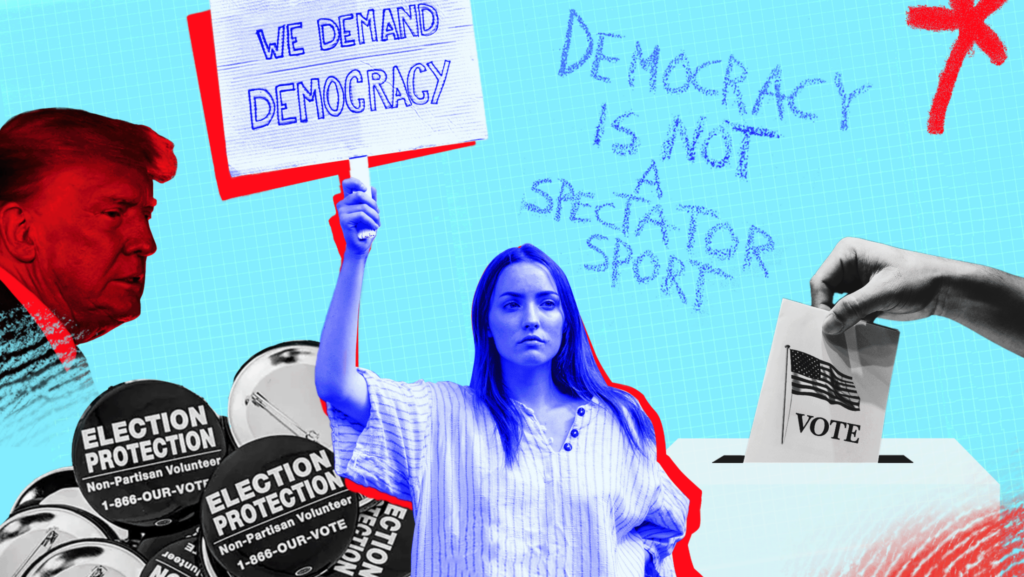
As President Donald Trump and his administration escalate threats to interfere in this year’s midterms, at least 11 states led by Democrats are taking steps to harden their elections against White House meddling.
From defending against the administration’s threats to send law enforcement agents to the polls to shoring up voting rights, these states are passing legislation to help ensure that voters — not Trump — have the final say.
Officers at the polls
Federal law bars the deployment of federal troops or armed federal law enforcement to any polling place unless “such force be necessary to repel armed enemies of the United States.”
But Trump allies have made it clear that they are open to deploying federal immigration agents to the polls this year. During an appearance at the Conservative Political Action Conference (CPAC), Deputy Attorney General Todd Blanche signaled his support for the idea. And Trump ally Steve Bannon suggested that the president’s decision to deploy Immigration and Customs Enforcement (ICE) agents to U.S. airports was part of a “test run” for upcoming elections.
Some states with Democratic leadership are taking those threats seriously. And state-level protections could become essential if the administration violates federal law prohibiting such deployments.
Last month, New Mexico signed into law a measure prohibiting the deployment of troops or federal law enforcement at the polls. The legislation also prohibits interference in the conduct of an election, and it gives the state attorney general, secretary of state, county clerks and voters the right to bring civil action in district court to enforce the law.
Get updates straight to your inbox — for free
Join 350,000 readers who rely on our daily and weekly newsletters for the latest in voting, elections and democracy.
The Maryland General Assembly is now considering a bill that would require police officers at polls to obey the orders of state and local election officials. It also would give state and local election officials the authority to order the arrest of individuals who interfere with conducting an election. The bill has passed in the state Senate and is close to a final vote in the House.
Illinois is considering a bill that would block law enforcement agents from entering polling places unless called upon by election officials or required by court order.
And California has a measure under consideration that would prohibit federal, state or local law enforcement officers from making arrests within 200 feet of a polling place on election day.
State Sen. Tom Umberg (D), an author of the bill, said the proposal is meant to help protect against election interference.
“Our state is facing serious threats from the Trump administration,” Umberg said in a statement after filing the bill, “and we will not treat them as idle or hypothetical.”
The Brennan Center for Justice published model legislation last month that provides a template for state lawmakers to introduce bills aimed at reinforcing the federal provisions banning troops or other federal agents at the polls.
Protecting voting
Last week, Trump signed a sweeping executive order that would sharply restrict mail voting. Meanwhile, he and his allies are still desperately fighting to pass the federal SAVE America Act, exceedingly anti-voting legislation that would place proof of citizenship hurdles in the way of millions of eligible voters. And some GOP-controlled states like Florida have scrambled to pass their own state versions of the restrictions.
It remains unclear whether any of those provisions will be in place for this year’s midterms. But some states controlled by Democrats are looking for ways to counter their potential damage in advance.
This week, New Jersey signed into law a measure that expands the early voting period from a total of four days to seven days. The Virginia General Assembly passed a bill last month prohibiting the hand counting of ballots. Hand counts are a popular idea among election deniers, but are actually less accurate and effective for counting large numbers of ballots than machine counts.
And in Colorado, the state House passed a bill last month that would require election officials to send out mail ballots one week earlier, giving voters more time to return them. It would also clarify that authorities who certify election results have a duty to certify the vote, and it would expand an existing prohibition on voting interference to a wider area surrounding a polling location.
And with Trump’s redistricting arms race still playing out across the country, Vermont and Rhode Island could become the latest states to pass state-level voting rights act legislation aimed at protecting voters against gerrymandering.
Prohibiting interference
States are also working on shoring up their protections against election interference.
As the U.S. Department of Justice (DOJ) sues 30 states — including Washington — for refusing to turn over their unredacted statewide voter registration lists, the Evergreen State recently signed into law a measure protecting its data. The law makes it a felony for state or local election officials to disclose private voter information.
And Minnesota lawmakers are considering a bill that would increase the penalty for intimidation and interference with voting or an election official’s duties from a misdemeanor to a felony.