Voting advocates call on Supreme Court to uphold block on Trump’s anti-mail voting order
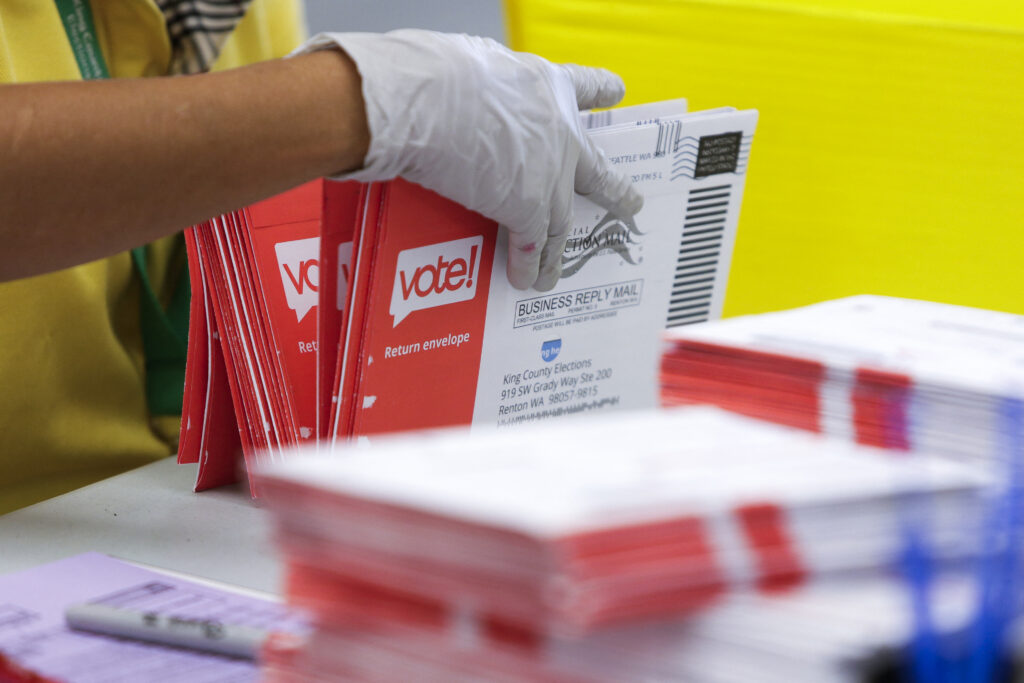
A dozen groups are urging the Supreme Court to uphold a block on President Donald Trump’s sweeping executive order attempting to restrict mail voting before the upcoming midterms.
In court filings this week, voting rights advocates, local election officials, and former governors and judges said the Court should reject the Department of Justice’s (DOJ) and Republican-led states’ emergency applications to lift a lower court ruling currently blocking Trump’s order.
The groups warned that granting the appeals less than 100 days before the vote would sow chaos, risk disenfranchising voters and create administrative nightmares for election officials.
Get updates straight to your inbox — for free
Join 350,000 readers who rely on our daily and weekly newsletters for the latest in voting, elections and democracy.
In one brief, 56 former federal and state judges appointed by both Republican and Democratic presidents and governors warned that granting the DOJ’s and GOP-led states’ requests “is not in the public’s interest and would undermine confidence in elections and the court system.”
“Emergency relief from this Court would impose these burdensome new requirements on state and local election officials simply because the President wishes to impose them, notwithstanding his lack of any role in administering elections under the Constitution,” the former judges wrote.
The dozen groups joined Democratic officials in 23 states and the District of Columbia who are challenging Trump’s order. On Monday, the officials filed a motion calling on the Supreme Court not to lift the block.
The Supreme Court could now rule on the emergency applications at any moment.
If the Court stays the lower court’s order, federal agencies could continue to implement Trump’s anti-voting directives. That would include his instruction to the U.S. Postal Service to only deliver ballots to voters on a list pre-approved by the federal government.
U.S. District Judge Indira Talwani blocked that directive, and many others, in a major ruling in June. She found that they were “legally void” and encroached on states’ authority to administer elections.
After a three-judge panel for the First Circuit Court of Appeals upheld Talwani’s ruling, the DOJ and 12 conservative states asked the Supreme Court for an emergency stay.
In another filing, the American Association of People with Disabilities (AAPD), which advocates for the civil rights of over 70 million disabled Americans, said that greenlighting Trump’s restrictions risks disenfranchising voters with disabilities.
“Regardless of the Court’s view of the merits, undoing the injunction will (at best) sow confusion about how AAPD’s members can vote,” AAPD wrote. “At worst, it will nullify their vote entirely by imposing new and chaotic layers of bureaucracy that cannot be untangled in time for disabled voters to return a mail ballot.”
“The prudent course is to maintain the status quo for the 2026 election, while the government promulgates the rules it says are forthcoming. The stay should be denied,” it added.
Officials from Harris County, Texas, the third most populous county in the U.S., also opposed lifting the block, arguing that it “would dangerously upend the November 2026 election and allow haphazard implementation of an Executive Order that violates the Constitution, federal statutes and Texas law.”
“It is wholly unworkable for Harris County—and likely most any other jurisdiction—to comply with the regulatory scheme envisioned by the Executive Order in time to administer the November 2026 election,” county officials said in their filing.
The amicus briefs filed in the case strongly favored denying a stay. Of the 13 briefs submitted, only one supported Trump’s order and called for the Court to stay Talwani’s ruling.
A handful of conservative groups led by Citizens United — the organization behind the landmark 2010 U.S. Supreme Court case Citizens United v. FEC, which lifted limits on independent campaign spending — said the Court should grant a stay.
The conservative groups called Talwani’s order “lawless” and claimed it “has already done great damage to the nation” by freezing “efforts to enforce the federal ban on voting by noncitizens in federal elections.”
They also asserted that Trump’s executive order was permitted because he has a responsibility under the Take Care Clause of the U.S. Constitution to ensure that noncitizens do not vote.
Talwani rejected that line of reasoning in her order. She found that while the Constitution empowers the president to take care that laws are faithfully executed, it doesn’t give him any specific powers to regulate voting and elections.