Supreme Court refuses to restore Virginia redistricting plan approved by voters
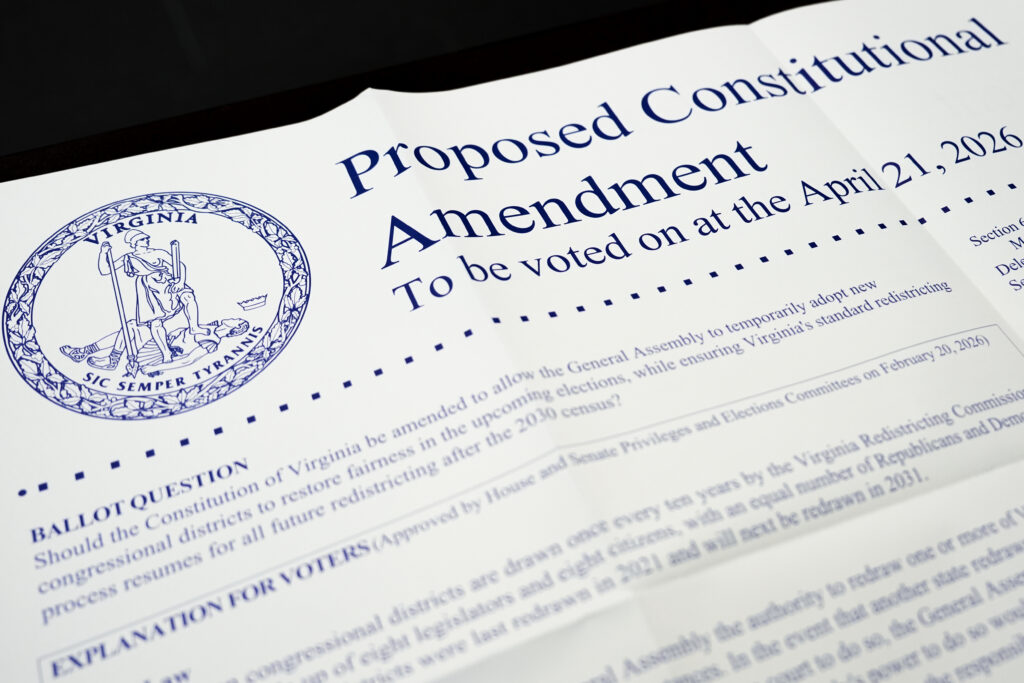
The U.S. Supreme Court Friday rejected Virginia Democrats’ emergency request to revive a voter-approved plan that would have allowed the state to redraw its congressional map in response to Republican gerrymanders in other states.
The decision leaves in place a bombshell ruling from the Virginia Supreme Court, which threw out the referendum after more than 3 million Virginians voted on whether to authorize new congressional districts. A majority of voters approved the amendment, but the state Supreme Court ruled 4-3 that the process violated Virginia’s constitutional requirements and declared the vote “null and void.”
The denial comes after Virginia Gov. Abigail Spanberger (D) said Thursday the state would proceed with the current congressional map for the 2026 midterms regardless of the Supreme Court’s decision, citing looming election administration deadlines.
Get updates straight to your inbox — for free
Join 350,000 readers who rely on our daily and weekly newsletters for the latest in voting, elections and democracy.
Virginia Attorney General Jay Jones (D), House Speaker Don Scott (D), Senate Majority Leader Scott Surovell (D) and Senate President Pro Tempore L. Louise Lucas (D) had asked the U.S. Supreme Court to intervene, arguing the state court misread federal election law, overstepped its authority and nullified the votes of millions of Virginians.
The filing placed Democrats in an unusual posture where they asked the U.S. Supreme Court to rein in a state Supreme Court using a narrower version of an argument rooted in the independent state legislature theory, a legal theory more commonly invoked by Republican litigants.
In its extreme form, that theory claims state courts have little power to review state legislatures’ election rules. The Supreme Court dismissed that sweeping version in 2023 but left open the possibility that federal courts can step in when state courts “transgress the ordinary bounds of judicial review.”
Democrats also argued the Virginia ruling misunderstood federal Election Day law by treating early voting as part of the “general election” itself, rather than voting that occurs before Election Day.
The Supreme Court’s refusal to grant emergency relief is a major blow to Democrats as Republican-led states across the South move quickly to redraw maps after the court’s devastating Callais decision gutted key Voting Rights Act protections.
With Tennessee and Alabama already enacting a new GOP gerrymander at the expense of Black voters and Georgia, Louisiana, Mississippi and South Carolina advancing similar efforts, Virginia had represented Democrats’ clearest opportunity to fight back with a new map of their own.
The path for Democrats to restore fair representation on a national scale remains hindered.