Virginia Democrats ask Supreme Court to restore voter-approved redistricting plan
 Prefer us on Google
to see more of our voting rights news coverage when you search.
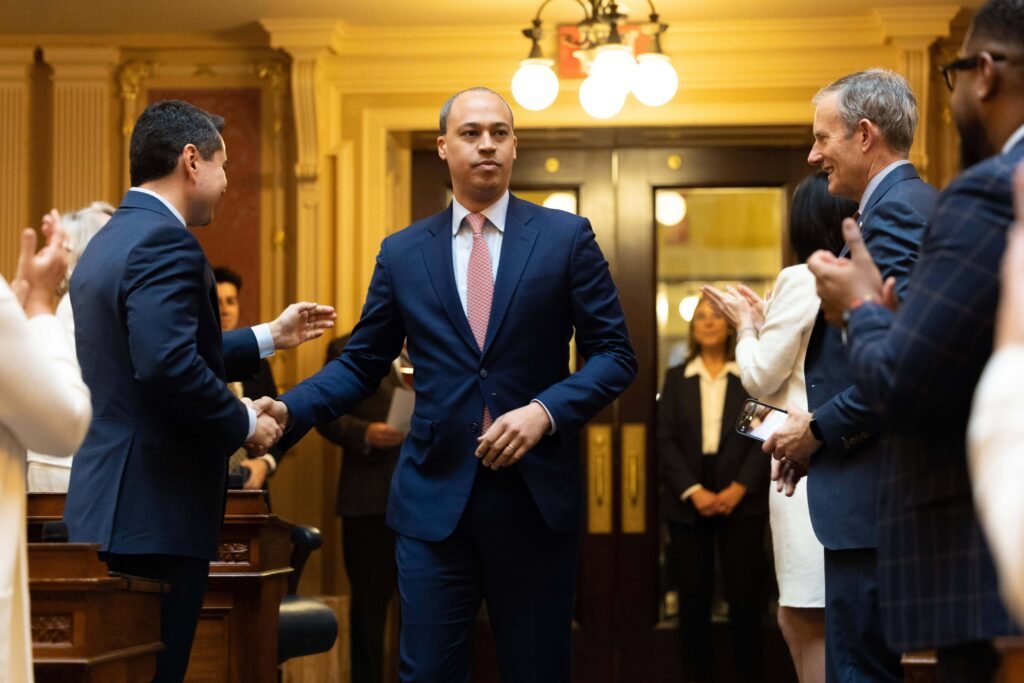
Virginia Democrats have asked the U.S. Supreme Court to pause a state Supreme Court ruling that invalidated a voter-approved constitutional amendment aimed at redrawing the state’s congressional map in response to Republican gerrymanders in other states.
In an emergency application filed Monday, Virginia officials and Democratic lawmakers argued the state Supreme Court misread federal election law, overstepped its authority and nullified the votes of millions of Virginians.
Get updates straight to your inbox — for free
Join 350,000 readers who rely on our daily and weekly newsletters for the latest in voting, elections and democracy.
The emergency application, filed by Virginia Attorney General Jay Jones (D), House Speaker Don Scott (D), Senate Majority Leader Scott Surovell (D) and Senate President Pro Tempore L. Louise Lucas (D), asks Chief Justice John Roberts to issue an immediate administrative stay while the Court considers whether to take up the case.
Roberts handles emergency matters arising from Virginia.
The filing comes after the Virginia Supreme Court ruled 4-3 Friday that the state’s redistricting referendum was “null and void,” effectively wiping out a special election in which more than 3 million Virginians voted on whether to approve a constitutional amendment authorizing new congressional maps.
The case puts Virginia Democrats in a delicate posture by asking the U.S. Supreme Court to rein in a state court’s interpretation of election law using a narrower version of a legal theory more commonly associated with Republican election litigation.
That theory is rooted in the Elections Clause of the U.S. Constitution, which gives state legislatures authority to regulate federal elections subject to congressional oversight.
In its most extreme form, known as the independent state legislature (ISL) theory, Republican litigants have argued that state courts have almost no power to review state legislatures’ federal election rules under state constitutions.
The Supreme Court rejected that sweeping version in the 2023 case Moore v. Harper. But the Court also left open a narrower principle, ruling that state courts cannot go so far in interpreting state law that they “transgress the ordinary bounds of judicial review” and effectively seize election authority from state legislatures.
Virginia Democrats are now relying on that narrower opening.
“By rejecting the plain text of the Virginia Constitution’s definition of the term ‘election’ to adopt its own contrary meaning, the Supreme Court of Virginia ‘transgressed the ordinary bounds of judicial review such that it arrogated to itself the power vested in the state legislature to regulate federal elections,’” the applicants wrote, quoting Moore. “Either violation is sufficient for this Court to reverse the decision below.”
That argument is striking.
Democrats have spent years largely warning that the independent state legislature theory could empower partisan legislatures and weaken checks on election manipulation. Here, however, they are using the more limited version preserved in Moore to argue that a conservative state court went too far by overriding both the legislature and voters.
The filing stresses that Democrats are not claiming state courts can never enforce state constitutions in federal election cases.
Instead, they argue the Virginia Supreme Court departed so dramatically from ordinary interpretation that it crossed a federal constitutional line.
Their first major argument is that the Virginia Supreme Court misunderstood federal law governing Election Day.
The Virginia court’s ruling turned on whether the General Assembly passed the redistricting amendment before the “next general election,” as required by the Virginia Constitution’s amendment process. The state court concluded that because early voting had already begun, the election was already underway before the legislature first approved the amendment.
But, Virginia Democrats say that interpretation conflicts with federal law, which treats congressional elections as occurring on a single day in November — even if voters cast early or absentee ballots beforehand.
“[The Supreme Court of Virginia] predicated its interpretation of the Virginia Constitution on a grave misreading of federal law, which expressly fixes a single day for the ‘election’ of Representatives and Delegates to Congress,” the applicants wrote.
They point to federal statutes establishing Election Day as “the day for the election” of members of Congress, arguing early voting happens before the election but does not legally transform the election into a weeks-long event.
That argument intersects with another major pending Supreme Court case — Watson v. Republican National Committee — which concerns whether federal Election Day statutes prohibit states from counting mail ballots received after Election Day if they were cast by Election Day.
The case, argued in March, asks whether federal Election Day laws override state laws that count timely cast mail ballots received during a short grace period after Election Day.
In Watson, Republicans have argued that federal law requires ballots to be received by Election Day. Voting rights advocates and some election officials warn that theory could invalidate mail ballots cast by eligible voters who followed state law.
The Virginia application uses the Election Day debate in a different way.
Democrats argue the Virginia Supreme Court effectively adopted a view of “election” that, if taken seriously, could undermine legal arguments for post election ballot receipt deadlines in another case pending before the court.
“The understanding of federal law on which the Virginia Supreme Court based its ruling was gravely mistaken,” the applicants wrote. “It simply ignored the federal statutes that settle the question.”
They also argue federal appellate courts have upheld early voting because the legal election is still “consummated,” or finalized, on Election Day — not because early voting expands Election Day into a broader time period.
That matters because if the Virginia Supreme Court’s ruling depended on federal law, then the U.S. Supreme Court has a clearer path to step in.
Normally, state supreme courts have the final word on state constitutional questions. But Virginia Democrats argue this ruling is reviewable because the state court’s interpretation was “interwoven” with federal election law.
The filing’s second major argument is that the state court’s ruling caused immediate and irreparable harm by forcing Virginia to use maps that voters rejected.
The emergency application repeatedly emphasizes that the referendum already occurred, voters approved the amendment and that election deadlines are imminent.
“Based on that novel and manifestly atextual interpretation, the Court overrode the will of the people who ratified the amendment by ordering the Commonwealth to conduct its election with the congressional districts that the people rejected,” the applicants wrote.
Virginia Democrats argue the ruling harms not only state officials but also voters and candidates who need certainty as the 2026 midterm election approaches.
The application says the primary is scheduled for Aug. 4, military and overseas ballots must be sent 45 days before Election Day and election administrators must finalize ballot order by May 28.
“The window for orderly administration of Virginia’s congressional elections is closing rapidly,” the applicants wrote. “This Court should act now to preserve the status quo while it considers the grave federal questions the decision below raises.”
The broader political stakes are enormous.
The Virginia referendum was one of Democrats’ most significant countermeasures to a wave of Republican gerrymanders nationwide, especially those unleashed after the Supreme Court’s Louisiana v. Callais decision, which gutted key Voting Rights Act protections.
Since Callais, GOP-led states including Alabama, Louisiana, Tennessee and South Carolina have moved quickly toward new congressional maps that voting rights advocates warn will dilute Black voting power and lock in Republican advantages ahead of the midterms.
Virginia Democrats argue the state’s voters approved a lawful response to that national landscape — only to have it nullified by a divided state court days before election administration deadlines.
“The Virginia Supreme Court’s decision amounts to judicial defiance of the Commonwealth’s Constitution and the statutes enacted by the General Assembly lawfully establishing congressional districts to be used in the upcoming 2026 election,” the applicants wrote.
The Supreme Court could deny the application, grant a temporary administrative stay while it considers the matter or pause the Virginia ruling while it considers whether to fully review the case.