Supreme Court greenlights Alabama’s racial gerrymander, signaling free rein for states to discriminate
 Prefer us on Google
to see more of our voting rights news coverage when you search.
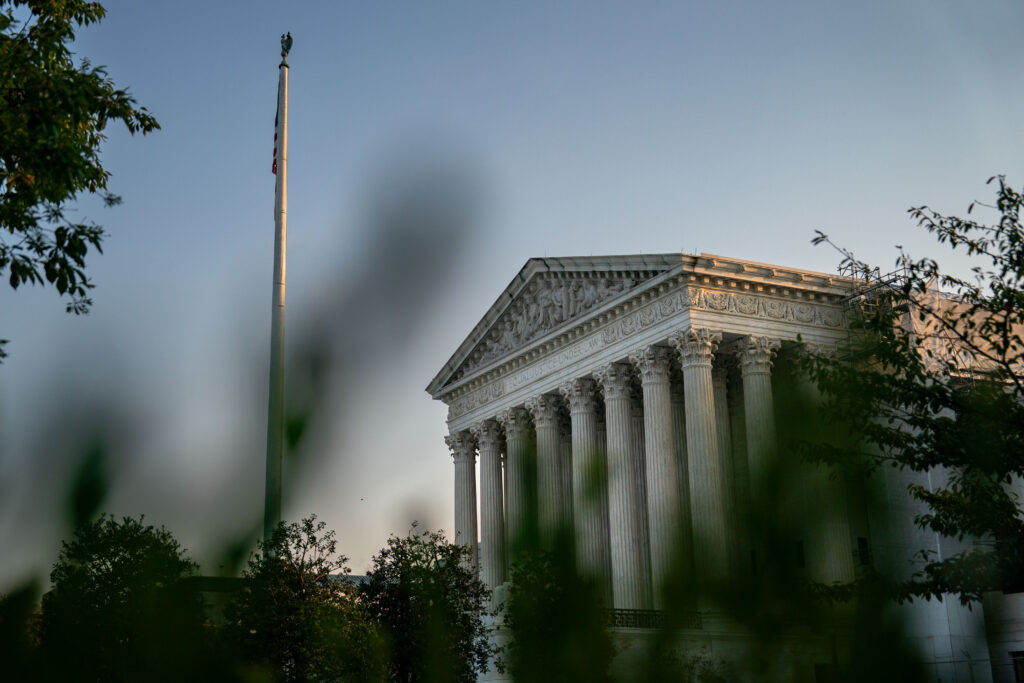
The U.S. Supreme Court will allow Alabama to use a congressional map found to have intentionally discriminated against Black voters, it said Tuesday.
When the court gutted the Voting Rights Act (VRA) in Louisiana v. Callais, it found that intentional racial discrimination in voting remains unconstitutional. But the new ruling, to which all six conservative justices signed on, suggests that, in practice, almost no federal protections remain for non-white voters, even in extreme cases.
Get updates straight to your inbox — for free
Join 350,000 readers who rely on our daily and weekly newsletters for the latest in voting, elections and democracy.
The most immediate impact of the ruling is that Alabama will be free to use its gerrymandered map in its primary election, which has been rescheduled for August.
A federal court found in 2023 that lawmakers intentionally discriminated in drawing Alabama’s congressional map, which diluted the voting strength of Black Alabamians. The Supreme Court agreed, and in 2024 the state was required to use a fairer map, with two Black-majority districts.
“As to intentional vote dilution, the District Court did not heed the presumption of legislative good faith because it interpreted the State’s legal disagreement with the court’s earlier remedial order as proof of discriminatory animus,” the court’s conservative majority wrote.
In the April 29 Callais ruling — which all but ended the VRA’s ability to block maps that reduce minority voting power — Justice Samuel Alito wrote that the decision had “no bearing” on the court’s earlier finding on Alabama’s map. He wrote that maps could still be found in violation of the VRA if it was proven that they were drawn with the explicit intent of discriminating against a state’s minority voters.
Still, shortly after Callais, Alabama lawmakers resuscitated the state’s previously blocked map. They did so while an active election was happening, hoping that courts would quickly step in and allow them to use it. Alabama Gov. Kay Ivey scheduled a special election based on that map for August 11, also betting on courts’ approval.
But last month, a three-judge panel found the map to still be a violation of the 14th Amendment and the court’s new legal standard under Section 2 of the VRA. Alabama appealed that ruling to the Supreme Court.
The request has been seen as the first major test of the high court’s new approach to policing racial discrimination in voting.
“Before the Court are two paths. Down one lies an orderly election, held under a tried-and-tested congressional map that protects Black Alabamians’ right to vote and with which all voters, elections officials, and candidates alike are familiar,” the court’s dissenting justices wrote. “Down the other lies a chaotic election, held under a never-before-used congressional map that intentionally discriminates against Black Alabamians, that Alabama adopted in unashamed defiance of a prior court order directly affirmed by this Court, and that will require officials to change the voter registrations of hundreds of thousands of voters in just days at best, a task that Alabama previously represented would take months.”
Citing the election law doctrine known as the Purcell principle, the justices said the lower court erred by changing election rules close to an upcoming election, risking confusion for voters and election administrators.
“To switch to the 2023 Redistricting Plan now, however, county elections officials will have to reassign hundreds of thousands of voters across the State to new congressional districts,” the dissent added. “Three of Alabama’s counties will be particularly hard hit because they are split across two congressional districts. These counties have about 600,000 registered voters between them (roughly 15% of the State’s total number of registered voters).”
Critics say the Court’s conservative majority has applied that principle selectively to reach its preferred outcomes. In December, the Court invoked similar reasoning to stay a lower-court order blocking Texas’ 2025 congressional map, which the lower district court had found likely to be an unconstitutional racial gerrymander. The map is expected to give Republicans several additional seats in Congress.