Prominent MAGA figures pushing Supreme Court to hear John Eastman disbarment appeal
 Prefer us on Google
to see more of our voting rights news coverage when you search.
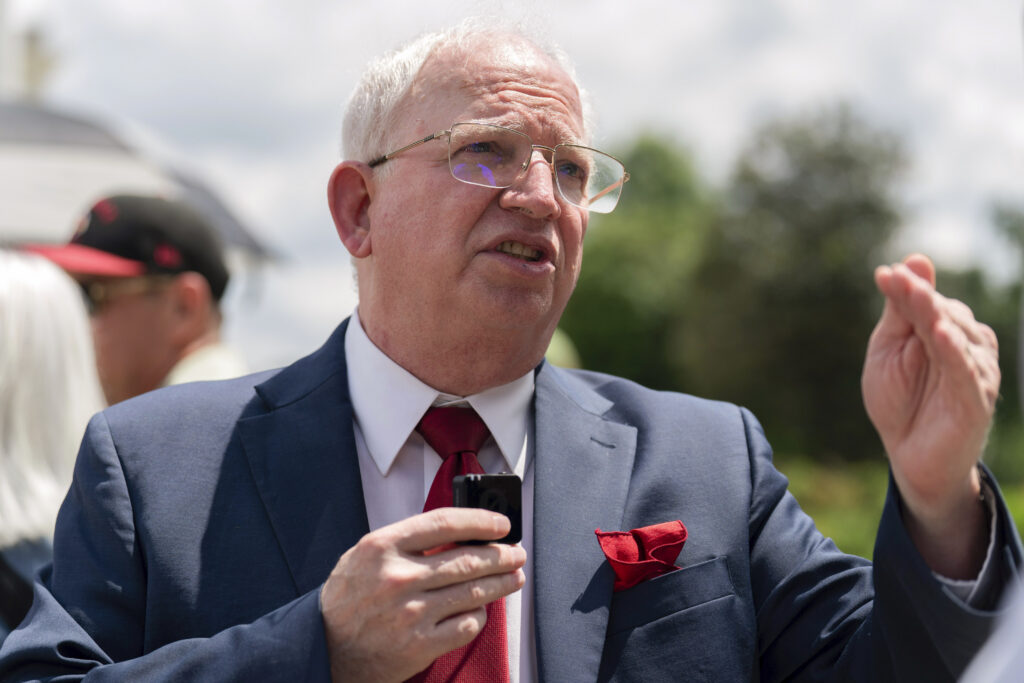
Prominent Republicans and key allies of President Donald Trump are supporting John Eastman’s bid to get the U.S. Supreme Court (SCOTUS) to overturn his disbarment — and there’s a chance the nation’s highest court could take up the case.
Eastman is a longtime conservative attorney and Trump ally whom the California Supreme Court in April permanently barred from practicing law in the Golden State over his direct involvement in the president’s effort to overturn the 2020 presidential election results.
Among the people now going to bat for Eastman are Sens. Ted Cruz (R-Texas) and Mike Lee (R-Utah), and a coalition of former Trump attorneys who helped his 2020 election subversion effort: anti-voting lawyer Cleta Mitchell, former One America News Network reporter Christina Bobb, recently departed U.S. Department of Justice pardon attorney Ed Martin, lawyers Jenna Ellis and Sidney Powell, and others.
In September, Eastman asked the nation’s highest court to consider overturning his disbarment because, he argued, the California Supreme Court’s ruling violated his First Amendment rights and “embraces the use of the bar disciplinary process as a politicized weapon.”
His supporters have also embraced that argument.
“That whole proceeding in CA is a travesty and must be reversed,” Mitchell, who leads the anti-voting Election Integrity Network, wrote on social media. “SCOTUS should put a stop to this abuse of the bar disciplinary process being used as a partisan political weapon. This is a well funded, leftwing coordinated conspiracy and SCOTUS needs to address it.”
But Eastman wasn’t disbarred for his opinions. He was the key architect in the election subversion effort, drafting two controversial memos that presented ways in which Trump could remain in the White House after losing the 2020 election. The second memo was a six-page document that advocated persuading Vice President Mike Pence to throw out the electoral votes for Joe Biden in seven key states.
Get updates straight to your inbox — for free
Join 350,000 readers who rely on our daily and weekly newsletters for the latest in voting, elections and democracy.
The plan hinged, in part, on the fringe independent state legislature theory, which posits that only the legislature can set the rules for federal elections, including how presidential electors are chosen.
Pence rebuffed Eastman’s scheme, acknowledging he had no authority to overturn the election. Trump’s efforts to cling to power then faltered, but they nonetheless birthed wide-ranging conspiracy theories that the 2020 election was stolen, which culminated in a deadly riot by Trump supporters at the U.S. Capitol on Jan. 6, 2021.
In the days after the Jan. 6 attack, Eastman sought a pardon from Trump, even though he hadn’t yet been charged with any crime.
“I’ve decided that I should be on the pardon list, if that is still in the works,” Eastman wrote in an email to Trump allies.
These efforts led the State Bar Court of California to recommend disbarring Eastman in 2024, charging him with one count of “failing to support the Constitution and laws of the United States,” two counts of “seeking to mislead a court,” six counts of “moral turpitude by making various misrepresentations” and, finally, two counts of “moral turpitude.”
Eastman appealed the State Bar Court’s ruling to the state’s highest court, which upheld his disbarment.
In a statement, the American First Policy Institute (AFPI) — a right-wing think tank that filed a brief on behalf of the former Trump attorneys — said that the Court’s “decision could mark a critical step toward ending the political weaponization of the legal profession and restoring fairness and independence to attorney disciplinary proceedings.”
“This case is ultimately about the inherent fairness of state systems regulating attorney conduct and to the extent those systems can be influenced by partisan organizations. Dr. Eastman represented President Trump in election integrity litigation challenging aspects of the 2020 presidential election,” AFPI added. “As a result, he was targeted by leftist advocacy organizations seeking to strip him of his license to practice law simply because they opposed his political viewpoint and his client, President Donald J. Trump.”
In total, 14 briefs were filed with the Court supporting Eastman’s bid to get his law license back. On social media, Eastman wrote that the briefs support his argument that the California Supreme Court had violated his First Amendment rights.
“Collectively, they tell a powerful story both of the First Amendment violations we’ve raised but also of the broader risk posed by barfare, particularly in intensely partisan election disputes,” Eastman wrote.
Popular with conservatives, the term “barfare” refers to the purported use of state bar disciplinary proceedings to punish lawyers who represent politically controversial clients.
The U.S. Supreme Court on Thursday asked the State Bar of California for a response, which means at least one justice was interested enough in the case to want more information from the state.
The nation’s highest court asking the California Bar to respond does not necessarily mean it will grant Eastman’s request to review the case — at least four justices need to sign on for that to happen.