The courts blocked their gerrymander. So Missouri GOPers want to rig the courts
 Prefer us on Google
to see more of our voting rights news coverage when you search.
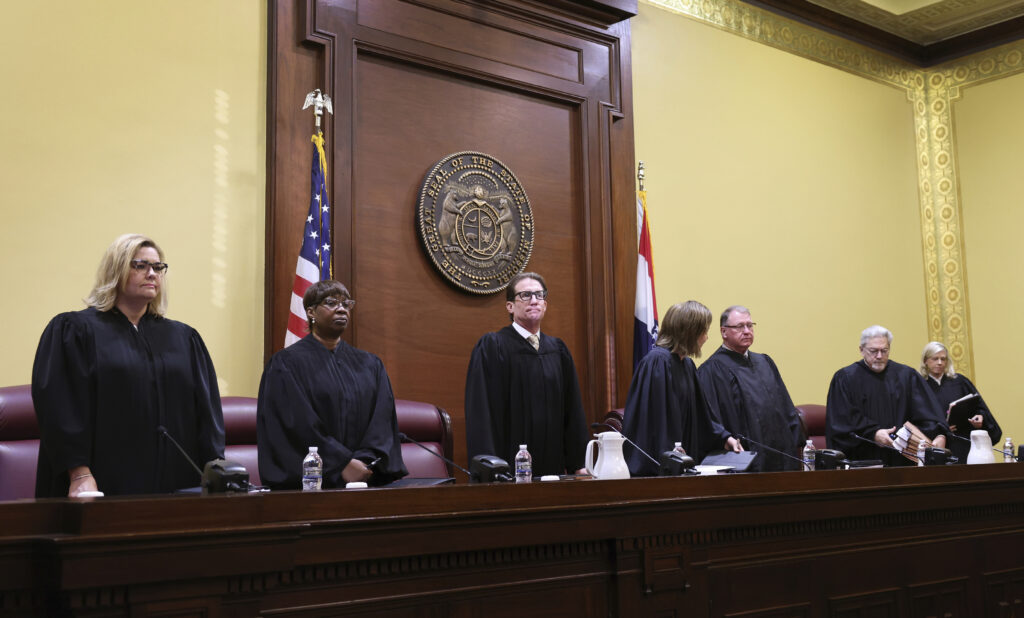
When Missouri Republicans tried to redraw their state’s congressional map, eliminating a Democratic district to advance President Donald Trump’s nationwide gerrymandering campaign, it was the state’s Supreme Court that stood in their way.
So now — naturally — the GOP wants to take control of the state’s system for picking judges, so it can get more favorable results.
The push to change the current system, known as the Missouri plan, began soon after the Missouri Supreme Court’s final ruling against the gerrymander on Sept. 3.
Get updates straight to your inbox — for free
Join 350,000 readers who rely on our daily and weekly newsletters for the latest in voting, elections and democracy.
“If nothing else, this Missouri Supreme Court has just made a fantastic case that the Missouri Plan … is a failed experiment whose usefulness has come to an end,” Republican National Lawyers Association President MIchael Thielen wrote in an X post.
Missouri GOP executive director Miles Ross was blunter in his own post: “The Missouri Plan is done.”
Under the Missouri Plan, implemented in 1940, state judges are selected by the governor from a slate of candidates presented by a nonpartisan nominating commission made up mostly of lawyers and members of the bar. The goal was to ensure that judges were selected based on legal qualifications rather than party affiliation. It has become the judge-appointment model for several other mostly red-leaning states.
In 2012, Missouri voters overwhelmingly rejected a GOP-backed effort to replace the system with one giving the governor more control.
Now, spurred by the redistricting ruling, Republicans are trying again.
State Rep. Cathy Jo Loy (R) has introduced legislation in the past to replace the Missouri Plan with a system allowing the governor to pick judges directly, subject to Senate confirmation. She plans to introduce the legislation again in the next session, ProPublica reported.
U.S. Rep. Jason Smith (R-Mo.) also wants to scrap the Missouri Plan, but instead wants to let voters elect judges, he wrote in a post on X last month, decrying “unelected judges usurping the will of the people.”
The state Supreme Court ruled last month that Missouri’s gerrymander never properly went into effect because under state law, opponents can block it by gathering enough signatures to put a veto measure on the ballot, as occurred. As a result, the court said, Missouri must revert to its old map, and voters will have a chance to defeat the gerrymander for good at the polls this fall. The U.S. Supreme Court rejected a last-ditch GOP effort to have the gerrymander reinstated.
The current system for selecting judges has produced a state Supreme Court with five Republicans and two Democrats. But Daniel Seitz, a top aide to state Sen. Brad Hudson argued ina lengthy X post after the ruling hat the court has nonetheless been captured by the left.
“A Leftist judiciary is politicizing the bench and usurping legislative authority to overrule Republicans and boost Democrats,” Seitz wrote, arguing for the governor to be able to nominate judges directly.
Theodore Wold, a former Trump Department of Justice (DOJ) official, claimed in an X post that the Missouri Plan was hatched by liberals.
“Progressives designed the so-called ‘Missouri Plan’ to give control over state judiciaries to legal ‘experts’ like state bar associations and legal academics,” Wold wrote. “Even in states with ‘elected’ judiciaries, the Missouri Plan ensures citizens and their elected representatives have no say in who wears a robe. Many Red States, including Idaho, use the Missouri Plan and the result is that the most conservative states have judiciaries stocked with radical left-wing activists.”
Under the system, the judges are initially selected by the governor from the nominating commission’s recommended slate, but after that they face retention votes, where voters decide whether they should stay on the bench.
Not all conservatives are against the plan, though. The “Act for Missouri” X account, which bills itself as “an online resource for Missouri Conservatives looking for ways to get involved,” came to the plan’s defense last month.
“Today there’s a renewed push to scrap it and replace it with a system where the Governor nominates and the Senate confirms,” the post reads. “That would mean no nominating commission, no public interviews, and politicians choosing judges behind closed doors.”