Supreme Court must let students use IDs for voting, advocates say
 Prefer us on Google
to see more of our voting rights news coverage when you search.
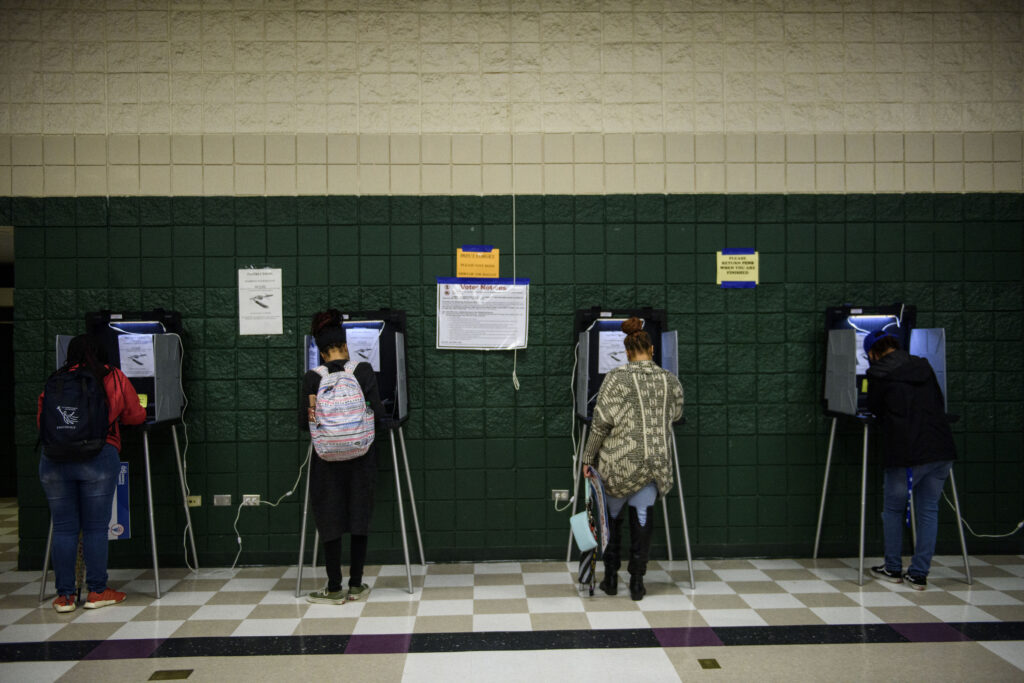
A pro-voting group is urging the U.S. Supreme Court to reject New Hampshire’s effort to fully ban voters from using student IDs to confirm their identity to vote.
The Coalition for Open Democracy (COD) filed its response to the Supreme Court Monday after New Hampshire Secretary of State David Scanlan (R) asked the nation’s highest court last week to outlaw any consideration of student identification in the upcoming midterms.
The filings come after the U.S. 1st Circuit Court of Appeals upheld New Hampshire’s student ID ban, as well as the lower court’s decision that barred the state from fully enforcing a prohibition on election officials accepting student IDs for voting. In practice, that means election officials can consider student IDs as evidence of identity if a voter lacks other ways to prove it.
In Monday’s response, COD argued that if the Supreme Court were to once again change New Hampshire’s rules around student IDs, it would create confusion about voting and disenfranchise voters.
“It would turn away the voters who arrive on November 3 with the evidence the Secretary’s website told them to bring,” the response reads. “The public interest lies in letting eligible voters prove who they are on election day, without a second reversal in the final weeks.”
Supporting Scanlan is the Republican National Committee (RNC), which filed a brief urging the Supreme Court to pause a lower court’s ruling that blocks a directive prohibiting local election workers from considering a voter’s student ID as evidence of identity.
The RNC argued that the federal district court’s ruling violated Purcell — a legal principle stating that courts should not change voting rules too close to an election because it could confuse voters and officials.
Get updates straight to your inbox — for free
Join 350,000 readers who rely on our daily and weekly newsletters for the latest in voting, elections and democracy.
“Purcell applies to voter identification laws,” the RNC wrote. “And courts at all levels, including this Court, have concluded across election cases that it is now too close to the election to issue injunctions which could disrupt elections and confuse voters and officials.”
In its response Monday, COD also said that a Supreme Court intervention would violate Purcell if it led to a change in the rules around Student IDs.
The monthslong legal battle over the student ID restrictions has created confusion and uncertainty for students, who already face a range of obstacles to voting.
In April, New Hampshire Gov. Kelly Ayotte (R) signed into law HB 323, which eliminated student IDs as an acceptable form of identification for obtaining a ballot. Immediately after the law was enacted, Scanlan sent a directive to local election officials instructing them to no longer accept student IDs to prove a voter’s identity.
COD sued New Hampshire in August to block the new student ID ban and Scanlan’s directive for the Sept. 8 primary election. The organization argued that the new law unconstitutionally burdens the right to vote. The lawsuit also said that Scanlan’s directive contradicted the state’s safety-valve provision, which lets voters who lack standard identity documents present other evidence to prove their identity when voting.
U.S. District Judge Joseph Laplante denied COD’s motion for a preliminary injunction, citing Purcell. But Laplante also said that the state’s student ID ban “may be on different footing” for the general election.
Since then, there’s been legal back-and-forth over the restrictions.
Earlier this month, Laplante upheld the ban, but struck down Scanlan’s directive to election officials, again allowing election officials to consider a student ID to establish a voter’s identity.