The long game: These are the states where Democrats could redistrict for 2028
In the weeks since the U.S. Supreme Court’s conservative majority dismembered the Voting Rights Act through its landmark Louisiana v. Callais ruling, Republicans have raced to pass new gerrymandered congressional maps that eliminate Black political representation across the South.
Get updates straight to your inbox — for free
Join 350,000 readers who rely on our daily and weekly newsletters for the latest in voting, elections and democracy.
Egged on by President Donald Trump, Republican attempts to rig the upcoming midterm elections could give the GOP up to 14 more seats in Congress. Democrats’ efforts to counteract these gerrymanders have been significantly less successful: They’ve only secured up to six more seats.
But Democrats have a chance to fight back and level the playing field ahead of the 2028 elections — and they’re starting to do just that.
At least seven blue states are taking steps to redraw maps for 2028 and eliminate Republican-held House seats, House Democratic Leader Hakeem Jeffries (D) said last month.
But enthusiasm for redistricting varies by state, and some have laws making it significantly more difficult to redraw electoral maps.
Moreover, Democrats must also contend with the risk that their attempt to draw additional blue districts could turn into a “dummymander” — an overly ambitious map that backfires by spreading Democratic voters too thin and ultimately costing the party seats.
Here’s where redistricting stands in the seven states Jeffries highlighted.
New York
Current representation: 19 Democrats, 7 Republicans
New York lawmakers voted last week to approve a constitutional amendment that would allow them to redistrict for 2028. After the next general election in November, the state legislature will need to pass the measure again before sending it to the voters for final approval.
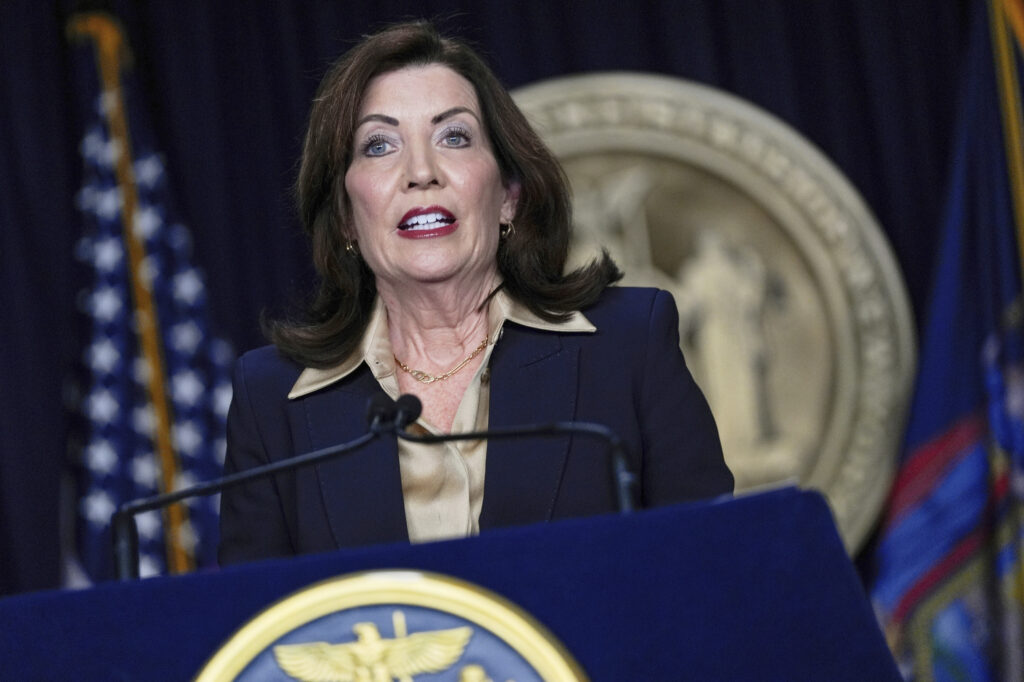
Gov. Kathy Hochul (D) has signaled she’s on board with the plan. In a social media post shortly after the Callais ruling, she said she would begin working with lawmakers “so we can fight back against Washington’s attempts to rig our democracy.”
Maryland
Current representation: 7 Democrats, 1 Republican
Maryland Democrats, led by Gov. Wes Moore, tried to redraw the map for the 2026 cycle, but ran into staunch opposition from leadership within their own party — most prominently, Senate President Bill Ferguson, who insisted the plan would backfire if struck down by courts. But since the Callais ruling, Ferguson has switched sides.
“Maryland must respond as the ground shifts under us. I’m in active conversations with my caucus about a special session and constitutional amendment to address the 2022 Maryland court redistricting decision and new U.S. Supreme Court [Voting Rights Act] decision, with the aim of putting this before Maryland voters in November,” Ferguson told a local TV outlet.
Ferguson, who faces a primary challenger who has criticized his reluctance on redistricting, added that next steps won’t come until after the June 23 primary election.
Oregon
Current representation: 5 Democrats, 1 Republican
Oregon does not have a redistricting commission and the state is controlled by a Democratic trifecta that could move to redraw districts.
However, Gov. Tina Kotek is not considering redistricting “at this time,” a spokesperson told a Portland news outlet last week.
Illinois
Current representation: 14 Democrats, 3 Republicans
The Illinois congressional map is drawn by the legislature and subject to the governor’s veto. The state is controlled by a Democratic trifecta.
But Black legislators said last year they won’t support a Democratic proposal that comes at the expense of Black political representation, and Gov. JB Pritzker hasn’t expressed much enthusiasm for a redraw.
Virginia
Current representation: 6 Democrats, 5 Republicans
The Virginia Supreme Court threw out Democrats’ redistricting plan this year, ruling that legislators violated procedural rules while passing a constitutional amendment allowing them to temporarily work around the state’s redistricting commission process and redraw the congressional map themselves.
That doesn’t stop Democrats from passing it again ahead of 2028 and sending it back to the voters for approval.
Last month, Gov. Abigail Spanberger (D) called it “outrageously premature” to be talking about 2028 redistricting, saying Democrats should be focused now on winning this year’s midterms.
New Jersey
Current representation: 9 Democrats, 3 Republicans
The state’s congressional map is drawn up by a redistricting commission. To work around that, state lawmakers would need to temporarily suspend that process by passing a constitutional amendment by a two-thirds vote, then sending the measure to voters for approval.
Gov. Mikie Sherrill (D) signaled last month that she’s open to redistricting. Senate President Nick Scutari (D) has also indicated his support.
“We’re having active discussions, and I’m in favor of that,” Scutari said during a recent primary debate.
Washington
Current representation: 8 Democrats, 2 Republicans
The state uses a redistricting commission to draw its maps. But Gov. Bob Ferguson (D) has said he’s ready to take action to help counter GOP gerrymanders in other states.
“In Washington state, we would need a two-thirds majority in both the House and Senate to change our redistricting process. If we get that supermajority, I would not only support a redistricting effort — I would lead it,” Ferguson told The Seattle Times last month.