Kansas elections chief launches legal full-court press against mail ballot grace periods
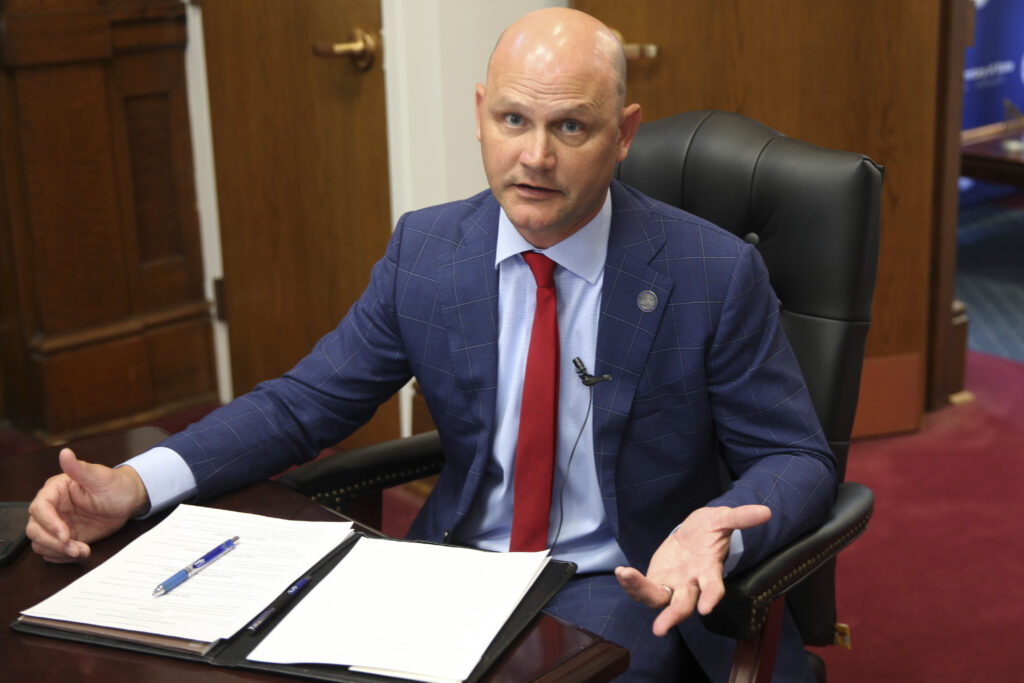
The top election official in Kansas is doing everything he can legally do to disenfranchise mail voters this election cycle.
Since a Kansas court last week suspended a state law that would have eliminated a three-day grace period for mail ballots postmarked by Election Day, Secretary of State Scott Schwab (R) has filed a slew of appeals and emergency motions.
He has appealed the decision, asked both the district court and the appeals court to stay the decision pending that appeal, asked the appeals court to expedite that stay request, and filed an emergency motion to skip the appellate court and transfer his appeal directly to the Kansas Supreme Court.
Schwab, who is running for governor, argues across those filings that the lower court got it wrong, and the grace period must be ended before the Aug. 4 primary elections.
“Voting has already begun in the August primary election, with 50,345 ballots having been mailed out and hundreds of votes having already been cast as of today, July 20,” he said in one of the stay motions.
In 2025, Kansas Republicans enacted Senate Bill 4 (SB 4) to eliminate the three-day grace period for mail ballots.
Since its establishment in 2017, the late-arriving vote buffer has saved thousands of votes from being thrown out. In 2024, 2,110 mail ballots arrived within three days after Election Day out of 137,000 total cast. In 2022, the three-day rule saved 1,000 of the 131,000 mailed ballots. And in 2020, when 465,000 mail ballots were cast — a third of all votes — 32,000 were delivered within the grace period.
Voting rights groups challenged SB 4, arguing that the change would make it “virtually impossible” for voters to cast a mail ballot and would violate the state’s constitution.*
Get updates straight to your inbox — for free
Join 350,000 readers who rely on our daily and weekly newsletters for the latest in voting, elections and democracy.
The district court agreed, ruling that the plaintiffs showed “a substantial likelihood that SB 4 violates the Kansas Constitution’s protections of the right to vote.”
“The three-day grace period for mail-in ballots has significant value in protecting mail ballots from unpredictable mail delays — and this safeguard has successfully saved ballots in Kansas from arbitrary disenfranchisement for nearly ten years,” the judge wrote.
In the lower court, Schwab contended that federal election-day statutes preempted state laws permitting mail-in ballot grace periods, so all votes must arrive by Election Day, mirroring claims made before the U.S. Supreme Court in Watson v. Republican National Committee.
But in a 5-4 ruling in late June, the Supreme Court rejected those arguments, finding that the federal statutes could not bar states “from counting ballots postmarked after election day yet received afterward.” And in its ruling last week, the Kansas district court cited the Watson decision.
In his emergency stay request, Schwab now argues that a different Supreme Court principle, known as the Purcell doctrine, should sway the state court to his side. In Purcell v. Gonzalez, the Court reinstated a voting law blocked by the lower courts just a few weeks before the election under the reasoning that judicial injunctions late in campaign season might confuse voters. Since then, critics have contended that the Purcell principle has been applied with growing inconsistency.
“The ballots that have been sent contain instructions comporting with current Kansas law, stating they must be returned by 7 p.m. on Election Day. Allowing the district court’s order to remain in effect would cause mass confusion in the electorate in the midst of an ongoing election,” Schwab contends. “The United States Supreme Court has ‘repeatedly emphasized that lower federal courts should ordinarily not alter the election rules on the eve of an election.’”
On Tuesday, the Kansas district court ordered additional briefings on whether it has jurisdiction to hear Schwab’s stay request, or whether that power lies entirely with higher courts.
*Plaintiffs in this case are represented by Elias Law Group (ELG). ELG firm chair, Marc Elias, is the founder of Democracy Docket.