Court blocks Kansas law disqualifying late-arriving mail ballots
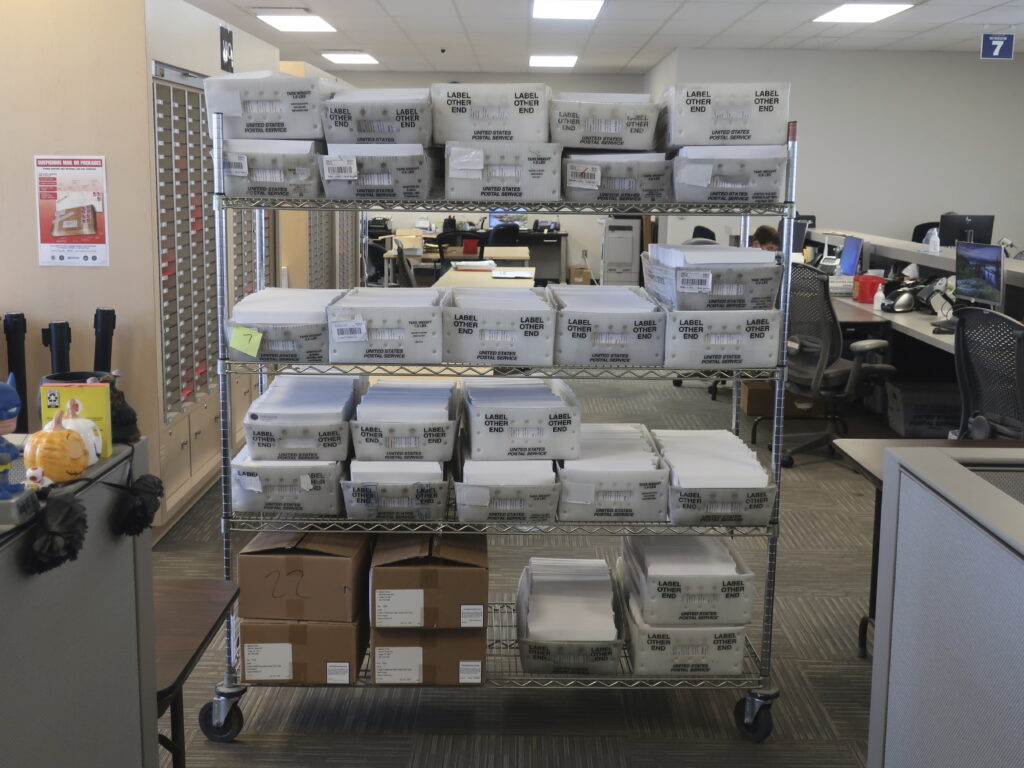
A Kansas court temporarily blocked a state law that would disqualify late-arriving mail ballots in the first ruling since the Supreme Court rejected a GOP challenge to grace periods for mail ballots that arrive after Election Day.
Ruling in favor of Kansas voting rights groups* Thursday, a Douglas County judge found that the law likely violates the state constitution’s voting rights protections.
The judge cited the Supreme Court’s recent decision in Watson v. Republican National Committee (RNC) while rejecting Kansas Secretary of State Scott Schwab’s (R) defense of the law.
Get updates straight to your inbox — for free
Join 350,000 readers who rely on our daily and weekly newsletters for the latest in voting, elections and democracy.
“The U.S. Supreme Court recently rejected the Secretary’s argument that federal election-day statutes preempt state statutes that allow a grace period for mail-in ballots,” Douglas County District Court Judge Carl Folsom wrote.
Folsom’s decision means that Kansas will continue to count mail ballots that arrive up to three days after Election Day.
Since 2017, Kansas has required election officials to count ballots that arrive within that three-day grace period.
In 2025, state Republicans adopted a new law, Senate Bill 4, meant to eliminate the grace period for mail ballots.
Voting rights groups challenged the law, arguing that the change would make it “virtually impossible” for voters to cast a mail ballot and would violate the state’s constitution.
In his ruling, Folsom agreed with plaintiffs, ruling that they showed “a substantial likelihood that SB 4 violates the Kansas Constitution’s protections of the right to vote.”
He also said preserving the grace period was necessary to protect the integrity of mail voting in the state.
“The three-day grace period for mail-in ballots has significant value in protecting mail ballots from unpredictable mail delays—and this safeguard has successfully saved ballots in Kansas from arbitrary disenfranchisement for nearly ten years,” the judge wrote.
“Kansas voters who submit their lawful advance ballots by mail, who do their part and vote and timely return it, should be able to trust that their ballot will be counted,” he added.
In his defense of the law, Schwab argued that federal election-day statutes preempt state statutes that allow a grace period for mail-in ballots, so all ballots must arrive by Election Day.
Schwab’s argument mirrored the RNC’s argument in Watson. It claimed that federal election-day statutes also set deadlines for ballot receipt and preempt states from counting mail ballots that arrive late.
In a 5-4 ruling, the Supreme Court rejected the RNC’s argument, finding that the federal statutes could not bar states “from counting ballots postmarked after election day yet received afterward.”
Folsom said that Kansas’ grace period was necessary for protecting rural voters in particular. He highlighted data from the 2024 election that indicated the state’s most rural counties see “more than double the rate of ballots [arriving] during the grace period compared to the most urban counties.”
Voters with disabilities and those who temporarily reside out of the state, such as college students, would also be greatly affected by Senate Bill 4, he found.
In November, the RNC attempted to intervene in the suit against Senate Bill 4, but Folsom denied its motion.
*Plaintiffs in this case are represented by Elias Law Group (ELG). ELG firm chair, Marc Elias, is the founder of Democracy Docket.
This story has been updated with new details throughout.