In ominous sign, USPS initially rejected Florida county’s mail ballot over spacing issue
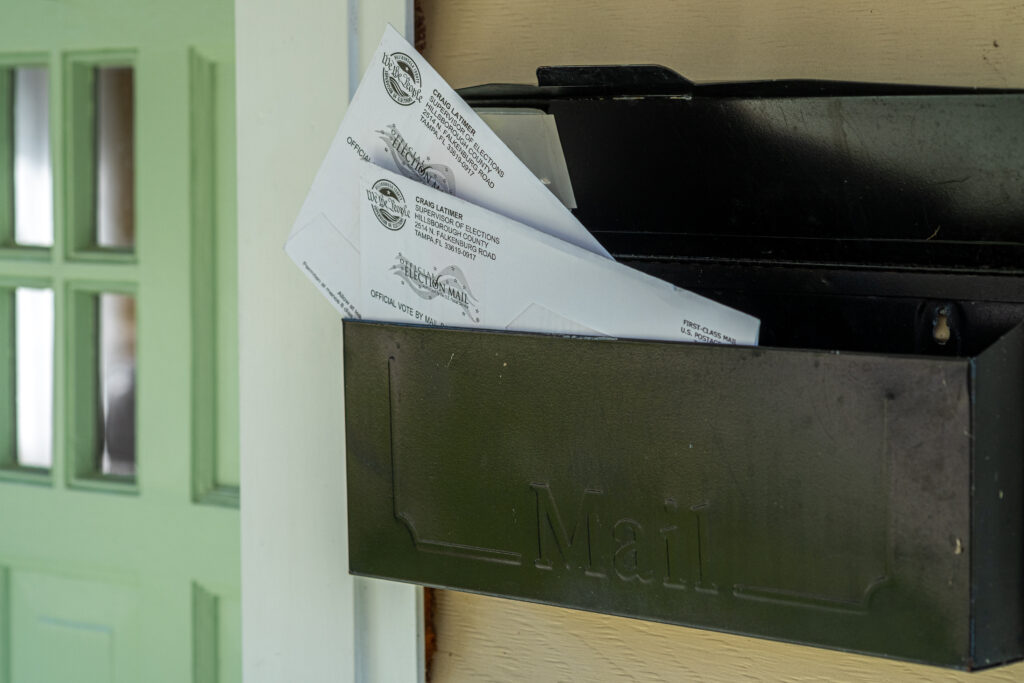
When the U.S. Postal Service (USPS) rejected a Florida county’s mail ballot envelope design, it inadvertently offered a test case for just how disruptive President Donald Trump’s efforts to restrict mail voting could be this November.
The postal agency rejected Leon County’s envelope because the words “return service requested” and the election office’s return address were only 0.236 inches apart — when there should have been a full quarter-inch between them.
“It’s ridiculous,” Supervisor of Elections Mark Earley told the Tallahassee Democrat, which first reported on the issue.
The envelope design was only accepted when Earley’s office filed an appeal, a representative told Democracy Docket Friday.
Still, the snafu offers a taste of what will likely happen if the U.S. Supreme Court lifts an injunction blocking USPS from implementing its new design rule, which stems from Trump’s March executive order attacking mail voting: States and counties will have to scramble to get their ballots approved — and they can face petty, technical rejections that could prevent voters from casting mail ballots.
While the federal court’s injunction remains in place, seeking USPS approval for mail ballot envelope designs is voluntary. The judge’s order also prevents USPS from refusing to mail non-conforming ballot envelopes.
The Supreme Court could rule at any moment.
Had its appeal not succeeded, Leon County would be in trouble. Earley previously noted to the Tallahassee Democrat that there was not enough time to reprint new envelopes before Florida’s Sept. 24 deadline to mail them.
State deadlines for mailing ballots
USPS rejected Leon County’s ballot envelope on Sept. 2, barely two months before Election Day. Such petty, technical rejections were among the concerns raised by hundreds of election officials — including Earley — in an amicus brief to the Supreme Court, urging it to continue blocking the USPS rule’s implementation.
That rejection seems to be based on older, voluntary standards for faster mail processing — standards not explicitly included in USPS’s official election mail kit for local officials — that are incorporated into the new final rule’s requirements that all envelopes undergo USPS review.
In a statement emailed to Democracy Docket after this report first published, Earley said he submitted Leon County’s envelopes — the same barcoded mailers his office used without incident in the 2024 elections — for review shortly after USPS posted its final rule, because he “did not wish to take any chances that Leon County voters would be potentially negatively impacted by the Rule.”
“On September 2, we received a reply stating the design did not meet standards under the Rule, as two elements on the envelope were 0.014 inches too close to one another,” Earley wrote. “I subsequently appealed that initial decision. After an initial denial of the appeal and some more back and forth, we received approval of the current envelope design on September 10.”
Ballot design isn’t the only problem with the new postal rule. Earley also noted that the proposed internet portal that election officials would use to submit their ballot envelope designs and mail voter lists to USPS is not yet available online.
“None of that’s been developed,” he told the Tallahassee Democrat. “Nobody out here has a login to this portal because there is no portal. At least we suspect there is no portal. There might be one being built somewhere — there probably is. But as an end user, I have not had any information about how to use the portal.”
The new USPS rule requires election officials to use mail ballot envelopes with unique barcodes for each voter — something Leon County already does for its 32,000 mail voters. But the county still got rejected over a barely perceptible difference in spacing on the envelope.
This story has been updated with additional information.