Top GOP election chiefs call on Supreme Court to halt Trump’s mail voting restrictions for midterms
 Prefer us on Google
to see more of our voting rights news coverage when you search.
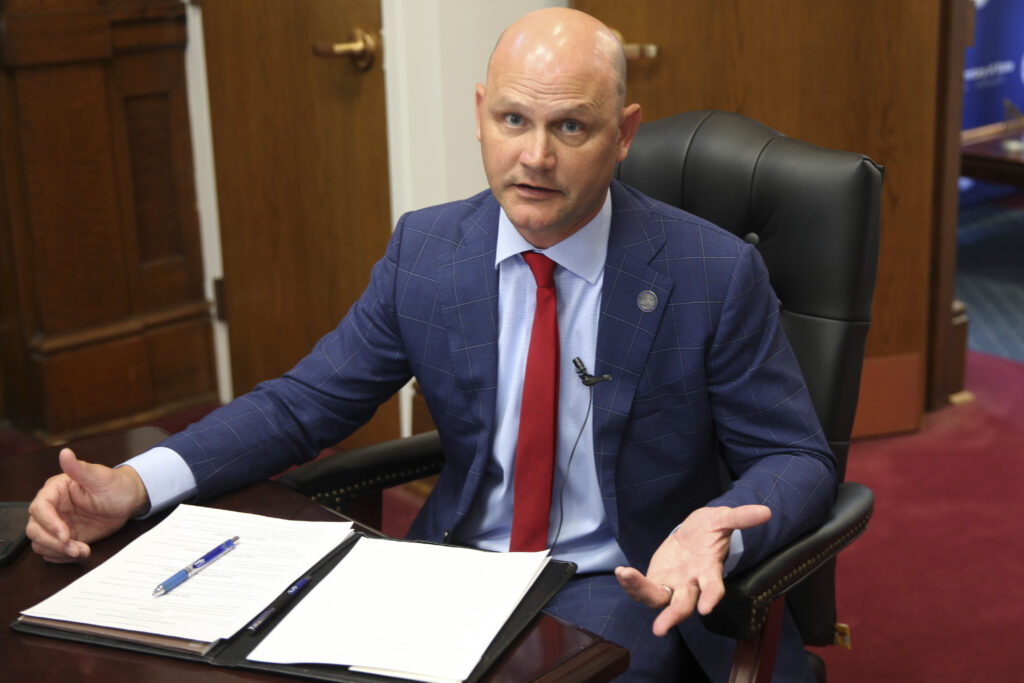
Over three dozen election officials — including several Republican secretaries of state — urged the Supreme Court Thursday to uphold a lower court ruling barring the U.S. Postal Service (USPS) from forcing states to comply with sudden new mail voting regulations this November.
The new court filing represents the most significant pushback so far from the people who run elections against mail voting restrictions stemming from a sweeping executive order President Donald Trump signed in March 2026.
The officials, some of whom run elections in states currently defending the USPS in court, warned the Court that election offices around the country simply do not have the time, money or staff to comply with the postal agency’s new mail voting rule for the upcoming midterms.
Get updates straight to your inbox — for free
Join 350,000 readers who rely on our daily and weekly newsletters for the latest in voting, elections and democracy.
“In many respects, the election is already underway,” the officials wrote. “Ballots have been prepared and proofed. Poll workers and other election officials have been trained on processes.”
“Attempting to implement this rule now significantly increases the risks of problems to the election. Those problems could be different in each jurisdiction, but election officials know that late changes almost always lead to unforeseen consequences,” they added.
In their brief, the officials — who included dozens of current and former county-level elections directors and clerks — took no stance on whether USPS has the authority to pursue its mail voting rule or whether the rule violates the Constitution by encroaching on states’ authority to administer elections.
However, they argued USPS should not be allowed to mandate that states comply with its new restrictions in the upcoming election because it would mean that many ballots would likely never reach voters through no fault of their own.
The officials’ “concern is not a partisan one,” they wrote. “A mail ballot that is never delivered disadvantages no party in particular; it simply denies the franchise to an eligible voter who has followed state law in every respect.”
Notably, South Dakota Secretary of State Monae Johnson (R) and Kansas Secretary of State Scott Schwab (R) joined the brief even as those two states are among the 12 Republican-led states defending USPS’s new rule alongside the Department of Justice (DOJ).
Georgia Secretary of State Brad Raffensperger, Kentucky Secretary of State Michael Adams, North Dakota Secretary of State Michael Howe and Utah Lt. Gov. Deidre Henderson — all Republicans — also joined the filing.
Under the rule, states and local election officials are required to alter the design of the envelopes they use to send mail ballots to voters and to give the federal government a list of all people — including their names and addresses — eligible to vote by mail in the upcoming election.
If officials do not comply with those requirements, USPS would refuse to deliver ballots to voters in those states or localities, which would likely disenfranchise thousands of voters.
Because of U.S. District Judge Indira Talwani’s court order last week, USPS is currently allowed to implement aspects of its rule, but cannot reject or refuse to deliver election mail that does not comply with its regulations.
Specifically, the election officials asked the Court to uphold Talwani’s order under what’s known as the “Purcell principle.”
Stemming from the 2006 Supreme Court case Purcell v. Gonzalez, the principle is an unwritten election-law doctrine that generally holds that courts should not change election rules too close to an election because it may ignite confusion among voters and election officials.
“Attempting to implement this new process on the eve of an election is what Purcell v. Gonzalez … exists to prevent,” the officials said.
In fact, Helen Purcell — the former Maricopa County, Arizona, recorder who was at the center of the 2006 case — signed onto the brief, as well.
A three-judge panel for the 1st Circuit Court of Appeals Thursday denied the DOJ’s effort to stay Talwani’s order.