Trump order targeting mail voting leaves judge ‘very concerned’
 Prefer us on Google
to see more of our voting rights news coverage when you search.
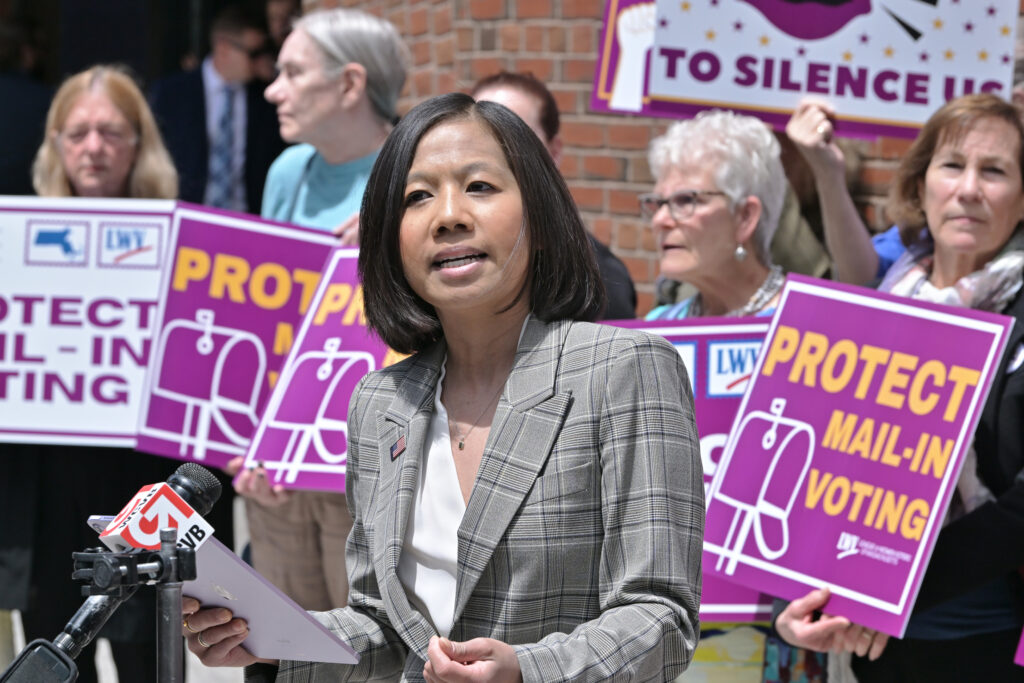
A federal judge in Massachusetts seemed skeptical of President Donald Trump’s executive order attacking mail-in voting, which, if allowed to stand, could have enormous consequences on the midterm elections.
U.S. District Judge Indira Talwani, an Obama appointee, expressed concern during a hearing Tuesday that the order poses a serious risk of unconstitutionally disenfranchising eligible voters, according to reporting by Reuters.
The order, signed by Trump in March, tasks the U.S. Department of Homeland Security and the Social Security Administration with creating a nationwide voter eligibility list — and then directs the U.S. Postal Service to restrict the delivery of mail-in ballots based on that list. Voting rights advocates and legal experts universally agreed that such a decree is unconstitutional, as states — not the executive branch — hold the power to administer elections.
The order was met with a barrage of lawsuits, including the one Talwani heard Tuesday, filed by attorneys general from 22 states and Washington, D.C., as well as a coalition of pro-voting groups, seeking to block the order.
Get updates straight to your inbox — for free
Join 350,000 readers who rely on our daily and weekly newsletters for the latest in voting, elections and democracy.
“Mail voting helps millions of Americans participate in our democracy, including seniors, voters with disabilities, military families, students, caregivers, and working people,” Marcia Johnson, chief of activation and justice for the League of Women Voters — one of the plaintiffs in the case — said in a statement. “No president has the authority to unilaterally rewrite election rules or dictate how states administer their elections.”
During the motion hearing in Boston, Talwani seemed unsure if it would even be possible for the federal government to create a full and accurate national voter list, which would be reason to block the order.
“What’s the harm if I say no one can use this list for the November election?” Talwani reportedly asked.
Sophia Lakin, an attorney for the American Civil Liberties Union — one of the pro-voting plaintiffs in the case — told Democracy Docket that Talwani was also fixated on resolving the matter quickly, given how close it is to the general election.
“She was very concerned and focused on timing and how close we are to the midterm election, with primaries along the way,” Lakin said.
Lakin also said Talwani emphasized the need for a speedy ruling, to “make sure that there’s an opportunity for us to seek judicial review,” given the likelihood that Trump’s anti-mail voting order makes its way to the U.S. Supreme Court before the November midterms.
Talwani isn’t the first judge to hear a challenge to the anti-mail voting order. A federal judge last month denied a legal attempt by Democrats to stop Trump’s mail voting order, on the basis that it’s premature, given that the White House has yet to actually implement the order.
The Democratic plaintiffs appealed that ruling Monday to the U.S. Circuit Court of Appeals.