After midterms, Georgia Dems have chance to reform controversial state election board
 Prefer us on Google
to see more of our voting rights news coverage when you search.
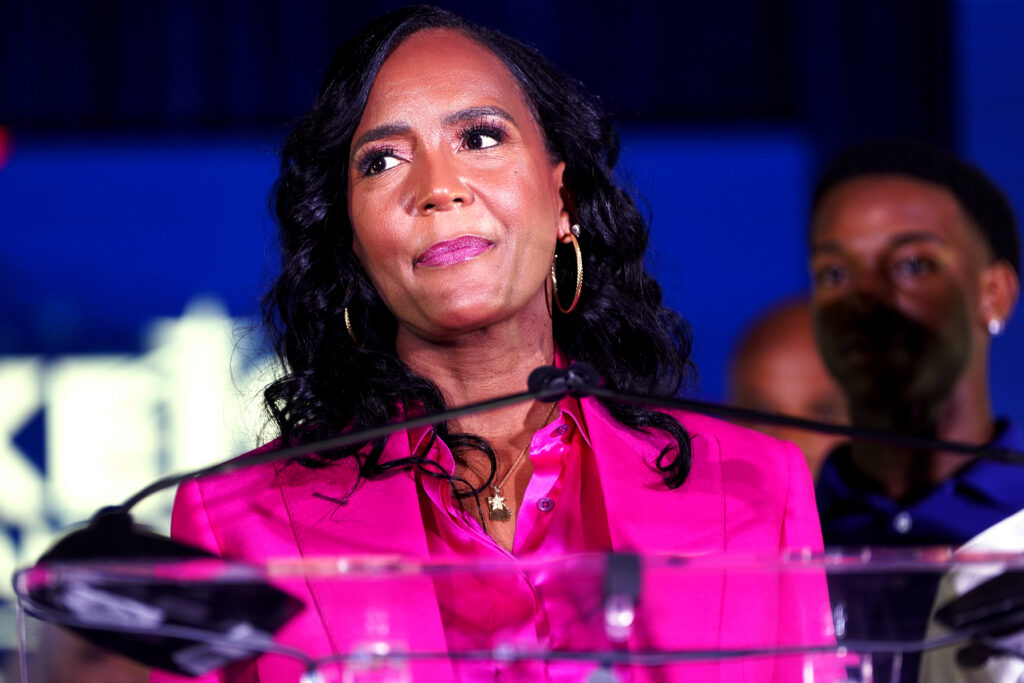
Newly elected Democratic lawmakers and state officials in Georgia may have an opportunity to change the state’s GOP-controlled election board, which has pushed anti-voting policies in recent years.
After Democrats’ sweeping victory in the midterms, Georgia’s state House of Representatives will flip blue. And Democrats have also decreased the GOP’s majority in the state Senate.
The party is now in a stronger position to change the composition of the state election board, an idea that state Democrats have long supported.
Get updates straight to your inbox — for free
Join 350,000 readers who rely on our daily and weekly newsletters for the latest in voting, elections and democracy.
Georgia Gov.-elect Keisha Lance Bottoms and Secretary of State-elect Penny Brown Reynolds, both Democrats, ran on purging anti-voting policies recently passed by the state election board.
Lance Bottoms has even proposed eliminating the board entirely and replacing it with an independent voting commission.
“The State Election Board has become mired in political games, conspiracy theories, and partisan interference,” Lance Bottoms’ campaign proposal on voting states. “Georgia’s election system should not be run by people trying to undermine confidence in elections, intimidate local officials, or change the rules to benefit one political party.”
Four of the current election board’s five members are Republicans, with several of them documented for holding anti-voting views.
Prior to joining the board in January 2026, Salleigh Grubbs was known for making outlandish claims about the 2020 election, including allegations that Fulton County election officials were double- and triple-counting ballots. She was appointed to the board by Lt. Gov. Burt Jones, in his capacity as state Senate president, who himself is a MAGA-aligned election denier who supports Trump’s claims that Georgia’s 2020 vote was rigged.
Another current election board member, Janelle King, has also spread misinformation about voter fraud in Fulton County and last year called on the U.S. Justice Department (DOJ) to seize the county’s 2020 election ballots to investigate fraud claims. The FBI cited her in its affidavit when it actually did seize the ballots in January.
In September, the board’s Republican majority asked the Trump administration to investigate the state’s voting machines — a request rooted in election deniers’ long, drawn-out crusade to undermine voters’ trust in the state’s election system.
In October, the board asked the DOJ to prohibit the state from using its voting machines altogether, just weeks before the midterm elections.
In 2024, a court blocked the board from enforcing controversial anti-voting rules that could’ve delayed election results and boosted allegations of fraud and election uncertainty.
The election board members are mostly appointed by the state legislature, with one picked by the state House, one by the state Senate, and the board chair elected by majorities from both state chambers. The other two members are each picked by the state’s Democratic and Republican parties.
The board chair used to be the secretary of state, but Republican lawmakers changed this in 2021, granting the legislature the power to make this appointment. This was done after Secretary of State Brad Raffensperger refused to do Trump’s and other election deniers’ bidding in advancing false claims of fraud for the 2020 election.
Lance Bottoms’ campaign proposal says that as governor she “will work with the General Assembly to eliminate the current State Election Board and replace it with a stronger, more independent election oversight structure that is insulated from partisan manipulation and focused on one mission: protecting free, fair, secure, and accessible elections.”